Why Does Air Resistance Increase With Speed? Physics Explained 2026
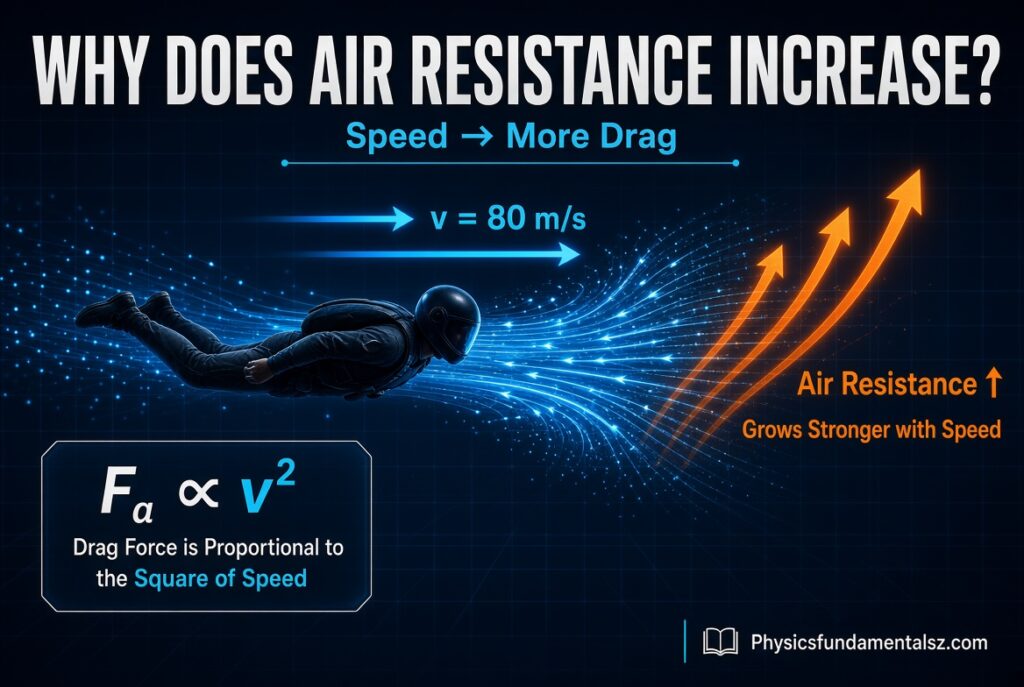
Why Does Air Resistance Increase With Speed? The answer lies in how a moving object interacts with the air around it. As an object travels faster, it collides with and pushes against air molecules more rapidly, causing the opposing force known as air resistance, or drag, to become stronger.
For many objects moving through air at ordinary speeds, drag is closely related to the square of velocity. This means that increasing speed does not simply produce a proportional increase in air resistance. For example, when speed doubles, aerodynamic drag can increase by roughly four times under conditions where the quadratic drag model applies.
Air resistance plays an important role in falling objects, skydiving, vehicle design, cycling, aircraft, and projectile motion. It also explains why a falling object eventually reaches terminal velocity, when air resistance becomes equal to the downward force of gravity and the object’s acceleration stops.
Table of Contents
Why Does Air Resistance Increase With Speed?
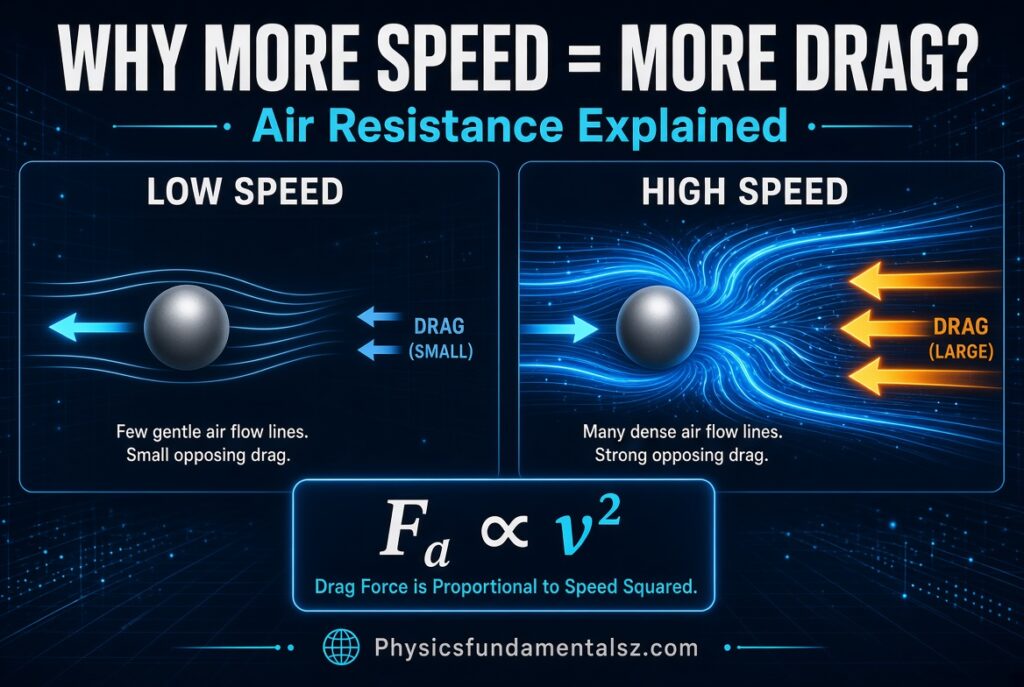
Air resistance (drag) increases with speed because of two combined effects: more air molecules are struck per second at higher speed, and each collision transfers more momentum.
- At low speeds, drag is roughly proportional to velocity (F ∝ v).
- At most everyday speeds, drag is proportional to velocity squared (F ∝ v²).
- This is described by the drag equation: F_d = ½ρv²C_dA.
- Because power needed equals force times velocity, power required to fight drag scales with v³.
What Is Air Resistance in Physics?
Air resistance, also called aerodynamic drag, is the frictional force exerted by air on any object moving through it. It always acts opposite to the direction of motion, slowing the object down.
It is a type of fluid resistance, the same broad category of force that also explains why swimming through water feels harder than walking through air.
Air resistance depends on four main things: the object’s speed, its shape, its cross-sectional area, and the density of the surrounding air.
The Physics Formula Behind Air Resistance
The standard equation engineers and physicists use for drag at everyday, non-microscopic speeds is:
F_d = ½ × ρ × v² × C_d × A
- F_d – drag force, measured in newtons (N)
- ρ (rho) – air density, in kilograms per cubic meter
- v – velocity of the object relative to the air, in meters per second
- C_d – drag coefficient, a dimensionless number describing shape
- A – frontal cross-sectional area, in square meters
Every variable here matters, but velocity is the one that changes the fastest and dominates the outcome, because it is squared in the equation.
Why Speed Squared Matters (The v² Relationship)
Velocity appears as v² in the drag equation, not just v. That single detail explains almost everything about why air resistance grows so quickly with speed.
Squaring means the relationship is not a straight line. It curves upward sharply, so small increases in speed create disproportionately large increases in resistance.
- Double the speed → 2² = 4 times the drag force.
- Triple the speed → 3² = 9 times the drag force.
- Ten times the speed → 10² = 100 times the drag force.
This is the same mathematical shape as kinetic energy, KE = ½mv², which is not a coincidence, since drag is fundamentally an energy-transfer problem.
The Molecular Collision Explanation
At the microscopic level, air is a mixture of billions of fast-moving gas molecules. A moving object constantly collides with these molecules as it travels forward.
Two things happen at once as speed increases, and both push the force higher at the same time.
- More collisions per second: a faster object sweeps through more air volume every second, so it strikes more molecules in that same second.
- Harder collisions: each molecule is struck with greater relative speed, so it receives a bigger push and transfers more momentum back to the object.
Because both effects scale with velocity, and they multiply together, the combined force scales with velocity times velocity, which is velocity squared.
Linear Drag vs Quadratic Drag
Air resistance does not always follow the same rule at every speed. Physicists actually split drag into two different regimes depending on how the airflow behaves.
| Drag Type | Relationship | Typical Situation | Dominant Effect |
|---|---|---|---|
| Linear (Stokes) drag | F ∝ v | Very slow speeds, small objects, thick fluids | Viscosity of the fluid |
| Quadratic drag | F ∝ v² | Normal speeds: cars, cyclists, skydivers, balls | Inertia of displaced air |
At very low speeds, airflow around an object is smooth and layered, called laminar flow, and viscous friction dominates, giving a roughly linear relationship with speed.
At the speeds most people care about, walking, driving, cycling, or falling, airflow becomes turbulent, and the quadratic v² relationship takes over completely.
Air Density, Shape, and Area Also Play a Role
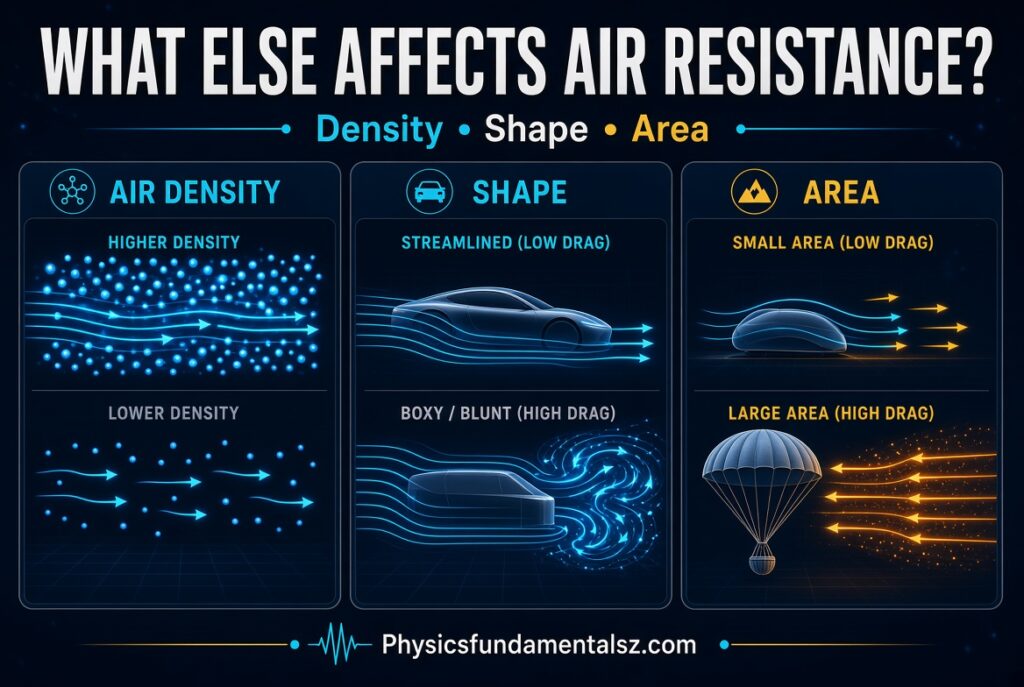
Speed is the variable that changes fastest, but it is not the only one in the drag equation. The other three factors set the overall scale of the force.
- Air density (ρ): thicker, denser air produces more drag at the same speed, which is why aircraft cruise at high altitude where air is thinner.
- Drag coefficient (C_d): a streamlined shape, like a teardrop, slices through air far more efficiently than a flat, blunt shape.
- Frontal area (A): a larger cross-section pushes more air aside, so a truck experiences more drag than a small car at the same speed.
None of these factors change the fundamental reason drag rises with speed, they only change how large or small that rise ends up being.
How Air Resistance Leads to Terminal Velocity
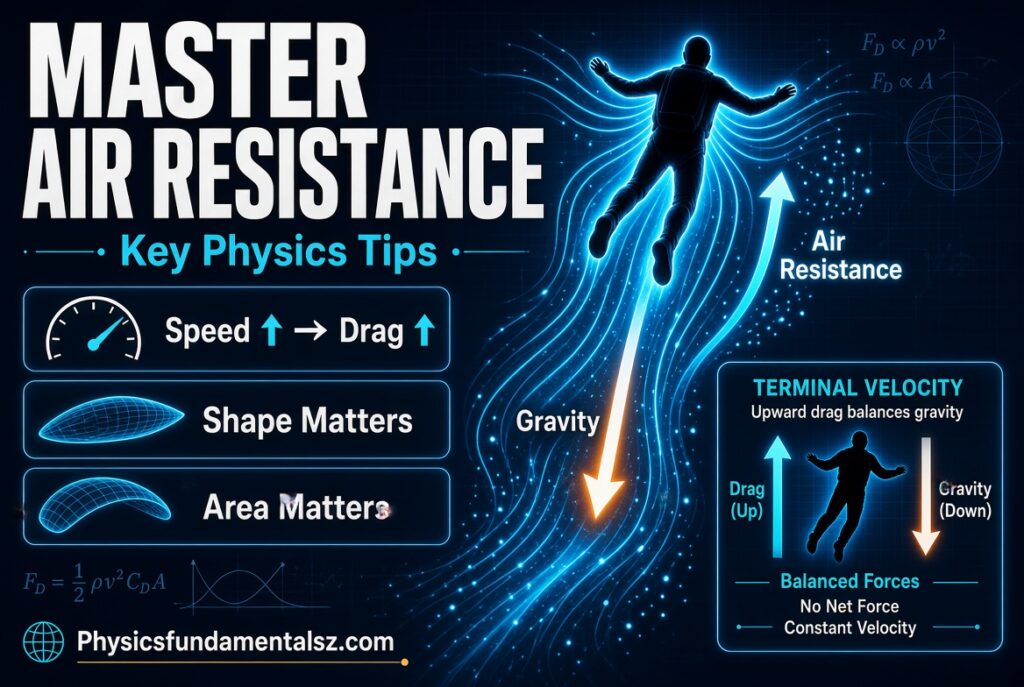
Terminal velocity is the direct real-world consequence of air resistance increasing with speed. Understanding one fully explains the other.
As a falling object speeds up, gravity stays constant, but drag keeps climbing because of the v² relationship described above.
- At low fall speed, gravity is much larger than drag, so the object accelerates quickly downward.
- As speed rises, drag rises even faster, closing the gap with gravity.
- Eventually drag force equals gravitational force exactly, net force becomes zero, and acceleration stops.
- The object then falls at a constant speed, its terminal velocity.
A skydiver in a belly-to-earth position typically reaches a terminal velocity of around 195 km/h (120 mph), while a head-down position can push that closer to 240 km/h (150 mph) because of reduced frontal area.
Kinetic Energy and Power Requirements at High Speed
Because drag force scales with v², the power needed to push through that drag scales even faster, with v³, since power equals force multiplied by velocity.
This is why fuel consumption in a car does not rise smoothly with speed, it rises steeply once you pass typical highway speeds.
- Going from 80 km/h to 160 km/h does not just double the required power.
- It multiplies the power needed to overcome aerodynamic drag by roughly eight times.
- This is a major reason high-speed trains, aircraft, and race cars invest so heavily in aerodynamic shaping.
Real-World Examples of Air Resistance Increasing With Speed
Seeing the physics play out in familiar situations makes the v² relationship far easier to remember and apply.
Driving a car: at city speeds, rolling resistance and engine friction dominate fuel use. At highway speeds, aerodynamic drag becomes the largest single force the engine must overcome.
Road cycling: at speeds above roughly 20–25 km/h, aerodynamic drag becomes the dominant resistive force on a cyclist, which is why racers crouch low to reduce frontal area.
Skydiving: a skydiver accelerates rapidly at first, then the rate of acceleration slows visibly as drag catches up with gravity, until speed levels off at terminal velocity.
Baseball and golf: a pitched or driven ball loses speed faster the harder it is thrown or hit, because drag grows faster than the extra velocity you put into it.
Spacecraft re-entry: at extreme atmospheric-entry speeds, air resistance is so severe it generates enough heat to require dedicated heat shields.
Common Misconceptions About Air Resistance and Speed
A few ideas about air resistance are repeated often but do not match the actual physics, so it helps to correct them directly.
- “Air resistance increases at the same rate as speed.” False for most real situations, it increases with the square of speed, not proportionally.
- “Heavier objects always fall faster because of air resistance.” Mass affects how quickly drag can overcome gravity, but in a vacuum, all objects fall at the same rate regardless of mass.
- “Air resistance is negligible at all speeds.” It is negligible only at very low speeds; it becomes a dominant force well before highway or sprint speeds.
- “Streamlining removes air resistance completely.” Streamlining reduces the drag coefficient, it does not eliminate drag, since some resistance always exists in a fluid medium.
Expert Tips for Understanding This Concept
- Always separate the speed effect (v²) from the shape and area effect (C_d and A), since students often mix them up.
- Remember the drag equation is an approximation valid for the turbulent-flow regime that covers almost all everyday motion.
- Compare drag to kinetic energy, KE = ½mv², to intuitively grasp why doubling speed does far more than double the effect.
- Use terminal velocity as the clearest proof that drag genuinely grows with speed, since without that growth, falling objects would never stop accelerating.
Key Takeaways
- Air resistance grows because faster motion means more air molecule collisions, each transferring more force.
- The drag equation, F_d = ½ρv²C_dA, shows the v² relationship mathematically.
- Doubling speed roughly quadruples drag force in normal, turbulent-flow conditions.
- Power needed to overcome drag scales with v³, explaining steep fuel-use increases at high speed.
- Terminal velocity exists precisely because drag eventually rises enough to balance gravity.
Frequently Asked Questions (FAQs)
Why does air resistance increase with speed in physics?
Air resistance increases with speed because a faster-moving object collides with more air molecules per second, and each collision transfers more force. Mathematically, drag is proportional to velocity squared in normal conditions.
Does air resistance increase linearly or exponentially with speed?
Neither, in most real situations it increases quadratically, meaning proportional to v². It is not a straight line (linear) and not a true exponential curve, though it does rise faster than speed itself.
What is the formula for air resistance?
The standard drag equation is F_d = ½ρv²C_dA, where ρ is air density, v is velocity, C_d is the drag coefficient, and A is the frontal area of the object.
Why does drag depend on velocity squared instead of just velocity?
Because two separate effects each depend on speed: more air molecules are struck per second, and each one is struck harder. Multiplying these two speed-dependent effects together produces a v² relationship.
Is air resistance the same as friction?
Air resistance is a form of fluid friction, but it behaves differently from solid-surface friction. Solid friction is usually roughly constant regardless of speed, while air resistance grows sharply as speed increases.
What happens to air resistance at very low speeds?
At very low speeds, drag behaves closer to a linear relationship with velocity, dominated by the fluid’s viscosity rather than by inertia. This is sometimes called Stokes drag.
Why does doubling speed quadruple air resistance?
Because drag force includes a v² term. Doubling velocity means squaring a value that has doubled, and 2² equals 4, so the resistive force becomes four times larger.
How does air resistance cause terminal velocity?
As a falling object speeds up, drag increases with the square of its speed while gravity stays constant. Eventually drag force grows large enough to exactly balance gravity, so acceleration stops and speed becomes constant.
Does a heavier object experience more air resistance?
Air resistance itself depends on shape, area, and speed, not directly on mass. However, heavier objects need a higher terminal velocity before drag can balance their larger weight.
Why do cyclists and cars care so much about aerodynamics at high speed?
Because air resistance dominates total resistive force at higher speeds, and the power needed to overcome it scales with velocity cubed. Small shape improvements save disproportionately large amounts of energy at high speed.
What is a drag coefficient?
A drag coefficient (C_d) is a dimensionless number that describes how streamlined an object’s shape is. Lower values mean the shape produces less drag for the same speed and area.
Why does air resistance increase with altitude drop?
Air resistance increases as altitude decreases because air density (ρ) is higher near sea level. The same object moving at the same speed experiences more drag in denser, lower-altitude air.
Is air resistance considered a conservative or non-conservative force?
Air resistance is a non-conservative force. It removes mechanical energy from a moving object and converts it into heat and disturbed air motion, energy that cannot be simply recovered.
Why does a feather fall slower than a hammer on Earth but not on the Moon?
On Earth, air resistance acts strongly on the feather’s large surface area relative to its weight, slowing it far more than the hammer. On the Moon, there is no atmosphere, so both fall at the exact same rate under gravity alone.
Does shape matter more than speed for air resistance?
Speed usually matters more once an object moves fast enough, because of the squared relationship, but shape (via the drag coefficient) sets how large the overall force is at any given speed.
Why does drag increase so quickly for high-speed vehicles like race cars?
Because they operate at speeds where the v² relationship dominates completely, small speed increases near top speed produce very large force and power increases, which is why aerodynamic design is critical at that range.
What is the difference between drag force and drag coefficient?
Drag force (F_d) is the actual force, measured in newtons, acting on a moving object. The drag coefficient (C_d) is a separate, shape-based number used inside the drag equation to help calculate that force.
Can air resistance ever decrease as speed increases?
In the normal turbulent-flow regime that covers almost all practical motion, no, air resistance consistently increases with speed. Only in rare, specific aerodynamic transitions can drag briefly behave in unusual ways.
Why is the drag equation written with a factor of one-half?
The one-half factor comes from the underlying physics of momentum transfer and kinetic energy in the fluid being displaced. It appears consistently across many physics equations involving v², similar to the one-half in kinetic energy.
How does air resistance affect projectile motion?
Air resistance reduces both the range and maximum height of a real projectile compared to the idealized, no-drag formulas taught in introductory physics. Faster projectiles lose proportionally more energy to drag along their path.
Conclusion
Air resistance increases with speed because a moving object strikes more air molecules every second and hits each one harder, and these two speed-dependent effects combine into the well-known v² drag relationship.
This single idea explains fuel consumption at highway speeds, why skydivers reach a stable terminal velocity, and why aerodynamics matters so much in high-speed engineering.
Once the drag equation, F_d = ½ρv²C_dA, feels familiar, the behavior of nearly every real-world moving object becomes far easier to predict and explain.