Photoelectric Effect Worked Examples: Step-by-Step Solutions 2026
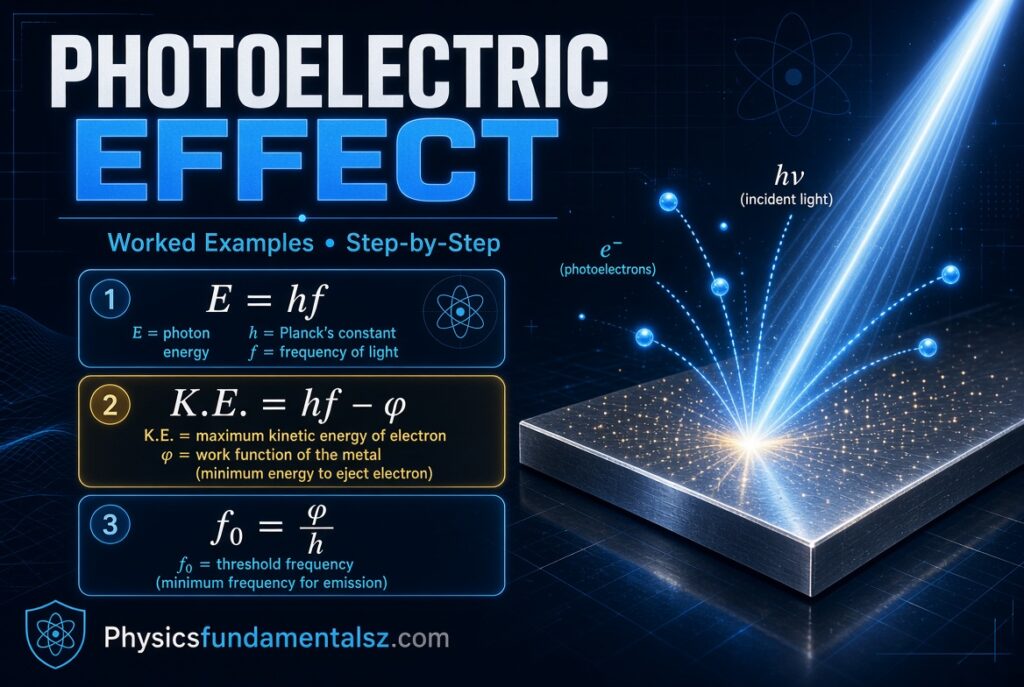
Photoelectric Effect Worked Examples make it easier to understand how light can behave in a surprisingly particle-like way. When light strikes a suitable metal surface, it can transfer energy to electrons and release them from the metal. But the result depends not simply on how bright the light is—it also depends on its frequency.
This phenomenon, known as the photoelectric effect, helped establish the quantum nature of light. The energy carried by each photon is given by , and if that energy is greater than the metal’s work function, electrons can be emitted with measurable kinetic energy.
The photoelectric effect is used in photocells, light sensors, automatic lighting systems, solar technologies, and scientific instruments. Worked examples involving photon energy, work function, threshold frequency, and electron kinetic energy show exactly how these quantities are connected and why changing the light frequency can dramatically change the outcome.
Table of Contents
What Is the Photoelectric Effect?
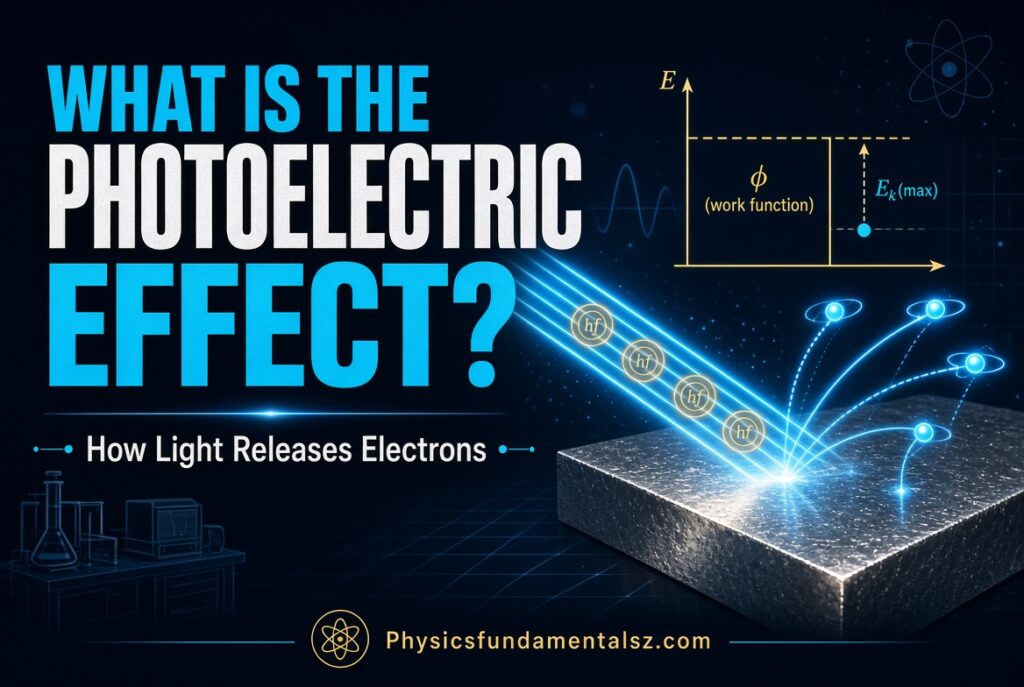
The photoelectric effect is the emission of electrons from a metal surface when electromagnetic radiation of energy equal to or greater than the metal’s work function strikes it.
Albert Einstein explained this phenomenon in 1905 using the photon model of light, work that later earned him the Nobel Prize in Physics.
The Key Formula You Need
Einstein’s photoelectric equation connects photon energy, work function, and the kinetic energy of ejected electrons:
E = hf = φ + KE_max
Where:
- E = energy of the incident photon (Joules or eV)
- h = Planck’s constant (6.626 × 10⁻³⁴ J·s, or 4.136 × 10⁻¹⁵ eV·s)
- f = frequency of incident light (Hz)
- φ = work function of the metal (J or eV)
- KE_max = maximum kinetic energy of the ejected photoelectron
A useful shortcut: E (eV) = 1240 / λ (nm), where λ is the wavelength in nanometers.
Formula Reference Table
| Quantity | Formula | Notes |
|---|---|---|
| Photon energy | E = hf = hc/λ | Use λ in meters for SI units |
| Max kinetic energy | KE_max = hf − φ | Only valid if hf > φ |
| Threshold frequency | f₀ = φ/h | Minimum frequency to eject electrons |
| Threshold wavelength | λ₀ = hc/φ | Maximum wavelength that works |
| Stopping potential | V_s = KE_max / e | Numerically equals KE_max in eV |
| Photon energy shortcut | E(eV) = 1240/λ(nm) | Fast estimation method |
Worked Example 1: Finding Photon Energy
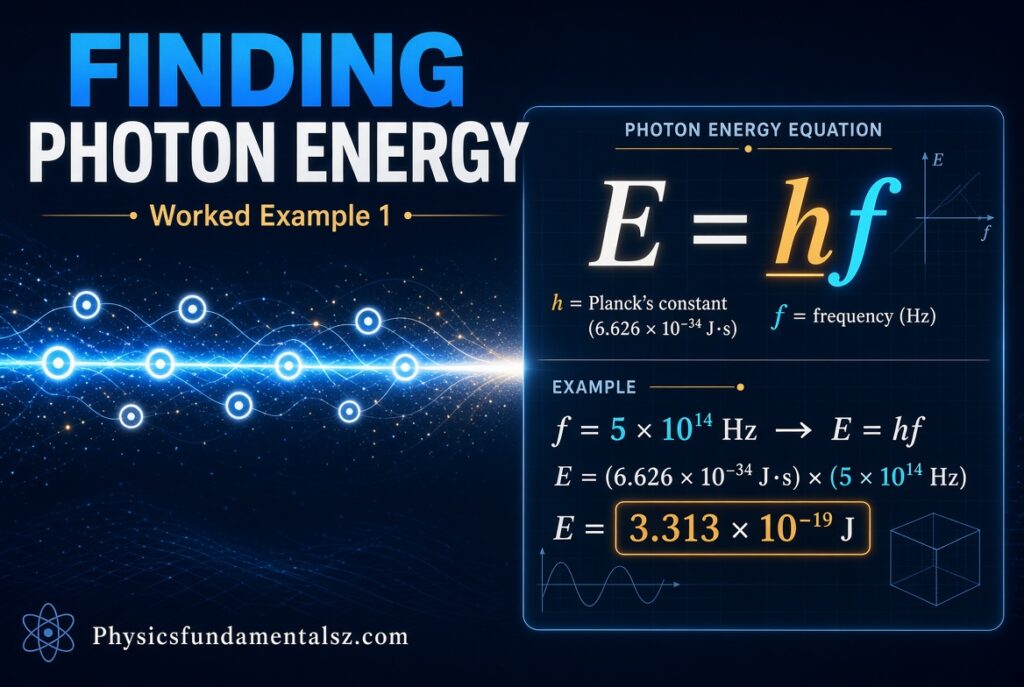
Problem: Find the energy of a photon of 400 nm violet light, in joules and electron volts.
Using E = hc/λ with h = 6.626 × 10⁻³⁴ J·s and c = 3 × 10⁸ m/s:
E = (6.626 × 10⁻³⁴ × 3 × 10⁸) / (400 × 10⁻⁹) = 4.97 × 10⁻¹⁹ J
Converting to eV: E = 4.97 × 10⁻¹⁹ / 1.602 × 10⁻¹⁹ ≈ 3.10 eV
Worked Example 2: Maximum Kinetic Energy of Photoelectrons
Problem: UV light of wavelength 200 nm strikes a calcium surface with a work function of 2.71 eV. Find the maximum kinetic energy of the ejected electrons.
First, find the photon energy using the shortcut formula:
E = 1240 / 200 = 6.20 eV
Then apply Einstein’s equation: KE_max = E − φ = 6.20 − 2.71 = 3.49 eV
Worked Example 3: Threshold Wavelength
Problem: Sodium metal has a work function of 2.3 eV. What is the longest wavelength of light that can still cause photoemission?
Threshold wavelength marks the point where photon energy exactly equals the work function.
λ₀ = 1240 / φ(eV) = 1240 / 2.3 ≈ 539 nm
Any wavelength longer than 539 nm will not eject electrons from sodium, no matter how intense the light is.
Worked Example 4: Calculating Stopping Potential
Problem: Using the kinetic energy found in Example 2 (3.49 eV), find the stopping potential needed to halt the photoelectrons.
Stopping potential is the voltage that just barely stops the fastest photoelectrons from reaching the collector.
Since eV_s = KE_max, the stopping potential in volts equals the kinetic energy in eV: V_s = 3.49 V
Worked Example 5: Photocurrent from Photon Flux
Problem: A 1 mW beam of 500 nm light strikes a photocathode. Assuming every photon ejects one electron, find the resulting photocurrent.
First find the energy per photon: E = 1240/500 = 2.48 eV = 3.97 × 10⁻¹⁹ J
Number of photons per second: n = P/E = (1 × 10⁻³) / (3.97 × 10⁻¹⁹) ≈ 2.52 × 10¹⁵ photons/s
Current: I = n × e = 2.52 × 10¹⁵ × 1.602 × 10⁻¹⁹ ≈ 4.03 × 10⁻⁴ A (0.403 mA)
Worked Example 6: No Emission Case
Problem: Red light of wavelength 650 nm shines on a metal with a work function of 2.5 eV. Will photoelectrons be emitted?
Photon energy: E = 1240/650 ≈ 1.91 eV
Since 1.91 eV is less than the work function of 2.5 eV, no photoelectrons are emitted, regardless of the light’s intensity.
Common Mistakes to Avoid
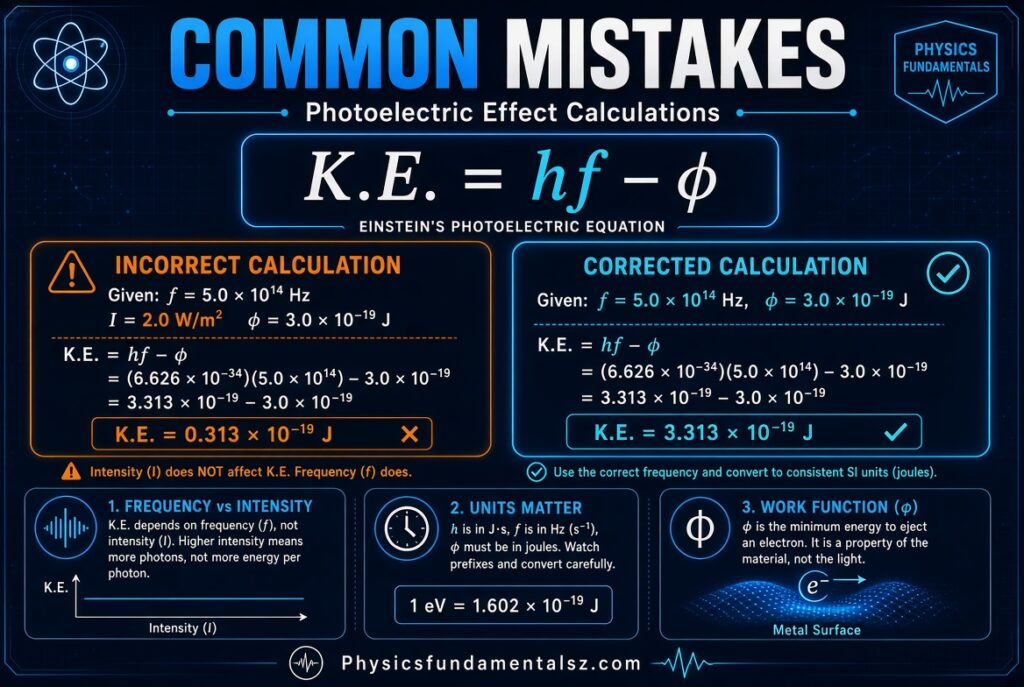
- Mixing units — always convert eV to Joules (or vice versa) consistently before comparing values.
- Forgetting that intensity does not affect KE_max; only frequency does.
- Using wavelength directly in the 1240/λ shortcut without keeping λ in nanometers.
- Assuming emission always happens if light is bright enough — frequency must exceed the threshold.
Practice Problems to Try
- A photon of 300 nm light strikes zinc (φ = 4.3 eV). Find KE_max.
- Find the threshold frequency for platinum, given φ = 6.35 eV.
- Calculate the stopping potential for electrons ejected by 250 nm light from a metal with φ = 3.0 eV.
Frequently Asked Questions (FAQs)
What is the photoelectric effect in simple terms?
It’s the release of electrons from a metal surface when light of high enough frequency hits it. Einstein explained this using the idea that light travels in energy packets called photons.
What formula is used for photoelectric effect worked examples?
The core formula is Einstein’s photoelectric equation: E = hf = φ + KE_max. It links photon energy, work function, and the kinetic energy of ejected electrons.
Why does intensity not affect the kinetic energy of photoelectrons?
Kinetic energy depends only on the frequency of individual photons, not how many photons arrive. Higher intensity means more electrons ejected, not faster ones.
What is the work function in the photoelectric effect?
The work function is the minimum energy needed to remove an electron from a specific metal’s surface. It varies by material and is usually given in electron volts.
How do you find the threshold frequency?
Divide the work function by Planck’s constant: f₀ = φ/h. Below this frequency, no electrons are emitted no matter how bright the light is.
How do you calculate stopping potential?
Stopping potential equals the maximum kinetic energy divided by the electron charge: V_s = KE_max/e. Numerically, it equals KE_max when KE_max is expressed in eV.
Can visible light cause the photoelectric effect?
Yes, if the metal has a low enough work function. Metals like cesium and potassium respond to visible light, while others need ultraviolet light.
What happens if photon energy equals the work function exactly?
The electron is just barely freed with zero kinetic energy. This is the threshold condition, marking the boundary between emission and no emission.
Why is the photoelectric effect important in physics?
It provided the first strong evidence that light behaves as particles (photons), not just waves. This discovery helped establish the foundation of quantum mechanics.
What is the shortcut formula for photon energy in eV?
Use E(eV) = 1240/λ(nm), where λ is the wavelength in nanometers. It’s a fast way to estimate photon energy without unit conversions.
Does the photoelectric effect happen instantly?
Yes, emission occurs almost instantaneously once the frequency condition is met. This immediate response also supported the photon theory over the wave theory of light.
What units are used for work function?
Work function is typically measured in electron volts (eV), though it can also be expressed in joules for calculations in SI units.
How is the photoelectric effect used in real devices?
It’s used in solar cells, photodiodes, image sensors, night-vision equipment, and photomultiplier tubes used in scientific instruments.
What is a photoelectron?
A photoelectron is simply the name given to an electron ejected from a material due to the photoelectric effect. It’s not a different type of particle.
Why do metals with higher work functions need higher-frequency light?
A higher work function means electrons are bound more tightly. More photon energy, and therefore higher frequency, is needed to overcome that binding energy.
How do you convert joules to electron volts in these problems?
Divide the energy in joules by 1.602 × 10⁻¹⁹. This constant represents the charge of a single electron in coulombs.
What is the significance of Einstein’s Nobel Prize related to this topic?
Einstein won the 1921 Nobel Prize in Physics specifically for explaining the photoelectric effect, not for his theory of relativity.
Can you use the photoelectric effect to measure Planck’s constant?
Yes, by plotting stopping potential against frequency for several light sources, the slope of the line gives Planck’s constant experimentally.
What is the difference between threshold frequency and threshold wavelength?
Threshold frequency is the minimum frequency needed for emission, while threshold wavelength is the corresponding maximum wavelength. They describe the same physical limit from different angles.
Why do some photoelectric effect worked examples give negative kinetic energy?
A negative result means the photon energy is below the work function, so emission cannot actually occur. In practice, this signals “no emission,” not a real negative KE.
Conclusion
Working through photoelectric effect worked examples builds real confidence with Einstein’s equation and its related formulas.
Once you’re comfortable finding photon energy, work function, threshold frequency, and stopping potential, most exam-style problems become quick, mechanical calculations.
Keep practicing with different wavelengths and metals to strengthen your intuition for when emission occurs and when it doesn’t.