Lens Formula & Magnification Explained With Examples 2026
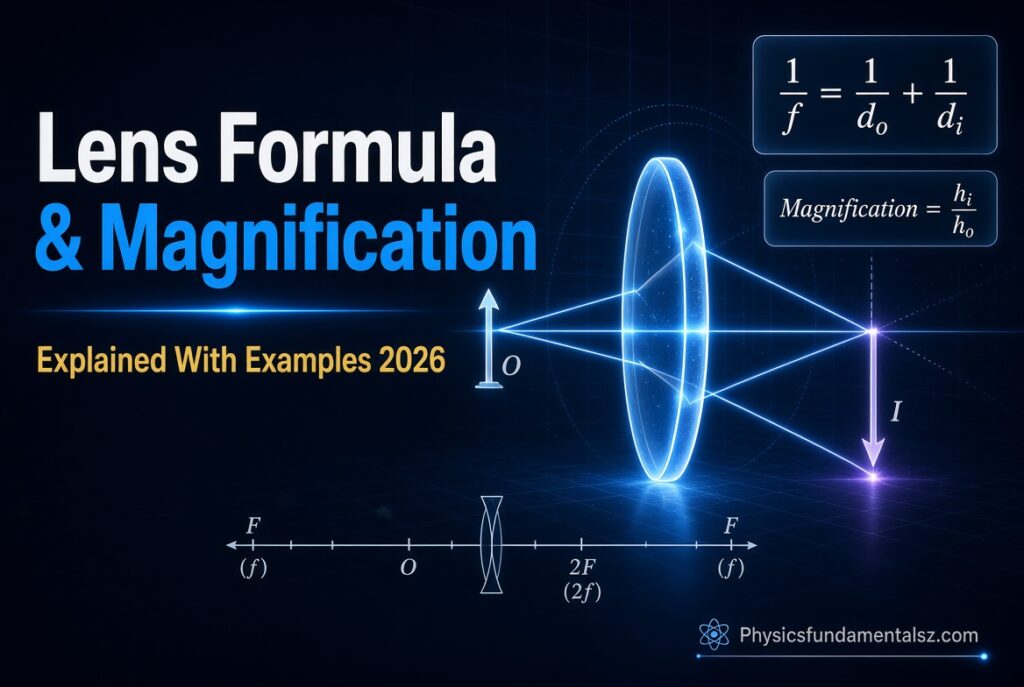
Lens Formula & Magnification Explained is an essential topic in optics that helps us understand how lenses form images and how those images differ from the original objects.
Whether a lens produces a larger, smaller, inverted, or upright image depends on factors such as the focal length and the position of the object.
The lens formula establishes the mathematical relationship between the focal length, object distance, and image distance.
Magnification, on the other hand, describes the relative size of the image compared with the object. Together, these concepts make it possible to predict important characteristics of images formed by convex and concave lenses.
Table of Contents
What Is the Lens Formula?
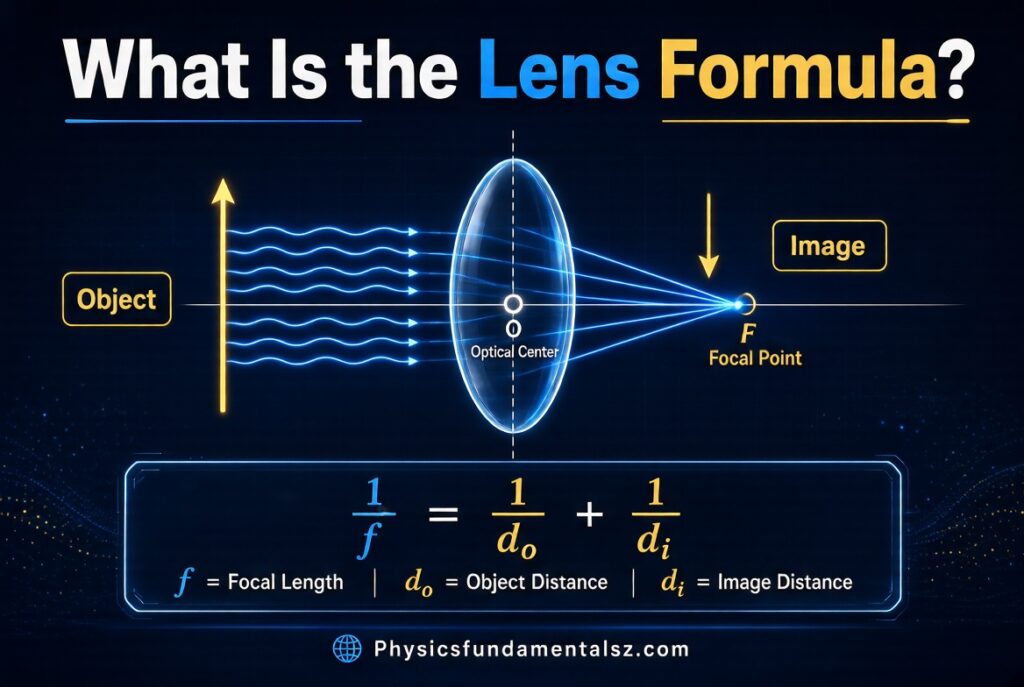
The lens formula relates the object distance (u), image distance (v), and focal length (f) of a lens through the equation 1/v − 1/u = 1/f.
This formula applies to both convex and concave lenses, as long as the correct sign convention is followed. It is derived from the geometry of ray diagrams and works for thin lenses.
The lens formula helps predict where an image will form once you know the object’s position and the lens’s focal length. It is one of the most tested concepts in optics.
Lens Formula Equation
The standard form of the lens formula is:
1/v − 1/u = 1/f
Here, v is the image distance, u is the object distance, and f is the focal length of the lens, all measured from the optical center.
Sign Convention Used in the Lens Formula
Distances measured in the direction of incident light are taken as positive. Distances measured against the direction of incident light are taken as negative.
The object distance (u) is almost always negative because the object is placed to the left of the lens. The focal length is positive for a convex lens and negative for a concave lens.
What Is Magnification in Lenses?
Quick Answer: Magnification (m) tells you how much larger or smaller the image is compared to the object. It is calculated as m = v/u = h’/h.
A positive magnification means the image is virtual and upright. A negative magnification means the image is real and inverted.
Magnification also tells you whether the image is magnified, reduced, or the same size as the object, based on whether the value is greater than, less than, or equal to one.
Magnification Formula
The magnification produced by a lens is given by:
m = v/u
It can also be expressed using image height (h’) and object height (h):
m = h’/h
How Magnification Relates to the Lens Formula
Once you calculate v using the lens formula, you can directly substitute it into the magnification formula. This makes the two formulas inseparable in practical problem-solving.
Most exam questions ask you to find both the image position and the magnification together. Solving the lens formula first always makes the second step easier.
Convex Lens vs Concave Lens: Magnification Behavior
| Feature | Convex Lens | Concave Lens |
|---|---|---|
| Focal length sign | Positive | Negative |
| Image type | Real or virtual | Always virtual |
| Magnification sign | Varies with object position | Always positive |
| Image size | Can be magnified, reduced, or equal | Always reduced |
| Common use | Magnifying glass, camera lens | Spectacles for myopia |
Step-by-Step Guide to Solving Lens Formula Problems
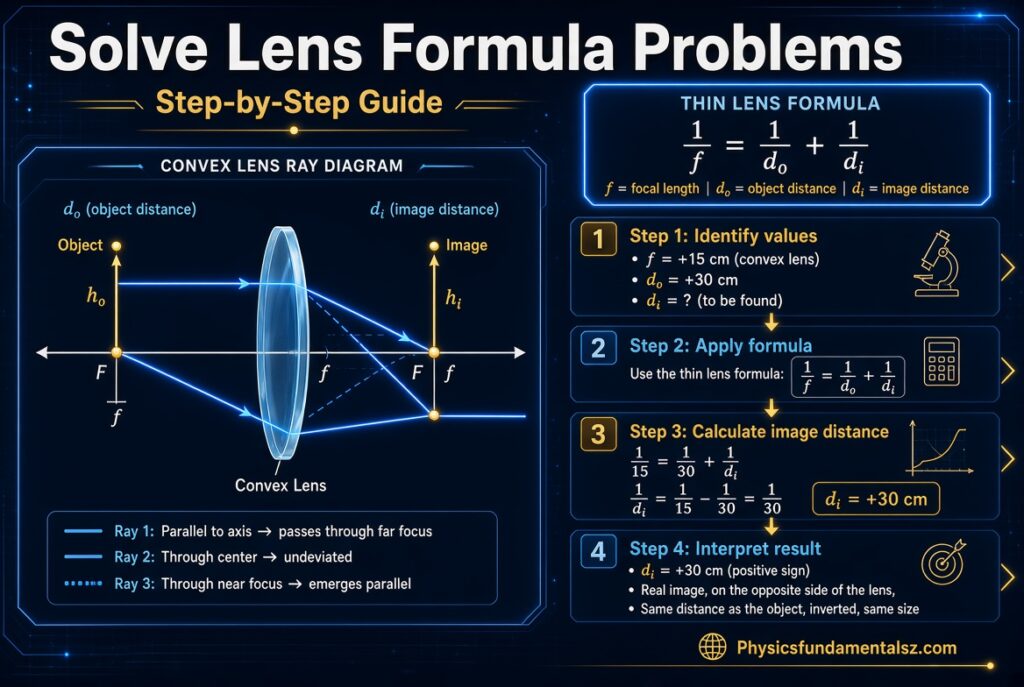
Step 1: Note Down the Given Values
Write down the object distance (u) and focal length (f) with correct signs before starting any calculation.
Skipping this step is the most common reason students get wrong answers.
Step 2: Apply the Lens Formula
Substitute the known values into 1/v − 1/u = 1/f and solve for the unknown image distance (v).
Always keep units consistent, usually in centimeters or meters.
Step 3: Calculate Magnification
Once you have v, use m = v/u to find the magnification of the image.
Check the sign of your answer to determine whether the image is real or virtual.
Step 4: Interpret the Result
A negative m means a real, inverted image. A positive m means a virtual, upright image.
Compare the magnitude of m to one to describe the image as enlarged, diminished, or the same size.
Solved Example 1: Convex Lens
An object is placed 30 cm from a convex lens of focal length 15 cm. Find the image distance and magnification.
Using 1/v − 1/u = 1/f with u = −30 cm and f = 15 cm, we get v = 30 cm.
Magnification m = v/u = 30/(−30) = −1. The image is real, inverted, and the same size as the object.
Solved Example 2: Concave Lens
An object is placed 20 cm from a concave lens of focal length 10 cm. Find the image distance and magnification.
Using the lens formula with u = −20 cm and f = −10 cm, we get v = −6.67 cm.
Magnification m = v/u = −6.67/−20 = 0.33. The image is virtual, upright, and smaller than the object.
Common Mistakes to Avoid
- Forgetting to apply the correct sign convention for u, v, and f.
- Mixing up the formula for lenses with the formula used for mirrors.
- Not checking whether the final image should be real or virtual based on the sign of magnification.
- Using inconsistent units between object distance and focal length.
Expert Tips for Remembering the Formulas
Always write the sign convention on your rough sheet before starting a problem. This single habit prevents most calculation errors.
Practice with both convex and concave lens examples so you get comfortable switching between positive and negative focal lengths.
Real-World Applications of Lens Formula & Magnification Explained
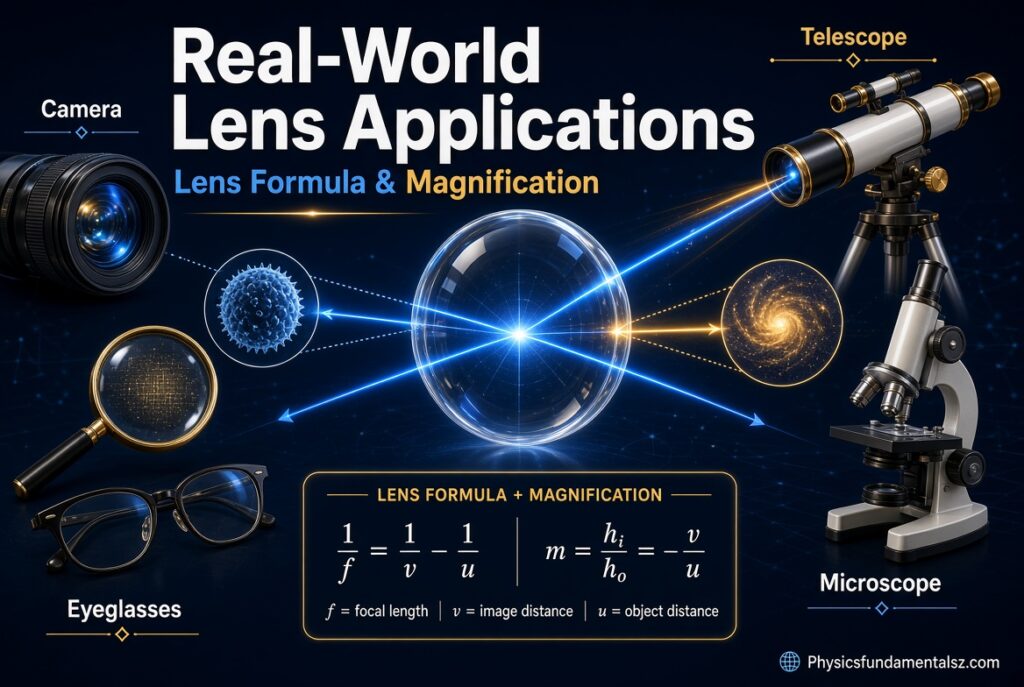
Cameras use the lens formula to focus light and form sharp images on the sensor. Adjusting the lens position changes v to keep the image in focus.
Microscopes and telescopes rely on magnification calculations to enlarge distant or tiny objects for clear viewing. Eyeglasses use lens power, which is directly derived from focal length, to correct vision.
Quick Reference Table
| Term | Formula | Meaning |
|---|---|---|
| Lens Formula | 1/v − 1/u = 1/f | Relates object distance, image distance, and focal length |
| Magnification | m = v/u = h’/h | Ratio of image size to object size |
| Convex Lens Focal Length | Positive | Converging lens |
| Concave Lens Focal Length | Negative | Diverging lens |
Key Takeaways
- The lens formula is 1/v − 1/u = 1/f, valid for both convex and concave lenses.
- Magnification is m = v/u, and its sign tells you if the image is real or virtual.
- Sign convention is the most important step to get right before solving any problem.
- Convex lenses can produce real or virtual images, while concave lenses always produce virtual, reduced images.
Frequently Asked Questions (FAQs)
What is the lens formula in physics?
The lens formula is 1/v − 1/u = 1/f, where v is image distance, u is object distance, and f is focal length. It applies to both convex and concave lenses.
What is the magnification formula for a lens?
Magnification is calculated as m = v/u or m = h’/h, comparing image distance to object distance or image height to object height.
Why is magnification negative for a real image?
A negative magnification occurs because the sign convention treats real, inverted images as having opposite orientation to the object, giving a negative value.
Can magnification be greater than 1?
Yes. When the image is larger than the object, magnification is greater than 1. This happens in magnifying glasses and projector lenses.
What does a magnification of exactly 1 mean?
A magnification of 1 means the image is exactly the same size as the object, though it may still be inverted or upright depending on the sign.
Is the lens formula the same for convex and concave lenses?
Yes, the formula 1/v − 1/u = 1/f is the same. Only the sign of the focal length changes based on lens type.
What is the difference between linear magnification and areal magnification?
Linear magnification compares lengths (like height), while areal magnification compares areas, which is the square of linear magnification.
How do you find focal length using the lens formula?
Rearrange the formula to f = (u × v)/(u − v) once you know both the object and image distances.
What happens to magnification when the object is at the focal point?
When the object is placed exactly at the focal point of a convex lens, the image forms at infinity and magnification becomes undefined or extremely large.
Why do concave lenses always produce reduced images?
Concave lenses diverge light rays, so the virtual image formed is always smaller than the object, regardless of object distance.
What is the unit of magnification?
Magnification has no unit because it is a ratio of two lengths or two distances.
How is the lens formula different from the mirror formula?
The lens formula is 1/v − 1/u = 1/f, while the mirror formula is 1/v + 1/u = 1/f. The sign convention also differs slightly between lenses and mirrors.
What is the power of a lens and how is it related to focal length?
Power of a lens is P = 1/f, measured in diopters when f is in meters. A higher power means a shorter focal length.
Does magnification depend on the size of the lens?
No, magnification depends only on object and image distances, not on the physical size of the lens itself.
What is the value of magnification for a plane mirror equivalent lens setup?
For a system that behaves like a plane mirror, magnification is always exactly 1, meaning the image size equals the object size.
Can a concave lens ever form a real image?
No, a concave lens always forms a virtual, upright, and diminished image regardless of where the object is placed.
How does object distance affect magnification in a convex lens?
As the object moves closer to the focal point of a convex lens, magnification increases. As the object moves far away, magnification decreases.
What is the New Cartesian Sign Convention?
It is the standard sign convention used in optics where distances measured against incident light are negative and distances in the direction of incident light are positive.
Why is the object distance always taken as negative?
Because the object is conventionally placed on the left side of the lens, opposite to the direction of incident light, making u negative by convention.
What is the relationship between magnification and image height?
Magnification equals the ratio of image height to object height, so m = h’/h directly links size comparison with the formula.
How do you know if an image is virtual using magnification?
If the magnification value is positive, the image is virtual and upright. If it is negative, the image is real and inverted.
What tools use the lens formula in real life?
Cameras, microscopes, telescopes, projectors, and corrective eyeglasses all rely on the lens formula and magnification calculations.
Is the lens formula valid for thick lenses?
The standard lens formula assumes thin lenses. Thick lenses require more advanced formulas that account for lens thickness.
What is the maximum magnification possible with a convex lens?
There is no fixed maximum. Magnification increases significantly as the object approaches the focal length, theoretically approaching infinity.
How can I practice lens formula and magnification problems effectively?
Start with simple convex lens examples, move to concave lens problems, and always double-check your sign convention before finalizing an answer.
Conclusion
The lens formula and magnification formula work together to explain how images form through lenses. Mastering the sign convention is the key to solving these problems accurately every time.
With consistent practice using both convex and concave lens examples, these calculations become quick and intuitive. Use the quick reference table above whenever you need a fast recap before an exam or practical application.