Electric Current: I = Q/t, Drift Velocity & Ohm’s Law Connection
Flip a light switch and electric current starts flowing in less than a second — but what is actually moving through that wire?
Understanding electric current is the first step to understanding almost every piece of technology you own, from phone chargers to electric cars.
Table of Contents
Electric Current
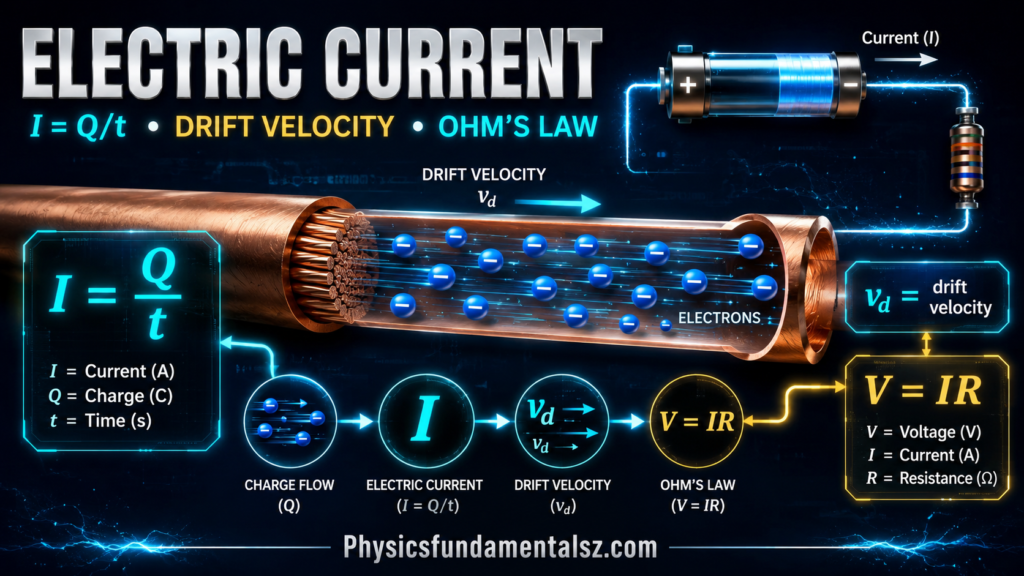
Electric current is the rate of flow of electric charge past a point in a circuit. It is measured in amperes (A), where 1 ampere equals 1 coulomb of charge flowing per second. Current is represented by the symbol I and is calculated using the formula:
$$I = \frac{Q}{t}$$
where Q is charge (in coulombs) and t is time (in seconds).
What Is Electric Current?
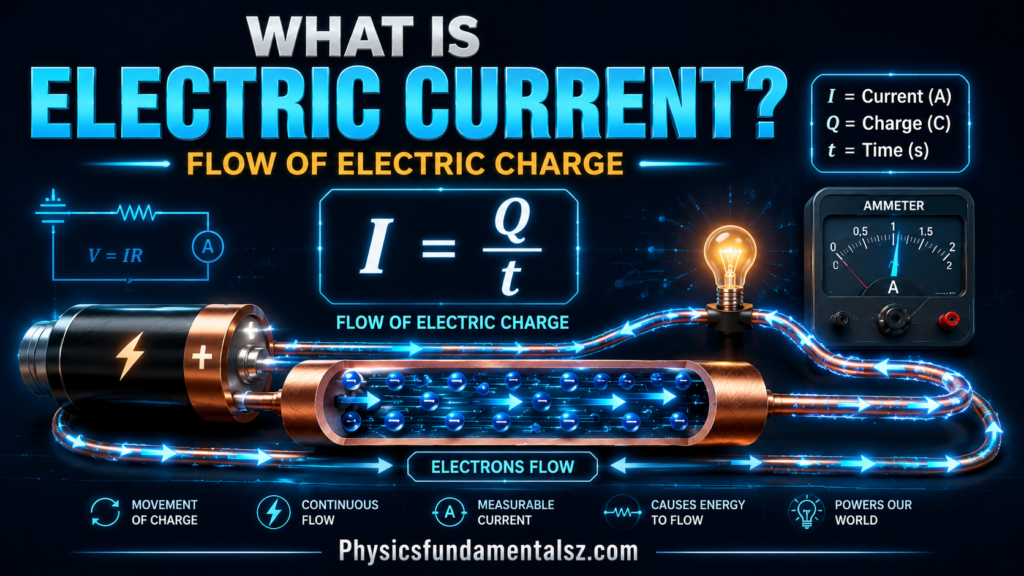
Electric current is the movement of electrically charged particles — usually electrons — through a conductor such as a copper wire. In liquids and gases, current can also be carried by ions, and in semiconductors it’s carried by both electrons and “holes” (missing electrons that behave like positive charges).
Think of it like water flowing through a pipe: the water molecules are the charge carriers, and the rate at which they pass a point is like current. A wider pipe (lower resistance) lets more water (current) flow for the same pressure (voltage).
Electric Current Formula
The basic formula for current is:
$$I = \frac{Q}{t}$$
Combined with Ohm’s Law, current can also be expressed as:
$$I = \frac{V}{R}$$
where V is voltage and R is resistance.
SI Unit of Electric Current
The SI unit of electric current is the ampere, often shortened to “amp” and abbreviated A. One ampere means one coulomb of charge passes a given point every second. Current is measured using a device called an ammeter, connected in series in the circuit.
Conventional Current vs. Electron Flow
This trips up almost every beginner: the direction we call “current” is actually opposite to the direction electrons move.
- Conventional current flows from the positive terminal to the negative terminal of a power source — this is the standard direction used in circuit diagrams and calculations.
- Electron flow is the actual physical movement of electrons, which travel from negative to positive — the opposite direction.
This convention was set before scientists knew electrons carry negative charge, and it has stuck ever since. Engineers and physicists still use conventional current in virtually all formulas and diagrams today.
Types of Electric Current
Direct Current (DC)
Direct current flows in one constant direction. Batteries, solar panels, and USB power all supply DC.
Alternating Current (AC)
Alternating current periodically reverses direction, typically 50 or 60 times per second depending on the country. Household wall outlets supply AC because it can be transmitted over long distances more efficiently.
AC vs. DC Comparison
| Feature | Direct Current (DC) | Alternating Current (AC) |
|---|---|---|
| Direction of flow | One constant direction | Reverses periodically |
| Common sources | Batteries, solar cells, USB | Power plants, wall outlets |
| Typical use | Electronics, small devices | Home and industrial power |
| Transmission | Less efficient over long distances | More efficient over long distances |
| Frequency | None (constant) | 50 Hz or 60 Hz (region-dependent) |
Current, Voltage, and Resistance: How They Relate
Current doesn’t exist in isolation — it depends on two other quantities:
- Voltage (V): The “push” or electrical pressure driving the current, measured in volts.
- Resistance (R): The opposition to current flow, measured in ohms (Ω).
These three quantities are tied together by Ohm’s Law:
$$V = IR \quad \text{or} \quad I = \frac{V}{R}$$
Example: If a circuit has a 12 V battery and a 4 Ω resistor, the current is:
$$I = \frac{12}{4} = 3\text{ A}$$
How Electric Current Is Measured
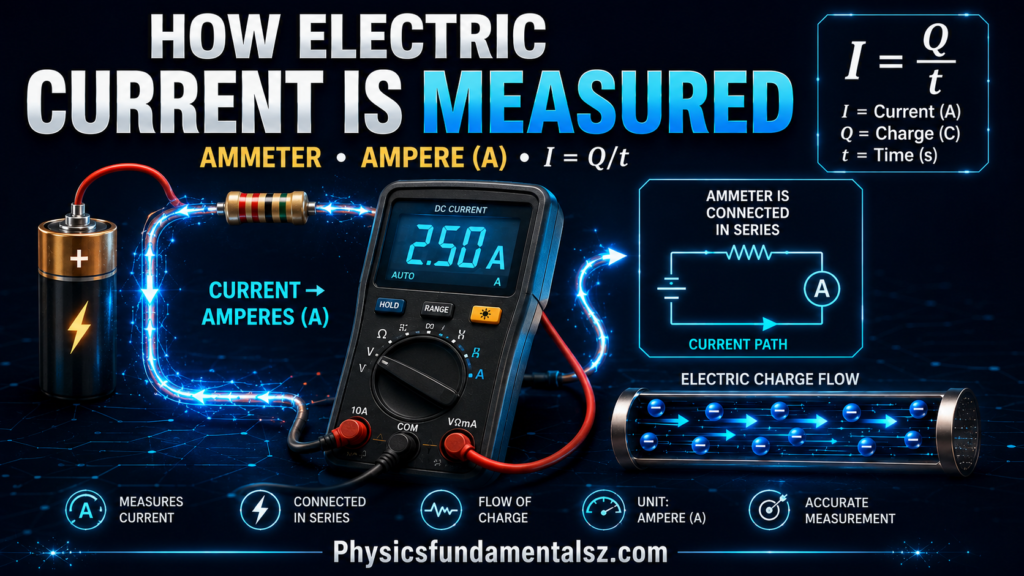
- Select the right tool — use a digital or analog ammeter, or a multimeter set to current mode.
- Break the circuit at the point you want to measure, since an ammeter must be connected in series.
- Connect the ammeter so current flows through it, matching positive and negative terminals correctly.
- Read the value displayed in amps, milliamps (mA), or microamps (µA) depending on the circuit’s scale.
- Disconnect safely and restore the circuit connection once the reading is taken.
Expert tip: Never connect an ammeter in parallel across a component — this creates a short circuit and can damage the meter or the circuit.
Common Mistakes When Working With Electric Current
- Connecting an ammeter in parallel instead of in series.
- Confusing current with voltage — current is the flow rate of charge, voltage is the driving force.
- Ignoring current ratings on wires or components, which can cause overheating.
- Assuming AC and DC are interchangeable — many devices only work safely with one type.
- Forgetting the direction convention when analyzing circuit diagrams.
Real-World Examples and Applications
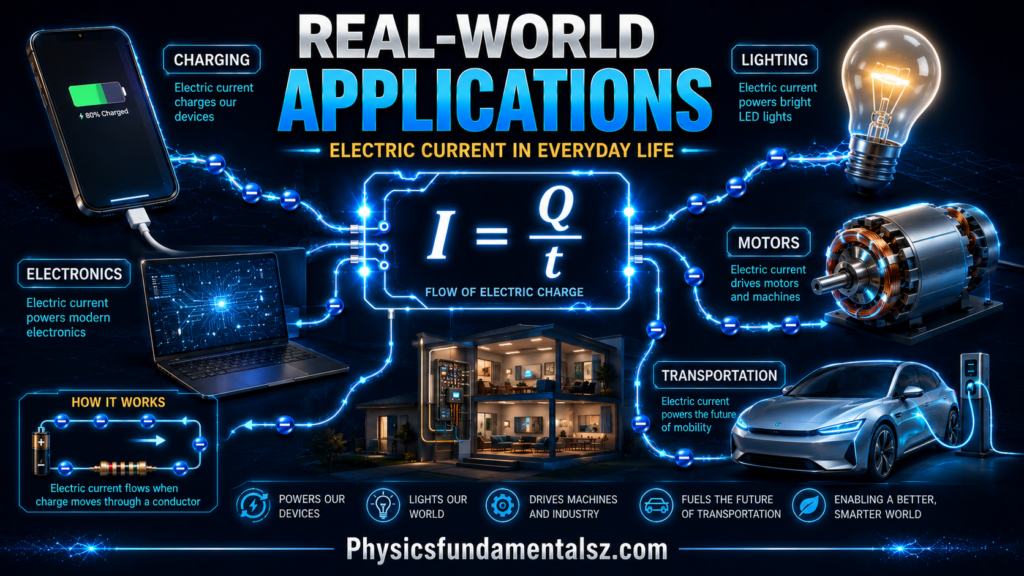
- Household wiring carries alternating current to power lights, appliances, and outlets.
- Phone and laptop batteries store and discharge direct current to run internal electronics.
- Electric vehicles use DC from the battery, converted to AC to drive the motor.
- Medical devices such as ECG machines measure tiny electric currents generated by the heart.
- Lightning is a natural, extremely large and brief electric current — often tens of thousands of amps.
Frequently Asked Questions (FAQs)
What is electric current in simple terms?
Electric current is the flow of electric charge, usually carried by electrons, through a conductor like a wire.
What is the SI unit of electric current?
The SI unit is the ampere (A), where 1 ampere equals 1 coulomb of charge flowing per second.
What is the formula for electric current?
The basic formula is I = Q/t (charge divided by time), and using Ohm’s Law it can also be written as I = V/R.
What is the difference between current and voltage?
Current is the rate of flow of charge, while voltage is the electrical “pressure” that pushes the charge to flow.
What is the difference between AC and DC current?
DC flows in one constant direction, while AC periodically reverses direction, typically 50 or 60 times per second.
Why does conventional current flow opposite to electron flow?
Conventional current follows the historical convention of positive-charge direction, which was set before electrons were discovered to be negatively charged.
What instrument is used to measure electric current?
An ammeter, or a multimeter set to current mode, is used to measure electric current, connected in series with the circuit.
Can electric current flow through air?
Yes, under strong enough electric fields, current can flow through air — lightning is a natural example of this.
What happens if resistance increases in a circuit?
According to Ohm’s Law, increasing resistance decreases current if voltage stays constant.
Is electric current dangerous?
Yes, even relatively small currents (around 0.1 A) passing through the human body can be dangerous or fatal, which is why electrical safety precautions matter.
What is the difference between current and charge?
Charge (Q) is the total amount of electric charge, while current (I) is the rate at which that charge flows past a point over time.
What carries electric current in metals?
In metals, current is carried by free electrons moving through the metal’s atomic lattice.
What carries electric current in liquids and gases?
In liquids and ionized gases, current is carried by positive and negative ions moving in opposite directions.
What is a short circuit?
A short circuit occurs when current takes an unintended low-resistance path, often causing a dangerous spike in current flow.
Why is current measured in series, not parallel?
Current must pass through the ammeter itself to be measured accurately, which requires a series connection in the circuit path.
What is drift velocity in relation to current?
Drift velocity is the average speed at which electrons move through a conductor under an electric field — it’s surprisingly slow, even though electrical effects travel almost instantly.
How is electric current related to electric power?
Electric power (P) is calculated as P = VI (voltage multiplied by current), showing how current directly affects the energy a device consumes.
What is a milliampere?
A milliampere (mA) is one-thousandth of an ampere, commonly used to describe very small currents in electronics.
Does electric current need a closed circuit to flow?
Yes, current requires a complete, closed conducting path from the power source back to itself in order to flow continuously.
What is the difference between conventional current and electron current?
Conventional current is defined as flowing from positive to negative, while actual electrons move from negative to positive — the two are opposite in direction.
Conclusion
Electric current is simply the flow of electric charge — but that simple idea powers everything from your smartphone to the entire electrical grid.
Once you understand the relationship between current, voltage, and resistance through Ohm’s Law, you have the foundation needed to read circuit diagrams, measure real circuits safely, and understand how nearly every electrical device works.