Electric Potential Energy: E = kQq/r, Work Done & Worked Examples
Push two magnets’ like poles together and you can feel the resistance building in your hand — that resistance is stored energy, waiting to snap them apart the moment you let go.
Electric charges behave the same way. Bring two positive charges close together, and the system stores energy that will release the instant you let them fly apart.
That stored energy has a name: electric potential energy. It’s one of the foundational concepts in electrostatics, and it shows up everywhere from AP Physics exams to the batteries in your phone.
Table of Contents
What Is Electric Potential Energy?
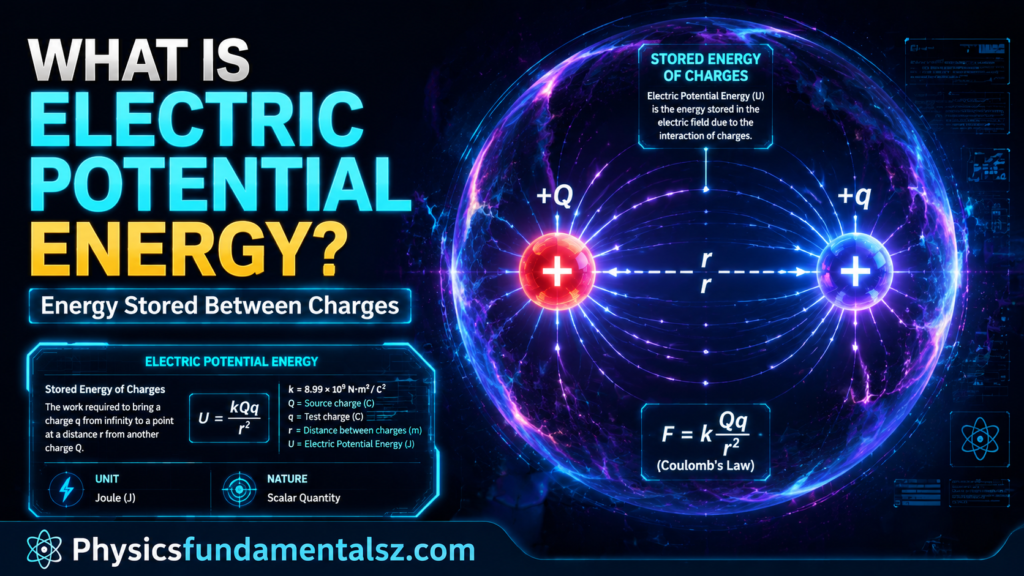
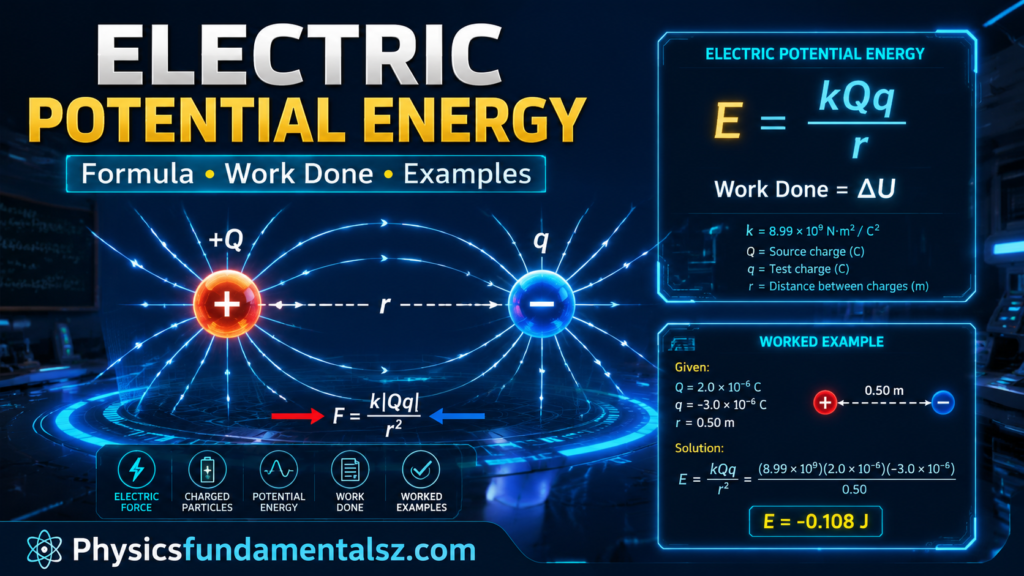
Electric potential energy is the energy stored in a system of electric charges because of their positions relative to one another. For two point charges, it’s calculated with the formula U = kq₁q₂ / r, where k is Coulomb’s constant, q₁ and q₂ are the charges, and r is the distance between them. It’s measured in joules, is a scalar quantity (magnitude only, no direction), and can be positive or negative depending on whether the charges are alike or opposite.
Think of it as the electric version of a compressed spring or a ball held at the top of a hill — energy stored by position, ready to convert into motion.
Understanding Electric Potential Energy
The Gravitational Analogy: Potential Energy on a “Hill”
Lift a ball off the ground, and you give it gravitational potential energy. Let go, and that stored energy converts into kinetic energy as it falls. Electric potential energy works the same way, just with charge and electric force instead of mass and gravity.
Push a positive charge toward another positive charge, and you’re doing work against the repulsive force — storing energy in the system, just like lifting the ball. Release it, and the charge accelerates away, converting that stored potential energy into kinetic energy.
Why Electric Potential Energy Depends on Position
Electric potential energy isn’t a property of a single charge sitting in isolation — it depends on where that charge is relative to other charges. Move a charge closer to another charge of the same sign, and the system’s stored energy increases. Move it farther away, and the stored energy decreases.
Key takeaway: Electric potential energy belongs to the system of charges, not to a single charge by itself — it only exists because of the relative position between two or more charges.
The Formula for Electric Potential Energy
Electric Potential Energy Between Two Point Charges
For two point charges q₁ and q₂ separated by a distance r, the electric potential energy of the system is:
U = kq₁q₂ / r
| Symbol | Meaning | Unit |
|---|---|---|
| U | Electric potential energy | Joules (J) |
| k | Coulomb’s constant (≈ 8.99 × 10⁹ N·m²/C²) | N·m²/C² |
| q₁, q₂ | Magnitude and sign of each charge | Coulombs (C) |
| r | Distance between the charges | Meters (m) |
Breaking Down U = kq₁q₂ / r
- U is directly proportional to the product of the charges. Double either charge, and the potential energy doubles.
- U is inversely proportional to distance. Move the charges twice as far apart, and the potential energy is cut in half.
- The reference point is infinity. By convention, electric potential energy is defined as zero when the charges are infinitely far apart — the formula measures the energy relative to that baseline.
Worked Example: Calculating Potential Energy of Two Charges
Problem: A +3.0 nC charge and a +5.0 nC charge are separated by 10 cm. Find the electric potential energy of the system.
Solution:
- Formula: U = kq₁q₂ / r
- Convert units: q₁ = 3.0 × 10⁻⁹ C, q₂ = 5.0 × 10⁻⁹ C, r = 0.10 m
- Plug in values: U = (8.99 × 10⁹)(3.0 × 10⁻⁹)(5.0 × 10⁻⁹) / 0.10
- Simplify: U = (8.99 × 10⁹ × 15 × 10⁻¹⁸) / 0.10 = (134.85 × 10⁻⁹) / 0.10
- Result: U ≈ 1.35 × 10⁻⁶ J, or about 1.35 microjoules — a positive value, since both charges are positive.
Understanding the Sign: Positive vs. Negative Potential Energy
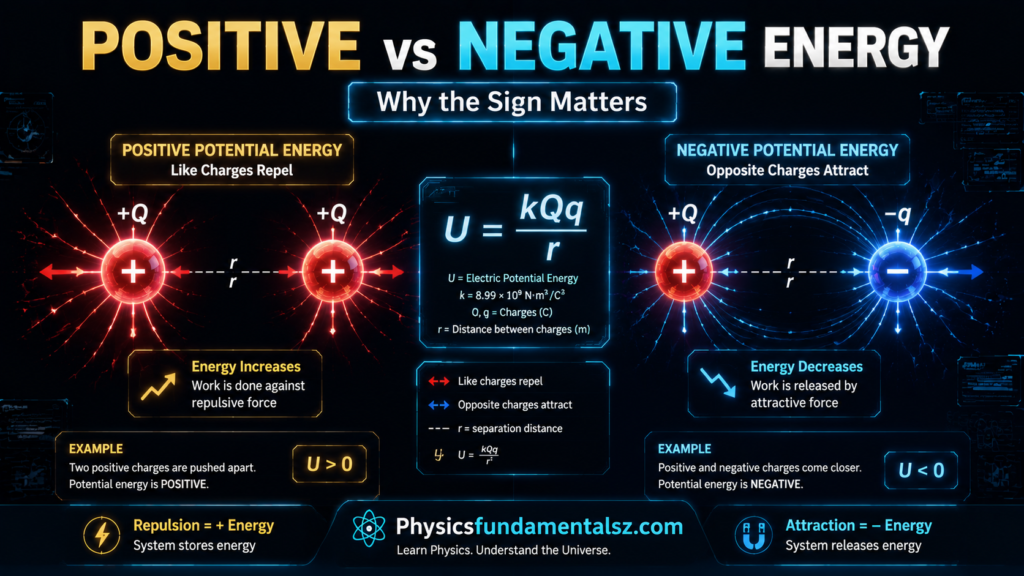
Like Charges: Positive Potential Energy
When both charges share the same sign — two positives or two negatives — the potential energy is positive. That’s because the charges repel each other, so an external force has to do positive work to push them together, and that work is stored in the system.
Unlike Charges: Negative Potential Energy
When the charges have opposite signs, the potential energy is negative. Opposite charges attract, so bringing them together from infinity actually releases energy rather than requiring it — the system’s energy drops below the zero baseline.
Why the Reference Point Is Infinity
Electric potential energy is always defined relative to a reference point, and physicists universally choose that reference to be an infinite separation between charges, where the electric force (and therefore the interaction energy) drops to zero. This gives every calculation a consistent, comparable baseline.
Key takeaway: Positive potential energy means work was required to assemble the charge configuration; negative potential energy means energy was released in assembling it.
Electric Potential Energy vs. Electric Potential vs. Voltage
This is the single most common point of confusion in the entire topic — and getting it straight is worth more than memorizing any formula.
Comparison Table: Key Differences
| Concept | What It Measures | Formula | Depends On | Unit |
|---|---|---|---|---|
| Electric Potential Energy (U) | Total stored energy of a system of charges | U = kq₁q₂ / r | Both charges and their distance apart | Joule (J) |
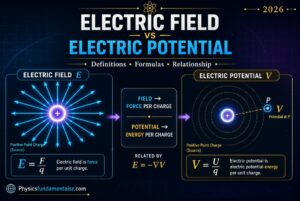
| Electric Potential (V) | Potential energy per unit charge at a point in space | V = kQ / r | The source charge and distance only (not the test charge) | Volt (V) = J/C |
| Voltage / Potential Difference (ΔV) | The difference in electric potential between two points | ΔV = ΔU / q | The change in potential energy per unit charge moved | Volt (V) |
How They’re Related (U = qV)
Electric potential energy and electric potential are connected by a simple relationship: U = qV, where q is the charge placed at a point and V is the electric potential at that point. In other words, potential is what a single charge would experience per unit of its own charge, while potential energy is the total energy once you actually place a specific charge there.
Key takeaway: Electric potential is a property of the space around a charge; electric potential energy is a property of an actual charge placed in that space; voltage is the difference in potential between two locations.
Electric Potential Energy for Multiple Charges
The Superposition Principle
Real systems rarely involve just two charges. When three or more charges are present, the total electric potential energy of the system is the sum of the potential energy of every possible pair of charges — calculated independently and then added together as scalars, not vectors.
Worked Example: Three-Charge System
Problem: Three point charges — q₁ = +2.0 nC, q₂ = +3.0 nC, and q₃ = -1.0 nC — sit at the corners of a triangle, each pair separated by 0.20 m. Find the total electric potential energy.
Solution:
- Calculate each pair’s energy separately using U = kq₁q₂ / r.
- U₁₂ = k(2.0×10⁻⁹)(3.0×10⁻⁹)/0.20 ≈ 2.70 × 10⁻⁷ J
- U₁₃ = k(2.0×10⁻⁹)(-1.0×10⁻⁹)/0.20 ≈ -8.99 × 10⁻⁸ J
- U₂₃ = k(3.0×10⁻⁹)(-1.0×10⁻⁹)/0.20 ≈ -1.35 × 10⁻⁷ J
- Add all three: U_total ≈ 4.5 × 10⁻⁸ J — a small positive value, since the repulsive pair outweighs the two attractive pairs.
Electric Potential Energy and Work
The Work-Energy Theorem in Electrostatics
Moving a charge within an electric field involves work, and that work is directly tied to the change in potential energy: W = -ΔU. When the electric field does positive work on a charge, the system loses potential energy — that lost energy shows up as kinetic energy instead.
Conservative Forces and Path Independence
The electrostatic force is a conservative force, meaning the work done moving a charge from one point to another depends only on the starting and ending positions — not on the path taken to get there. This is exactly why electric potential energy can be defined as a well-behaved function of position in the first place.
Units of Electric Potential Energy
The Joule
The standard SI unit for electric potential energy is the joule (J), the same unit used for all forms of energy — mechanical, thermal, and electrical alike.
The Electron Volt (eV)
At the atomic and subatomic scale, joules are inconveniently large numbers, so physicists commonly use the electron volt (eV) instead — the energy gained by a single electron accelerated through a potential difference of one volt. One electron volt equals 1.602 × 10⁻¹⁹ joules, making it far more practical for describing particle-scale energies.
Real-World Applications
Electric potential energy isn’t confined to textbook diagrams — it’s the working principle behind devices used every day.
- Capacitors: Store electric potential energy between their plates, calculated as U = ½CV², where C is capacitance and V is voltage — the basis for energy storage in everything from camera flashes to power electronics.
- Batteries: Convert stored chemical energy into electric potential energy at their terminals, which then drives current through a circuit as that energy converts to other forms.
- Defibrillators: Store a large amount of electric potential energy in an internal capacitor, then release it rapidly to deliver a controlled electric shock to restart a heart’s rhythm.
- Particle accelerators: Use enormous potential differences to convert electric potential energy into kinetic energy, accelerating charged particles to extremely high speeds for physics research.
Common Mistakes to Avoid
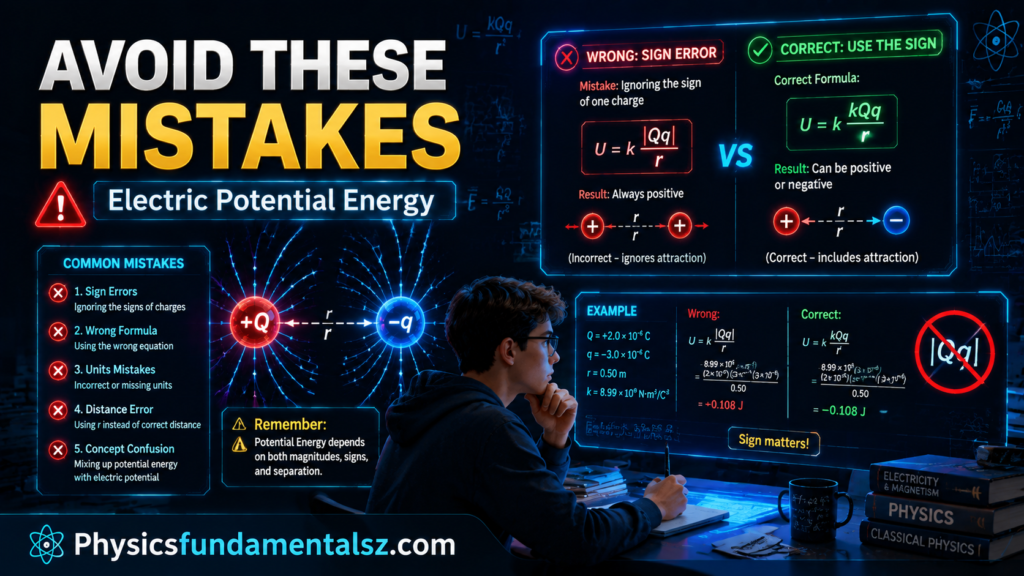
- Confusing electric potential energy with electric potential. Potential energy belongs to a charge placed in a field; potential belongs to the field itself, independent of any specific charge.
- Forgetting the sign of the charges. Plugging in only magnitudes without tracking positive/negative signs produces the wrong sign for U — and the wrong physical interpretation.
- Treating potential energy as a vector. It’s a scalar. When multiple charges are involved, add their pairwise energies as plain numbers, not as vector components.
- Mixing up the reference point. Assuming potential energy is “zero at the ground” (like in some gravity problems) instead of the correct electrostatic convention — zero at infinite separation.
- Using the wrong formula for the situation. U = kq₁q₂/r applies to point charges; U = qV applies to a charge in a known potential; U = ½CV² applies specifically to capacitors. Mixing these up is a frequent source of errors once circuits enter the picture.
Frequently Asked Questions (FAQs)
What is electric potential energy?
It’s the energy stored in a system of electric charges due to their relative positions, calculated for two point charges as U = kq₁q₂/r.
What is the formula for electric potential energy?
For two point charges, U = kq₁q₂/r, where k is Coulomb’s constant, q₁ and q₂ are the charges, and r is the distance between them.
What is the SI unit of electric potential energy?
The joule (J), the standard SI unit of energy.
Is electric potential energy a scalar or a vector quantity?
It’s a scalar quantity — it has magnitude only, no direction, though it can be positive or negative.
Can electric potential energy be negative?
Yes. It’s negative when the interacting charges have opposite signs, since energy is released (not required) when opposite charges are brought together.
Why is electric potential energy positive for two like charges?
Because like charges repel, so external work must be done to push them together, and that work is stored as positive potential energy.
Why is electric potential energy negative for two unlike charges?
Because opposite charges attract each other, releasing energy as they come together rather than requiring energy input.
What is the reference point for electric potential energy, and why is it infinity?
By convention, potential energy is defined as zero when charges are infinitely far apart, since the electric force — and interaction energy — approaches zero at infinite separation.
What is the difference between electric potential energy and electric potential?
Electric potential energy (U) is the total energy of a specific charge placed in a field; electric potential (V) is the energy per unit charge that the field itself would provide, independent of any particular charge placed there.
What is the difference between electric potential energy and voltage?
Voltage (or potential difference) is the difference in electric potential between two points; electric potential energy is the total stored energy of an actual charge at a specific position.
How is electric potential energy related to work done by an electric field?
The work done by the field equals the negative change in potential energy: W = -ΔU. Positive work by the field corresponds to a decrease in potential energy.
What is Coulomb’s constant and what is its value?
Coulomb’s constant, k, is approximately 8.99 × 10⁹ N·m²/C², used to quantify the strength of the electrostatic force and potential energy between charges.
What is the formula for electric potential energy between two point charges?
U = kq₁q₂/r, with charges in coulombs, distance in meters, and the result in joules.
How do you calculate electric potential energy for more than two charges?
Calculate the potential energy for every possible pair of charges individually, then add all the pairwise values together as scalars.
What is the superposition principle for electric potential energy?
It states that the total potential energy of a multi-charge system equals the sum of the potential energies of each individual pair of charges.
How does distance affect electric potential energy?
Potential energy is inversely proportional to distance — doubling the separation between charges halves the potential energy.
How does charge magnitude affect electric potential energy?
Potential energy is directly proportional to the product of the two charges — doubling either charge doubles the potential energy.
What happens to electric potential energy as two like charges move apart?
It decreases, approaching zero as the separation approaches infinity.
What happens to electric potential energy as two unlike charges move apart?
Its magnitude decreases toward zero (becoming less negative) as separation increases, again approaching zero at infinite distance.
What is an electron volt and how does it relate to electric potential energy?
An electron volt (eV) is the energy gained by an electron accelerated through a potential difference of one volt, equal to 1.602 × 10⁻¹⁹ joules — a convenient unit for atomic-scale energies.
How do you convert electron volts to joules?
Multiply the electron volt value by 1.602 × 10⁻¹⁹ to get the equivalent energy in joules.
What is the relationship between electric potential energy and kinetic energy?
As a charge moves under an electric force, potential energy converts into kinetic energy (or vice versa), with total mechanical energy conserved in the absence of other forces.
Why is the electrostatic force considered a conservative force?
Because the work it does moving a charge between two points depends only on the start and end positions, not on the specific path taken.
What does “path independence” mean in the context of electric potential energy?
It means the change in potential energy between two points is the same no matter what route the charge takes to get from one point to the other.
How is electric potential energy stored in a capacitor?
It’s stored in the electric field between the capacitor’s plates, calculated as U = ½CV², where C is capacitance and V is the voltage across the plates.
What is the formula for energy stored in a capacitor?
U = ½CV², where U is energy in joules, C is capacitance in farads, and V is voltage in volts.
How does a battery relate to electric potential energy?
A battery converts stored chemical energy into electric potential energy at its terminals, which drives current through a connected circuit.
What is EMF and how does it differ from potential energy?
EMF (electromotive force) is the energy per unit charge supplied by a source like a battery; it’s closely related to potential difference but accounts for the total energy supplied, including losses inside the source.
How do defibrillators use electric potential energy?
They charge an internal capacitor to store a large amount of electric potential energy, then discharge it rapidly through the body to help restore normal heart rhythm.
How do particle accelerators use electric potential energy?
They use strong electric fields and large potential differences to convert electric potential energy into kinetic energy, accelerating charged particles to very high speeds.
What is an equipotential surface?
It’s a surface where every point has the same electric potential, meaning no work is required to move a charge along it.
Does moving a charge along an equipotential surface require work?
No — since potential doesn’t change along an equipotential surface, moving a charge along it requires zero net work.
How is electric potential energy different from gravitational potential energy?
Both depend on position and a conservative force, but electric potential energy can be positive or negative depending on charge signs, while gravitational potential energy (in the usual near-Earth approximation) is typically treated as always positive relative to a chosen reference.
What is the analogy between electric potential energy and a ball on a hill?
Just as lifting a ball stores gravitational potential energy that converts to kinetic energy when released, pushing like charges together stores electric potential energy that converts to kinetic energy when released.
What common mistake do students make with the sign of electric potential energy?
Forgetting to include the sign of each charge in the formula, which leads to an incorrect sign for the potential energy and a misread of whether the interaction is attractive or repulsive.
What common mistake do students make confusing potential energy with potential?
Treating “potential” and “potential energy” as interchangeable terms, when potential is a per-unit-charge property of the field and potential energy is the actual energy of a specific charge in that field.
How do you calculate the change in electric potential energy between two positions?
Calculate the potential energy at each position separately using the relevant formula, then subtract the initial value from the final value: ΔU = U_final − U_initial.
What is the dimensional formula of electric potential energy?
Since it’s a form of energy, its dimensional formula is the same as any energy quantity: [ML²T⁻²].
Is electric potential energy the same as electrostatic potential energy?
Yes — the terms are used interchangeably to describe the same stored energy arising from the positions of electric charges.
How does electric potential energy apply to real electrica l circuits?
It underlies why charge moves through a circuit at all: charges move from higher to lower potential energy, releasing energy that circuit components convert into light, heat, motion, or other useful forms.
Key Takeaways
- Electric potential energy is the energy stored in a system of charges due to their relative positions, given for two point charges by U = kq₁q₂/r.
- It’s a scalar quantity, positive for like charges (repulsion) and negative for unlike charges (attraction), with infinity as the standard zero reference.
- Electric potential energy, electric potential, and voltage are related but distinct: potential energy belongs to an actual charge, potential is a per-unit-charge property of the field, and voltage is the difference in potential between two points.
- For multiple charges, total potential energy is the scalar sum of every pairwise interaction (superposition).
- The electrostatic force is conservative, so work and potential energy are directly linked through W = -ΔU, independent of the path taken.
- This concept underlies capacitors, batteries, defibrillators, and particle accelerators — turning an abstract formula into real, everyday technology.