Electric Circuits & Kirchhoff’s Laws: KCL, KVL & Worked Examples

Every circuit you’ve ever used — from a phone charger to a car’s electrical system — obeys two simple rules that a 19th-century physicist wrote down almost 200 years ago.
Once you understan Electric Circuits & Kirchhoff’s Laws, you can solve almost any circuit, no matter how tangled it looks on paper.
Table of Contents
Electric Circuits & Kirchhoff’s Laws
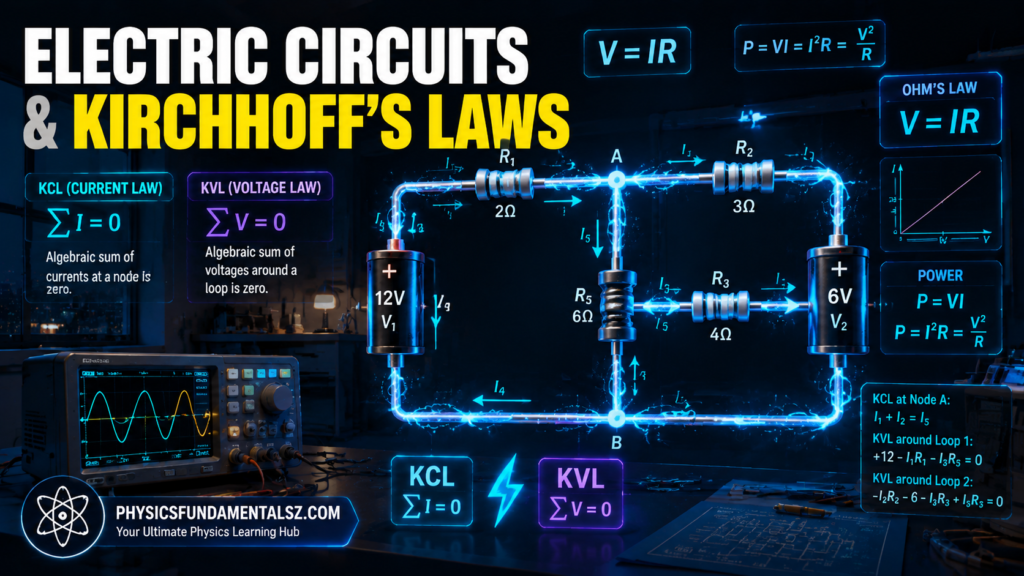
Kirchhoff’s laws are two rules used to analyze electrical circuits:
- Kirchhoff’s Current Law (KCL): The total current flowing into a junction equals the total current flowing out of it.
- Kirchhoff’s Voltage Law (KVL): The sum of all voltage changes around any closed loop in a circuit equals zero.
Together, KCL and KVL let you calculate unknown currents and voltages in circuits that are too complex for Ohm’s Law alone.
A Short History
Gustav Kirchhoff, a German physicist, published these two laws in 1845 while still a student. He built on Georg Ohm’s earlier work on resistance and current, and his laws later turned out to be consistent with James Clerk Maxwell’s equations, published roughly 15 years afterward. Kirchhoff’s laws remain the foundation of modern circuit analysis, used in everything from textbook problems to professional circuit-simulation software.
Kirchhoff’s Current Law (KCL)
Definition
Kirchhoff’s Current Law, also called the junction rule or Kirchhoff’s first law, states that at any node (a point where two or more wires meet), the current flowing in must equal the current flowing out. Nothing is created or destroyed — it’s simply a statement of conservation of electric charge.
Formula
$$\sum I_{in} = \sum I_{out}$$
Or, treating incoming current as positive and outgoing current as negative:
$$\sum_{n=1}^{N} I_n = 0$$
Example
Imagine a junction where a single wire carrying 6 A splits into two branches. If one branch carries 2 A, the other must carry 4 A, because 6 A must leave the junction just as it entered.
Kirchhoff’s Voltage Law (KVL)
Definition
Kirchhoff’s Voltage Law, also called the loop rule or Kirchhoff’s second law, states that if you add up every voltage rise and every voltage drop as you travel around any closed loop in a circuit, the total is zero. This reflects conservation of energy — a charge that returns to its starting point has gained and lost equal amounts of energy along the way.
Formula
$$\sum_{n=1}^{N} V_n = 0$$
Example
In a simple loop with one 9 V battery and two resistors in series, the voltage drops across the two resistors must add up to exactly 9 V — matching the voltage supplied by the battery.
Sign Conventions (Where Most Students Go Wrong)

Getting signs right is the single biggest source of errors when applying KVL and KCL. Use these consistent rules:
- For KCL: Pick a direction for each unknown current. Currents flowing into the node are positive; currents flowing out are negative (or vice versa — just stay consistent).
- For KVL: Choose a direction to “walk” around the loop (clockwise or counter-clockwise).
- Moving across a resistor in the direction of assumed current = voltage drop (−).
- Moving across a resistor against the assumed current = voltage rise (+).
- Moving from − to + terminal inside a battery = voltage rise (+).
- Moving from + to − terminal inside a battery = voltage drop (−).
If your final answer for a current comes out negative, it simply means the actual current flows opposite to the direction you assumed — the magnitude is still correct.
How to Solve a Circuit Using Kirchhoff’s Laws (Step by Step)
- Label all currents and their assumed directions on the circuit diagram.
- Identify all nodes and apply KCL at each one (except one, which is redundant).
- Identify all independent loops and apply KVL to each.
- Write out the system of equations from steps 2 and 3.
- Solve simultaneously using substitution, elimination, or matrix methods.
- Check your answer — currents in and out of every node should balance, and KVL should hold around every loop.
Worked Example: Two-Loop Circuit
Consider a circuit with two loops sharing a middle branch, containing two batteries (10 V and 4 V) and three resistors (2 Ω, 3 Ω, and 4 Ω).
Step 1 – Apply KCL at the shared node:
$$I_1 = I_2 + I_3$$
Step 2 – Apply KVL to Loop 1:
$$10 – 2I_1 – 4I_2 = 0$$
Step 3 – Apply KVL to Loop 2:
$$4I_2 – 3I_3 – 4 = 0$$
Step 4 – Solve the system:
| Variable | Result |
|---|---|
| I₁ | 1.6 A |
| I₂ | 1.4 A |
| I₃ | 0.2 A |
Step 5 – Verify: 1.6 A = 1.4 A + 0.2 A ✓ KCL holds. Plugging the values back into both loop equations confirms KVL holds as well.
KCL vs. KVL: Quick Comparison
| Feature | Kirchhoff’s Current Law (KCL) | Kirchhoff’s Voltage Law (KVL) |
|---|---|---|
| Full name | Kirchhoff’s First Law / Junction Rule | Kirchhoff’s Second Law / Loop Rule |
| Based on | Conservation of electric charge | Conservation of energy |
| Applies to | Nodes / junctions | Closed loops |
| Core statement | Current in = current out | Sum of voltages around a loop = 0 |
| Used in | Nodal analysis | Mesh analysis |
| Typical use case | Circuits with current splitting between branches | Circuits with multiple voltage sources in a loop |
Common Mistakes to Avoid
- Ignoring sign conventions — mixing up drops and rises is the #1 cause of wrong answers.
- Forgetting a node or loop — missing equations leave the system unsolvable.
- Applying KVL to an open path — the law only applies to closed loops.
- Not double-checking with KCL after solving with KVL (or vice versa) — always verify.
- Assuming current direction must be “correct” — a negative result is fine; it just flips the direction.
Real-World Applications
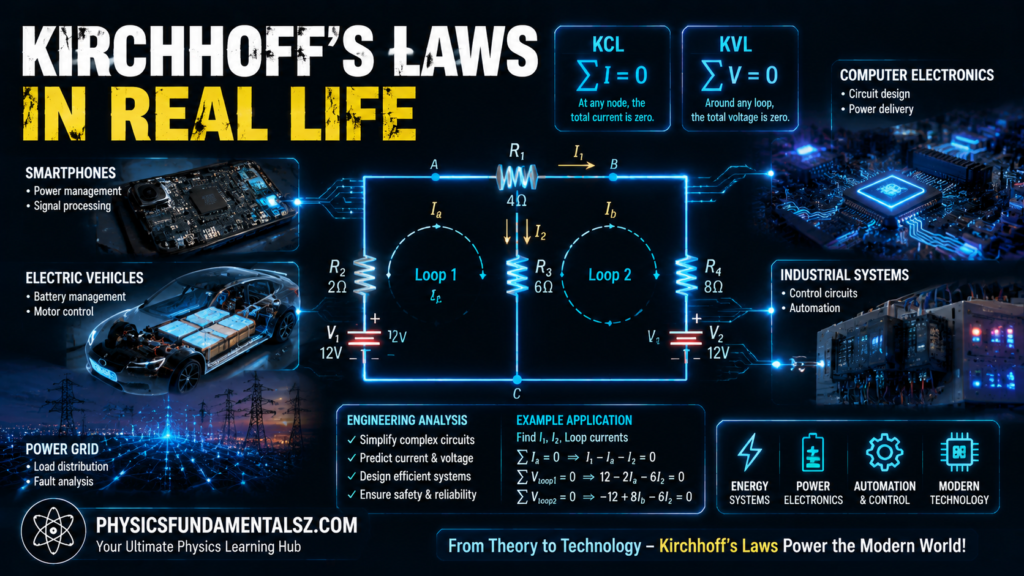
- Circuit board design: Engineers use KCL/KVL to ensure components receive the correct current and voltage.
- Power grid analysis: Utilities apply these laws at a large scale to balance load across transmission lines.
- Circuit simulation software (like SPICE): These tools solve KCL and KVL equations automatically for complex circuits.
- Troubleshooting electronics: Technicians use KVL to isolate faulty components by measuring where voltage doesn’t add up as expected.
- Renewable energy systems: Solar and battery systems rely on these laws to manage current from multiple parallel sources.
Frequently Asked Questions (FAQs)
What are Kirchhoff’s laws in simple terms?
They are two rules for analyzing circuits: current entering a junction must equal current leaving it (KCL), and the voltages around any closed loop must add up to zero (KVL).
Who discovered Kirchhoff’s laws?
German physicist Gustav Kirchhoff published both laws in 1845.
What is the difference between KCL and KVL?
KCL deals with current at a junction (conservation of charge); KVL deals with voltage around a closed loop (conservation of energy).
Why is KVL equal to zero?
Because a charge that travels around a closed loop and returns to its starting point ends up with the same energy it started with — so the total change in voltage is zero.
Can Kirchhoff’s laws be used for AC circuits?
Yes, both laws apply to AC circuits as long as the circuit dimensions are small compared to the wavelength of the signal, which is true for most practical electronics.
What is a node in Kirchhoff’s Current Law?
A node (or junction) is any point in a circuit where two or more circuit elements or wires connect.
What is a loop in Kirchhoff’s Voltage Law?
A loop is any closed path through a circuit that starts and ends at the same point.
Do Kirchhoff’s laws work with Ohm’s Law?
Yes — Kirchhoff’s laws are usually combined with Ohm’s Law (V = IR) to convert voltage drops into equations involving current and resistance.
What happens if a calculated current is negative?
It means the actual current flows opposite to the direction you originally assumed; the magnitude is still correct.
Is Kirchhoff’s Current Law the same as conservation of charge?
Yes, KCL is a direct application of the conservation of electric charge principle.
Is Kirchhoff’s Voltage Law the same as conservation of energy?
Yes, KVL reflects the conservation of energy as charge moves through a circuit.
What is mesh analysis?
Mesh analysis is a circuit-solving technique that applies KVL systematically to each independent loop in a circuit.
What is nodal analysis?
Nodal analysis is a circuit-solving technique that applies KCL systematically at each node in a circuit.
Can Kirchhoff’s laws be applied to circuits with multiple batteries?
Yes — that’s actually where they’re most useful, since Ohm’s Law alone can’t solve circuits with more than one voltage source.
Are Kirchhoff’s laws exact or approximate?
They are exact for DC circuits and highly accurate for AC circuits at frequencies where the circuit is small relative to the signal’s wavelength.
What’s the practical difference between using KCL vs. KVL to solve a circuit?
KCL-based nodal analysis is often faster for circuits with many parallel branches, while KVL-based mesh analysis is often faster for circuits with several loops and voltage sources.
Do Kirchhoff’s laws apply to non-linear components like diodes?
Yes, both laws still hold regardless of whether components are linear or non-linear; only the equations used to describe the components change.
How many independent equations do I need to solve a circuit?
You typically need one fewer KCL equation than the number of nodes, plus enough independent KVL equations to cover every loop, matching the number of unknown currents.
Why do we need both laws instead of just one?
Circuits usually have more unknowns than a single law can solve for; using KCL and KVL together provides enough independent equations to find every current and voltage.
What tools help apply Kirchhoff’s laws to complex circuits?
Circuit simulation software such as SPICE, MATLAB/Simulink, and various free online circuit simulators automate KCL/KVL calculations for large networks.
Conclusion
Kirchhoff’s current and voltage laws turn even a tangled multi-loop circuit into a solvable system of equations.
Master the sign conventions, practice writing KCL equations at each node and KVL equations around each loop, and you’ll be able to analyze circuits far beyond what Ohm’s Law can handle alone.