Power in Electrical Circuits: P = IV = I²R = V²/R Explained
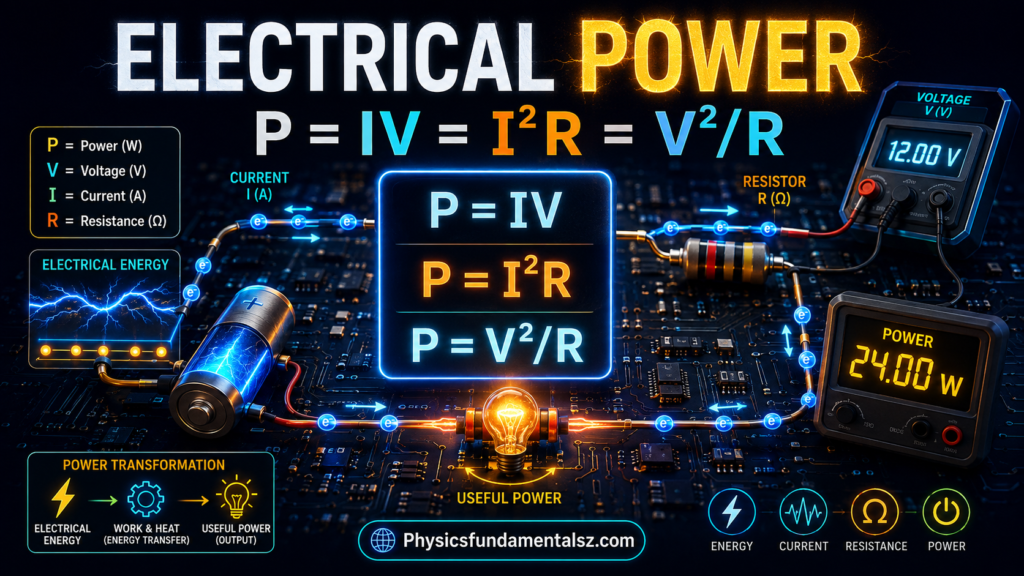
Power in Electrical Circuits is the rate at which electrical energy is converted into another form of energy — heat, light, or motion — measured in watts (W). The core formula is P = V × I, where P is power, V is voltage, and I is current.
Using Ohm’s Law (V = IR), this can also be written as P = I²R or P = V²/R. All three formulas give the same answer; you simply pick the one that matches the values you already know.
If you only remember one thing from this guide, remember this: power tells you how fast energy moves through a circuit, while energy tells you how much was used in total.
Table of Contents
What Is Power in Electrical Circuits?
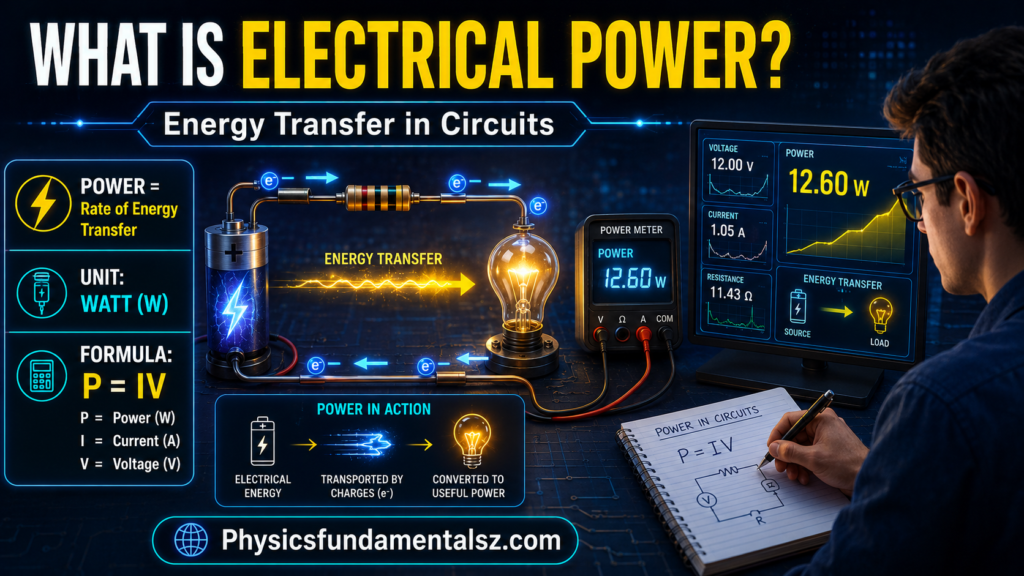
Every time current flows through a component, energy is transferred. A light bulb turns electrical energy into light and heat. A motor turns it into motion. A resistor turns it into heat alone. Electrical power measures how quickly that transfer happens.
The standard unit of power is the watt (W), named after James Watt. One watt equals one joule of energy transferred per second (1 W = 1 J/s). So a 100 W bulb converts 100 joules of electrical energy into light and heat every single second it’s switched on.
It helps to separate two ideas that people often blur together:
- Voltage is the “push” behind the current — the potential energy per unit charge.
- Current is how fast charge is actually moving through the circuit.
- Power is what happens when you combine the two: it’s the rate at which that push and that flow do useful (or wasted) work.
Neither voltage nor current alone tells you the power. You need both.
The Power Formula (P = VI) and Its Two Other Forms
The foundational electrical power formula is:
P = V × I
- P = power, in watts (W)
- V = voltage, in volts (V)
- I = current, in amperes (A)
Because Ohm’s Law states that V = I × R, you can substitute that into the power formula to get two more versions — useful when you don’t directly know both voltage and current:
| Formula | Use When You Know | Formula |
|---|---|---|
| P = VI | Voltage and current | P = V × I |
| P = I²R | Current and resistance | P = I × I × R |
| P = V²/R | Voltage and resistance | P = V × V ÷ R |
All three are mathematically equivalent — they’ll always agree if the circuit values are consistent. Pick whichever one matches the two quantities you already have.
Where This Formula Came From
The V×I relationship is often credited to Ohm’s Law, but the specific link between power dissipation and current through resistance — P = I²R — is actually Joule’s Law, published by physicist James Prescott Joule in 1841. Because it’s so tightly connected to Ohm’s Law equations, the two are frequently discussed together, but they’re distinct discoveries.
How Power Relates to Voltage, Current & Resistance
It’s worth building intuition, not just memorizing formulas.
- Power increases when current increases (for a fixed voltage) — more charge flowing per second means more energy transferred per second.
- Power increases when voltage increases (for a fixed current) — a stronger “push” moving the same amount of charge does more work per second.
- Power and resistance have a two-sided relationship. Using P = I²R, more resistance means more power dissipated if current stays constant. But using P = V²/R, more resistance means less power if voltage stays constant. This isn’t a contradiction — it depends on which variable (current or voltage) is being held fixed in the situation you’re analyzing.
Common point of confusion: People ask why an incandescent bulb dims right before it burns out. As the filament degrades, its resistance changes, altering the current draw at a fixed household voltage — which changes the power (and light output) even though the voltage from the wall never changes.
Types of Electrical Power: DC vs AC
The P = VI formula is exact and straightforward for DC (direct current) circuits — think batteries, simple resistive loads, and low-voltage electronics.
AC (alternating current) circuits, like the power coming out of a household wall outlet, are more nuanced:
- For purely resistive AC loads (space heaters, incandescent bulbs), P = VI still works, as long as you use RMS (root-mean-square) voltage and current values, not peak values.
- For loads with inductance or capacitance (motors, transformers, most electronics with power supplies), you need to distinguish between three kinds of power:
| Power Type | What It Means | Unit |
|---|---|---|
| Real (active) power | The power actually doing useful work or being converted to heat | Watts (W) |
| Reactive power | Power that oscillates back and forth without doing net work | Volt-amps reactive (VAR) |
| Apparent power | The combination of real and reactive power — what the supply must be capable of delivering | Volt-amps (VA) |
The ratio of real power to apparent power is called the power factor. A power factor of 1.0 means all delivered power is doing useful work; anything lower means some capacity is “wasted” moving reactive power back and forth, which is why utilities and equipment datasheets care about it.
Power in Series vs Parallel Circuits
Total circuit power always equals the sum of the power dissipated by each individual component — that principle doesn’t change based on circuit topology. But how you calculate it per component differs:
| Circuit Type | Current | Voltage | Power Calculation Approach |
|---|---|---|---|
| Series | Same current through every component | Voltage divides across components | Find voltage drop across each resistor, then use P = VI or P = I²R per component |
| Parallel | Current divides across branches | Same voltage across every branch | Find current through each branch, then use P = VI or P = V²/R per branch |
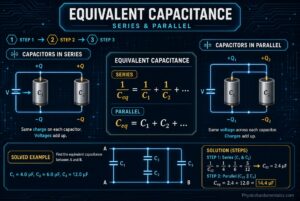
Key takeaway: whichever topology you’re working with, total power = P₁ + P₂ + P₃ … for every component in the circuit. Energy doesn’t disappear or get double-counted; it’s simply distributed differently depending on how components are wired.
Worked Examples
Example 1 — Given voltage and current: A device draws 5 A from a 120 V household outlet. P = V × I = 120 × 5 = 600 W
Example 2 — Given current and resistance: A heating element has a resistance of 10 Ω and carries 2 A. P = I²R = (2)² × 10 = 4 × 10 = 40 W
Example 3 — Given voltage and resistance: A 60 W bulb runs on 230 V mains. Current: I = P/V = 60/230 ≈ 0.26 A Resistance: R = V²/P = 230²/60 ≈ 882 Ω
Example 4 — Finding energy from power: A resistor dissipates 108 W of power for one minute (60 seconds). Energy = P × t = 108 × 60 = 6,480 joules
These examples cover the three most common “solve for the missing variable” scenarios you’ll encounter in coursework or real circuit troubleshooting.
Power Rating & Circuit Safety
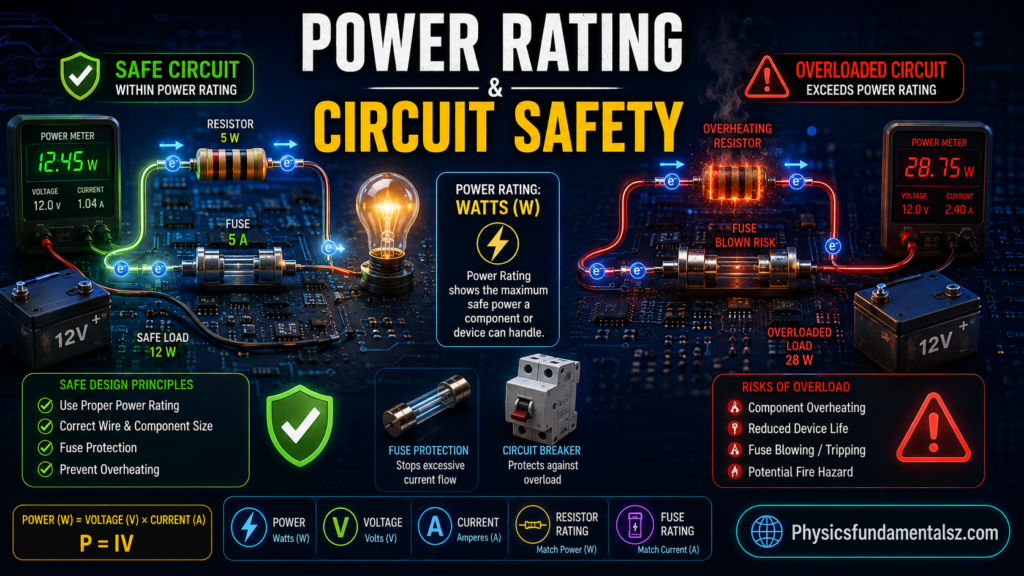
Every real-world component — resistors, wires, fuses, circuit breakers — has a maximum power (or current) rating. Exceeding it causes overheating, which can damage components or start a fire.
- A 1/4 W resistor can safely dissipate up to 0.25 W; push more power through it and it will overheat.
- Circuit breakers and fuses are rated in amps, not watts, but the underlying concern is the same: too much current through a wire means too much I²R heating in that wire.
- This is also why high-voltage transmission lines exist: for a fixed amount of power delivered, raising the voltage lowers the current needed (since P = VI), and lower current means far less power wasted as heat in the transmission cables (since losses follow P = I²R).
Best practice: always leave a safety margin. Engineers commonly rate components at only 50–70% of their maximum power rating for continuous-duty applications, since real-world conditions (ambient heat, tolerance variation) reduce the practical safe limit.
Power vs Energy — and Your Electric Bill
Power and energy are related but not the same thing, and mixing them up is one of the most common beginner mistakes.
- Power (watts) = the rate of energy transfer, at an instant.
- Energy (joules, or kilowatt-hours) = the total amount transferred over time.
The relationship: Energy = Power × Time (E = P × t)
Utility companies bill in kilowatt-hours (kWh) rather than joules because household energy use adds up to huge joule numbers. One kWh = 1,000 watts running for one hour = 3.6 million joules.
Quick cost example: A 1,500 W space heater run for 4 hours uses 1.5 kW × 4 h = 6 kWh. At $0.15/kWh, that’s $0.90 for that one session.
Common Mistakes to Avoid
- Confusing power and energy — a “60-watt bulb” describes its rate of consumption, not how much energy it has used in total.
- Using peak AC values instead of RMS values in the P = VI formula, which inflates the calculated power.
- Ignoring power factor in AC circuits with motors or electronics, leading to underestimating the apparent power a supply needs to deliver.
- Mismatched units — plugging in milliamps as if they were amps is a common error that produces answers 1,000× too large.
- Assuming resistance is constant — real components like light bulb filaments and thermistors change resistance with temperature, so power calculated at “nominal” resistance can be inaccurate under real operating conditions.
Best Practices for Working with Circuit Power

- Always double-check units before calculating: volts, amps, ohms — not millivolts, milliamps, or kilohms — unless you convert first.
- When given two known values, pick the power formula that uses those two directly rather than solving for a third variable first.
- For AC analysis, confirm whether a given voltage/current is peak or RMS before applying P = VI.
- When sizing a resistor or component for a design, build in a safety margin above the calculated power dissipation.
- Cross-check your answer using a second formula version (e.g., verify P = VI against P = I²R) to catch arithmetic errors.
Frequntly Asked Questions (FAQs)
What is power in an electrical circuit?
It’s the rate at which electrical energy is converted into another form, such as heat, light, or motion, measured in watts.
What is the formula for power in a circuit?
P = V × I is the primary formula; using Ohm’s Law it can also be written as P = I²R or P = V²/R.
What unit is electrical power measured in?
The watt (W), equal to one joule of energy transferred per second.
Is power the same as energy?
No. Power is the rate of energy transfer; energy is the total amount transferred over a given time (Energy = Power × Time).
How do you calculate power with voltage and current?
Multiply them directly: P = V × I.
How do you calculate power with current and resistance?
Use P = I²R — square the current, then multiply by resistance.
How do you calculate power with voltage and resistance?
Use P = V²/R — square the voltage, then divide by resistance.
Does higher resistance always mean higher power?
Not necessarily — it depends on whether current or voltage is held constant. With constant current, more resistance means more power (P=I²R). With constant voltage, more resistance means less power (P=V²/R).
Why do transmission lines use high voltage?
Raising voltage lowers the current needed to deliver the same power, which reduces I²R heating losses in the cables over long distances.
What is the difference between real power, reactive power, and apparent power?
Real power does useful work (measured in watts); reactive power oscillates without net work (measured in VAR); apparent power is their combination (measured in VA).
What is power factor?
The ratio of real power to apparent power. A power factor of 1.0 means all delivered power is being used productively.
Can power be negative in a circuit?
Yes — a negative calculated power indicates the component is a source (generating power, like a battery) rather than a load (absorbing power).
How do you find the power dissipated by a resistor?
Use P = I²R if you know the current through it, or P = V²/R if you know the voltage across it.
What is a power rating on a component?
The maximum power a component (like a resistor) can safely dissipate before overheating or failing.
How does power relate to an electricity bill?
Utilities bill based on energy used (kWh), which is power (kW) multiplied by the time (hours) it was used.
What is 1 kilowatt-hour equal to in joules?
1 kWh = 3.6 million joules (3.6 × 10⁶ J).
Why does a light bulb get dimmer before it burns out?
Its filament resistance changes as it degrades, altering current draw and therefore the power (and light output) at a fixed voltage.
What’s the difference between AC and DC power calculations?
DC power calculations use P = VI directly; AC calculations require RMS values and, for non-resistive loads, must account for power factor.
How is horsepower related to electrical watts?
1 horsepower ≈ 746 watts; divide watts by 746 to convert to horsepower.
What happens if you exceed a resistor’s power rating?
It overheats, which can damage the component, discolor or burn the circuit board, or create a fire risk.
Is more current always more dangerous than more voltage?
Both matter — power (and therefore heating/damage potential) depends on the combination of voltage and current, not either alone.
Conclusion
Power in electrical circuits comes down to one core idea: it’s the rate at which energy changes form as current flows.
Once you know the P = VI relationship — and how Ohm’s Law lets you rewrite it as P = I²R or P = V²/R — you can calculate power in almost any DC circuit scenario, size components safely, and understand why real-world systems (from transmission lines to your electricity bill) are designed the way they are.
For AC circuits, add RMS values and power factor to the same foundation, and the same core formula still gets you there.