Young’s Double-Slit Experiment: Fringe Formula, Proof & Applications
Physicist Richard Feynman once called this experiment the one phenomenon that “contains the only mystery” of quantum mechanics. That’s a bold claim for something you can recreate with a laser pointer and a piece of foil.
Young’s double-slit experiment is a landmark physics experiment, first performed by Thomas Young in 1801, that proved light behaves as a wave.
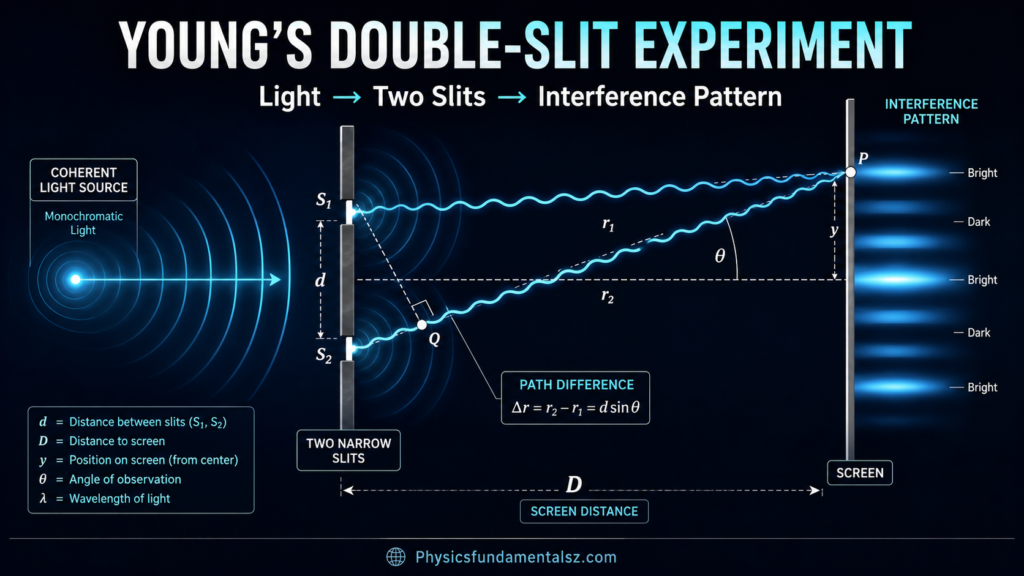
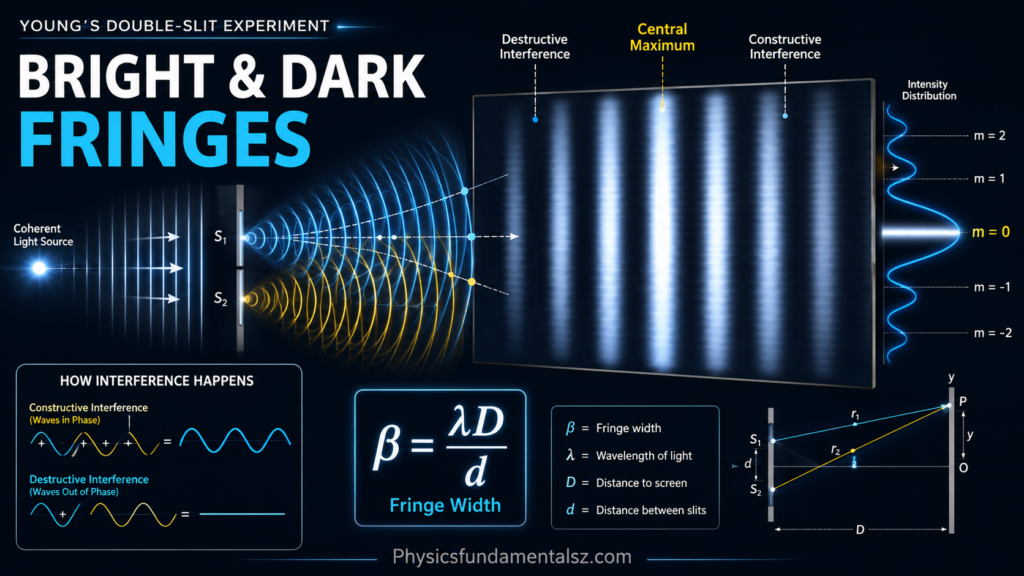
When coherent light passes through two closely spaced narrow slits, it produces a pattern of alternating bright and dark bands — called interference fringes — on a screen behind the slits.
Table of Contents
What Is Young’s Double-Slit Experiment? (Quick Definition)
Quick Answer: Young’s double slit experiment demonstrates the wave nature of light by passing coherent light through two narrow, closely spaced slits and observing the resulting interference pattern — alternating bright and dark fringes — on a screen. It was performed by Thomas Young in 1801 and remains a foundational demonstration in both classical optics and quantum mechanics.
The Experiment in Simple Terms
Picture two speakers playing the exact same musical note. In some spots in the room, the sound waves reinforce each other and get louder. In other spots, they cancel out and get quieter. Light does the same thing when it passes through two slits — the overlapping waves create bands of brightness and darkness instead of two simple stripes of light.
Why It Matters
Before Young’s experiment, most scientists — following Isaac Newton’s corpuscular theory — believed light was made of particles traveling in straight lines. Young’s interference pattern could only be explained if light behaved as a wave, making this one of the most consequential experiments in the history of optics.
Historical Background
Understanding the history helps explain why this single experiment carries so much scientific weight.
- Isaac Newton (1600s) — Proposed the corpuscular (particle) theory of light, which dominated scientific thinking for over a century.
- Christiaan Huygens (1678) — Proposed a competing wave theory of light, though it lacked strong experimental support at the time.
- Thomas Young (1801) — Performed the double-slit experiment, using sunlight diffracted through a small slit as a coherent light source, then projecting it through two closely spaced slits. He coined the term interference fringes to describe the resulting bands.
- Augustin-Jean Fresnel (early 1800s) — Built on Young’s work with a rigorous mathematical wave theory, further cementing the wave model of light.
- 20th century (quantum era) — The experiment was repeated with electrons (1927, and again more precisely in 1974), photons, and eventually large molecules, revealing that matter itself has wave-like properties — a discovery central to quantum mechanics.
How Young’s Double Slit Experiment Works
The Experimental Setup
- A coherent light source (originally sunlight through a narrow slit; today, typically a laser) illuminates a barrier containing two narrow, parallel slits, spaced a small distance apart.
- Light diffracts as it passes through each slit, causing it to spread out rather than travel in a straight line.
- The two diffracted waves overlap as they travel toward a screen placed some distance behind the slits.
- Where the overlapping waves are in phase, they combine constructively, producing a bright fringe. Where they’re out of phase, they cancel destructively, producing a dark fringe.
Constructive and Destructive Interference
Quick Answer: Constructive interference occurs when two waves arrive in phase and add together, producing a bright fringe. Destructive interference occurs when two waves arrive out of phase and cancel out, producing a dark fringe.
The key factor is the path difference — the difference in distance traveled by light from each of the two slits to a given point on the screen.
- Bright fringe (constructive interference): occurs when the path difference equals a whole number of wavelengths (0, λ, 2λ, 3λ…).
- Dark fringe (destructive interference): occurs when the path difference equals a half-integer number of wavelengths (λ/2, 3λ/2, 5λ/2…).
Why Coherence Matters
For a stable, observable interference pattern, the light from the two slits must be coherent — meaning the waves maintain a constant phase relationship with each other. This is why Young used a single, narrow slit to illuminate both double slits from one source, and why modern versions of the experiment typically use a laser, which produces naturally coherent light.
The Fringe Width Formula
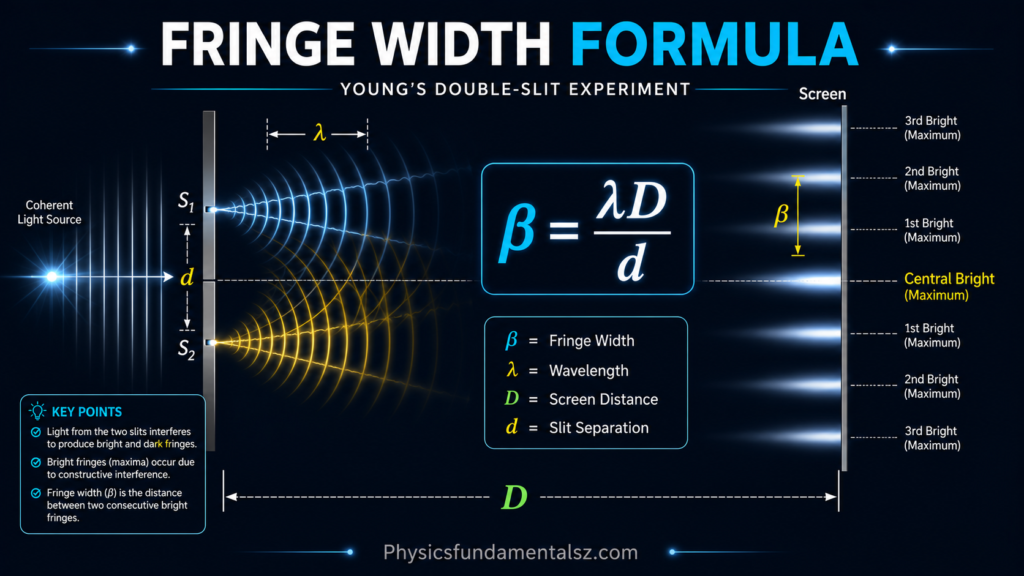
Quick Answer: Fringe width (β) is the distance between two consecutive bright or dark fringes. It’s calculated using the formula β = λD / d, where λ is the wavelength of light, D is the distance from the slits to the screen, and d is the separation between the two slits.
Formula Breakdown
| Symbol | Meaning | Typical Unit |
|---|---|---|
| β | Fringe width (spacing between fringes) | meters (m) |
| λ (lambda) | Wavelength of the light used | nanometers (nm) or meters (m) |
| D | Distance from the slits to the screen | meters (m) |
| d | Separation between the two slits | meters (m) or millimeters (mm) |
This relationship also works in reverse: if you measure the fringe width, slit separation, and screen distance, you can calculate the wavelength of the light source using λ = βd / D — a technique still used in introductory optics labs today.
Worked Example
Suppose a laser with a wavelength of λ = 650 nm (red light) illuminates two slits separated by d = 0.5 mm, with a screen placed D = 1.5 m away.
β = λD / d = (650 × 10⁻⁹ × 1.5) / (0.5 × 10⁻³)
β ≈ 1.95 mm
That means each bright fringe on the screen would appear roughly 2 millimeters apart from the next — easily visible to the naked eye in a darkened room.
What Affects Fringe Width
| Factor | Effect on Fringe Width |
|---|---|
| Increasing wavelength (λ) | Fringe width increases (fringes spread further apart) |
| Increasing slit separation (d) | Fringe width decreases (fringes get closer together) |
| Increasing screen distance (D) | Fringe width increases (fringes spread further apart) |
| Performing the experiment in water instead of air | Fringe width decreases, since the effective wavelength shortens in a denser medium |
Young’s Double Slit Experiment vs. Related Phenomena
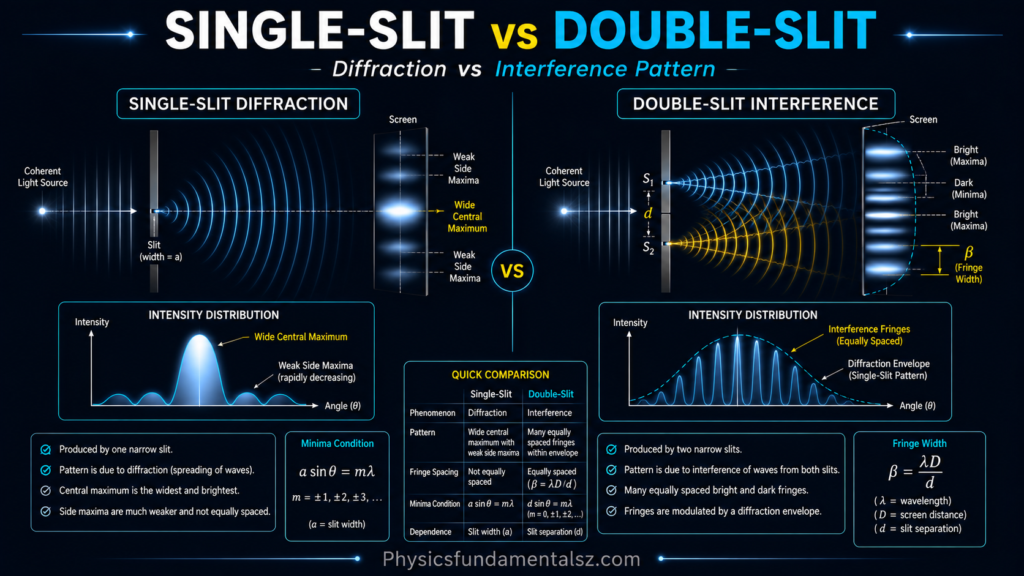
It’s easy to confuse this experiment with related optical concepts. Here’s a clear breakdown.
| Concept | What It Involves | How It Relates to Young’s Experiment |
|---|---|---|
| Diffraction | Bending/spreading of a wave through an opening or around an obstacle | Each individual slit diffracts the light before it interferes with light from the other slit |
| Interference | Two or more waves overlapping and combining | The core phenomenon Young’s experiment demonstrates |
| Single-slit diffraction pattern | A wave passing through one narrow opening | Produces a broader central band without the fine fringe structure of two slits |
| Diffraction grating | Many closely spaced slits | An extension of the double-slit setup, producing sharper, brighter spectral lines |
Young’s Experiment vs. Diffraction Gratings
Quick Answer: A diffraction grating is essentially Young’s double-slit setup scaled up to hundreds or thousands of slits, producing much sharper and brighter fringes — which is why gratings, not simple double slits, are used in real-world spectrometers.
The Quantum Version: Single Particles and Wave-Particle Duality
This is where Young’s simple 1801 experiment becomes genuinely mind-bending.
What Happens When You Fire One Particle at a Time?
Quick Answer: Even when photons or electrons are fired through the double slits one at a time, individual particles still build up the same interference pattern over time — proving each particle behaves as a wave that passes through both slits simultaneously.
This result, first clearly demonstrated with electrons in 1974, is one of the most direct pieces of experimental evidence for wave-particle duality in quantum mechanics. It shows that matter, not just light, has wave-like properties.
The Observer Effect
Quick Answer: If you place a detector at the slits to determine which slit each particle passes through, the interference pattern disappears, and the particles behave like simple particles instead — a phenomenon known as the observer effect or the collapse of the wave function.
This detail is what led Richard Feynman to describe the double-slit experiment as containing “the heart of quantum mechanics” — measuring which path a particle takes destroys the wave-like interference behavior.
Modern Extensions
Physicists have since performed double-slit-style experiments with:
- Electrons — confirming matter waves at the subatomic scale.
- Neutrons — extending the result to another fundamental particle.
- Large molecules — including buckminsterfullerene (C60) and even larger molecules composed of thousands of atoms, pushing the boundary of how “large” an object can be while still showing quantum wave behavior.
- Surface acoustic waves and other engineered wave systems — used in ongoing physics research to study interference in new physical platforms.
Real-World Applications and Significance
- Foundational proof of the wave theory of light — Young’s result was the decisive evidence that shifted scientific consensus away from Newton’s particle theory.
- Wavelength measurement — the fringe width formula lets scientists determine the wavelength of an unknown light source with simple, low-cost equipment.
- Quantum mechanics education and research — the single-particle version of the experiment is one of the clearest demonstrations of wave-particle duality available.
- Foundation for diffraction gratings and spectrometers — the same interference principles scale up into instruments used in spectroscopy, astronomy, and materials science.
- Interferometry — modern instruments like the Laser Interferometer Gravitational-Wave Observatory (LIGO) rely on interference principles closely related to Young’s original demonstration.
How to Recreate the Experiment (Simple Version)
You don’t need a research lab to see this phenomenon yourself.
- Get a coherent light source. A basic laser pointer works well and is far easier to use than Young’s original sunlight-through-a-slit setup.
- Create two narrow, closely spaced slits. Carefully cut two thin parallel slits in a piece of aluminum foil or opaque card, spaced roughly half a millimeter apart.
- Shine the laser through the slits in a darkened room, onto a wall or screen placed at least a meter away.
- Observe the pattern. You should see a series of evenly spaced bright and dark bands rather than two simple bright lines.
- Experiment with variables. Try changing the slit separation or screen distance and observe how the fringe spacing changes, matching the predictions of the β = λD/d formula.
Safety tip: Never point a laser directly at your eyes or anyone else’s, even a low-powered laser pointer.
Common Mistakes and Misconceptions
- Mistake: Assuming the double-slit experiment only demonstrates interference. Reality: Diffraction at each individual slit is what allows the two beams to overlap and interfere in the first place — both effects are involved.
- Mistake: Believing brighter light produces wider fringe spacing. Reality: Intensity does not affect fringe width — only wavelength, slit separation, and screen distance do.
- Mistake: Thinking the quantum version only works with photons. Reality: The same interference pattern has been demonstrated with electrons, neutrons, and even large molecules.
- Mistake: Assuming the pattern disappears immediately with a single particle. Reality: A single particle produces one dot on the screen; the interference pattern only emerges after many particles accumulate over time.
Expert Tips
- If you’re a student solving fringe-width problems, always double-check your units — wavelength is usually given in nanometers but needs to be converted to meters before using it in the β = λD/d formula.
- Remember that path difference, not distance alone, determines whether a point on the screen is bright or dark. A path difference of a whole wavelength always gives constructive interference, regardless of the absolute distances involved.
- When explaining the quantum version to a beginner audience, focus on the observer effect — it’s the single most compelling detail that makes the experiment memorable and demonstrates real quantum weirdness.
Key Takeaways
- Young’s double slit experiment, performed in 1801, was the first strong evidence that light behaves as a wave.
- Coherent light passing through two closely spaced slits produces alternating bright and dark interference fringes.
- Fringe width is calculated using β = λD / d.
- Bright fringes occur where path difference equals a whole number of wavelengths; dark fringes occur at half-wavelength differences.
- When repeated with single particles (electrons, photons), the interference pattern still builds up over time — strong evidence for wave-particle duality.
- Attempting to detect which slit a particle passes through destroys the interference pattern (the observer effect).
- The experiment underlies modern technologies including spectrometers, diffraction gratings, and interferometry.
Frequently Asked Questions (FAQs)
1. What is Young’s double slit experiment?
It’s a landmark 1801 experiment by Thomas Young that demonstrated the wave nature of light by passing it through two closely spaced slits and observing an interference pattern of bright and dark fringes.
2. Who performed the double slit experiment?
Thomas Young, an English physicist, first performed the experiment in 1801, using sunlight diffracted through a narrow slit as a coherent light source.
3. What does Young’s double slit experiment prove?
It proves that light behaves as a wave, since the resulting interference pattern of bright and dark fringes can only be explained by wave behavior, not simple particle motion.
4. What is the formula for fringe width in Young’s double slit experiment?
Fringe width is given by β = λD / d, where λ is wavelength, D is the distance from slits to screen, and d is the slit separation.
5. What causes bright and dark fringes?
Bright fringes occur where light waves from the two slits arrive in phase (constructive interference); dark fringes occur where they arrive out of phase (destructive interference).
6. What is path difference in the double slit experiment?
Path difference is the difference in distance traveled by light from each of the two slits to a specific point on the screen; it determines whether that point is bright or dark.
7. Why do the slits need to be narrow and closely spaced?
Narrow slits cause diffraction, allowing the light to spread out and overlap; close spacing ensures the resulting fringe pattern is wide enough to observe clearly.
8. What is coherent light, and why is it needed?
Coherent light maintains a constant phase relationship between waves, which is essential for producing a stable, observable interference pattern.
9. What happens if you use white light instead of monochromatic light?
White light produces overlapping fringe patterns for each wavelength it contains, resulting in a colored central fringe surrounded by blurred, less distinct fringes further out.
10. Does the double slit experiment work with electrons?
Yes. When electrons are fired through a double slit, they build up the same interference pattern over time, proving that matter has wave-like properties.
11. What happens if you try to observe which slit a particle passes through?
Observing or measuring which slit a particle passes through destroys the interference pattern, causing the particles to behave like classical particles instead — known as the observer effect.
12. Can the experiment be performed with single photons?
Yes. Even when photons are sent through the slits one at a time, an interference pattern gradually builds up on the detector after many photons are recorded.
13. What is the difference between diffraction and interference in this experiment?
Diffraction is the spreading of light as it passes through each individual slit; interference is the combination of the two diffracted waves to form the fringe pattern.
14. Does slit separation affect fringe width?
Yes. Increasing the slit separation (d) decreases the fringe width, making the bright and dark bands closer together.
15. Does the distance to the screen affect fringe width?
Yes. Increasing the distance from the slits to the screen (D) increases the fringe width, spreading the bands further apart.
16. Why is the central fringe always bright?
The central point on the screen has zero path difference between the two slits, meeting the condition for constructive interference and appearing as the brightest fringe.
17. What is the significance of Young’s experiment in quantum mechanics?
The single-particle version of the experiment provides direct evidence of wave-particle duality, a foundational concept in quantum mechanics.
18. What is the largest object shown to exhibit double-slit interference?
Large molecules composed of thousands of atoms, including buckminsterfullerene (C60) and larger, have shown interference patterns in modified double-slit experiments.
19. How is Young’s experiment different from a diffraction grating experiment?
A diffraction grating uses hundreds or thousands of slits instead of two, producing much sharper and brighter interference fringes than the basic double-slit setup.
20. What real-world instruments rely on principles from this experiment?
Spectrometers, diffraction gratings, and interferometers (including gravitational-wave detectors like LIGO) all rely on interference principles closely related to Young’s experiment.
21. Can you measure the wavelength of light using this experiment?
Yes. By measuring the fringe width, slit separation, and screen distance, you can calculate the wavelength using λ = βd / D.
22. Does performing the experiment in water change the results?
Yes. Since light’s effective wavelength is shorter in water than in air, the fringe width becomes narrower when the experiment is performed underwater.
23. What equipment is needed for a simple version of the experiment?
A coherent light source (such as a laser pointer), a barrier with two closely spaced narrow slits, and a screen or wall placed some distance away.
24. Is Young’s double slit experiment still relevant today?
Yes. It remains a core topic in physics education and continues to be adapted in cutting-edge quantum research involving electrons, neutrons, and large molecules.
Conclusion
Young’s double slit experiment is deceptively simple to set up, yet it fundamentally changed how physicists understand light and matter.
From proving the wave theory of light in 1801 to revealing wave-particle duality with individual electrons more than a century later, this single experiment bridges classical optics and modern quantum mechanics.
Whether you’re calculating fringe width for a physics assignment or trying to wrap your head around why observation itself changes the outcome, understanding this experiment gives you a genuine window into how light — and reality itself — behaves at the smallest scales.