Gravitational Fields: g = GM/r², Field Lines & Orbital Speed
Understanding gravitational fields means understanding why objects fall the way they do, why satellites stay in orbit, and why the strength of gravity changes depending on where you stand.
Drop a pen, watch the Moon orbit the Earth, or look up at the tides rolling in, and you are witnessing the same invisible influence at work. That influence is described by gravitational fields, one of the most fundamental concepts in classical mechanics.
Every object with mass creates one, and every object with mass responds to one, whether it is a falling apple, a planet, or an entire galaxy.
Table of Contents
What Is a Gravitational Field?
A gravitational field is a region of space surrounding any object with mass, in which another object with mass experiences a gravitational force. It is the way physics describes action at a distance, since two masses can attract each other without physically touching.
Every object with mass, from a grain of sand to a star, produces a gravitational field. The strength of that field depends on two things: the mass of the object creating it, and the distance from that object. A more massive body produces a stronger field, and the field weakens the further away you move from it.
Rather than thinking of gravity as a mysterious pull acting instantly across empty space, physicists picture a gravitational field as a property of space itself, one that tells any mass placed within it exactly which way to accelerate, and how strongly.
Gravitational Field Strength
The strength of a gravitational field at any point is defined as the gravitational force experienced per unit mass placed at that point. This quantity is known as gravitational field strength, given the symbol g, and it is measured in newtons per kilogram (N/kg), which is equivalent to metres per second squared (m/s²).
g = F / m
Here F is the gravitational force acting on an object, and m is the mass of that object. Rearranging this relationship shows why every object, regardless of its own mass, falls with the same acceleration in a given gravitational field. A heavier object experiences a proportionally larger force, but since gravitational field strength divides that force by mass, the two effects cancel out. This is why a feather and a bowling ball, dropped in a vacuum, hit the ground at exactly the same time.
Near the Earth’s surface, gravitational field strength has a value of approximately 9.8 N/kg, which is why the familiar value g = 9.8 m/s² appears throughout mechanics, from projectile motion to the gravitational potential energy formula.
The Gravitational Field Strength Formula
To calculate gravitational field strength directly from the mass creating the field, physicists use Newton’s law of universal gravitation:
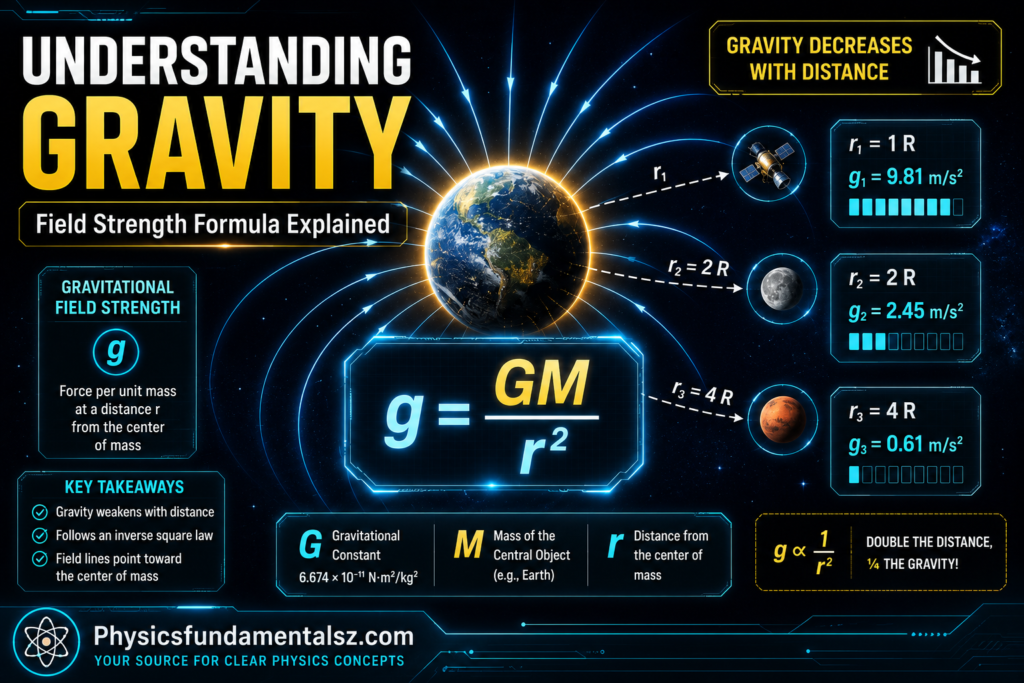
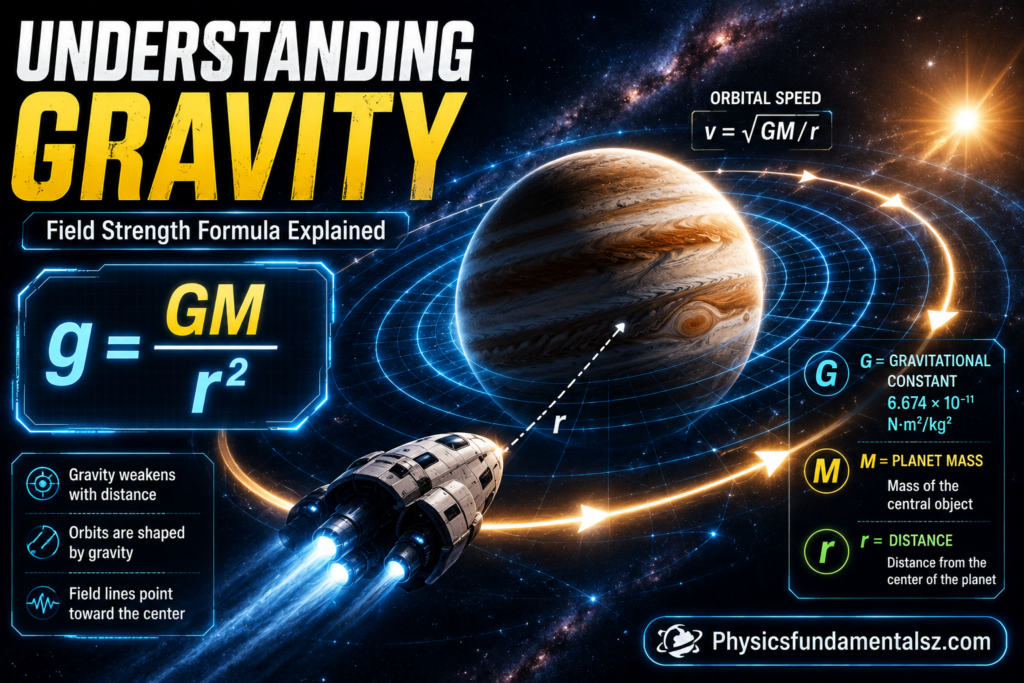
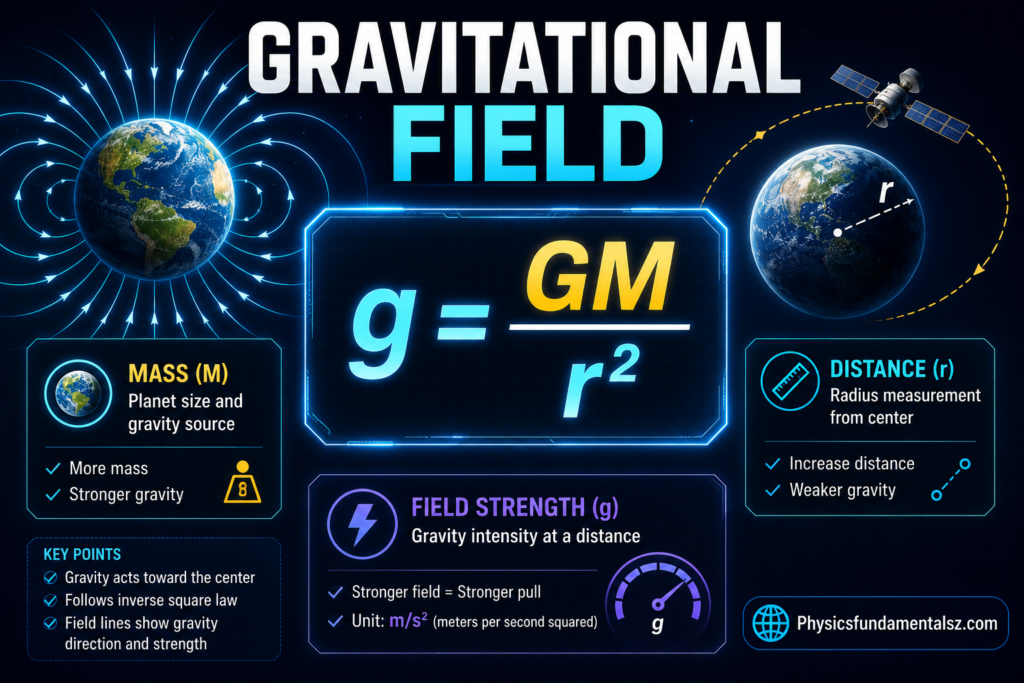
g = G · M / r²
- G is the universal gravitational constant, approximately 6.674 × 10⁻¹¹ N·m²/kg².
- M is the mass of the object producing the field, such as a planet or star.
- r is the distance from the centre of that mass to the point where the field is being measured.
This formula reveals the inverse square law at the heart of gravitational fields: double the distance from a planet, and the gravitational field strength drops to a quarter of its original value. Triple the distance, and it falls to a ninth. This rapid weakening with distance explains why astronauts feel dramatically less gravitational pull once they leave low orbit, even though the Earth’s mass has not changed at all.
Uniform Fields vs Radial Fields
Gravitational fields come in two main forms, depending on how far you are from the source and how the field behaves across that region of space.
Uniform gravitational fields occur when the field strength is essentially constant over the region being considered. Near the Earth’s surface, over the height of a building or even a mountain, gravitational field strength barely changes, so it is treated as uniform. In diagrams, a uniform field is shown with parallel, evenly spaced field lines pointing straight down, indicating that the force on any mass is the same magnitude and direction everywhere in that region.
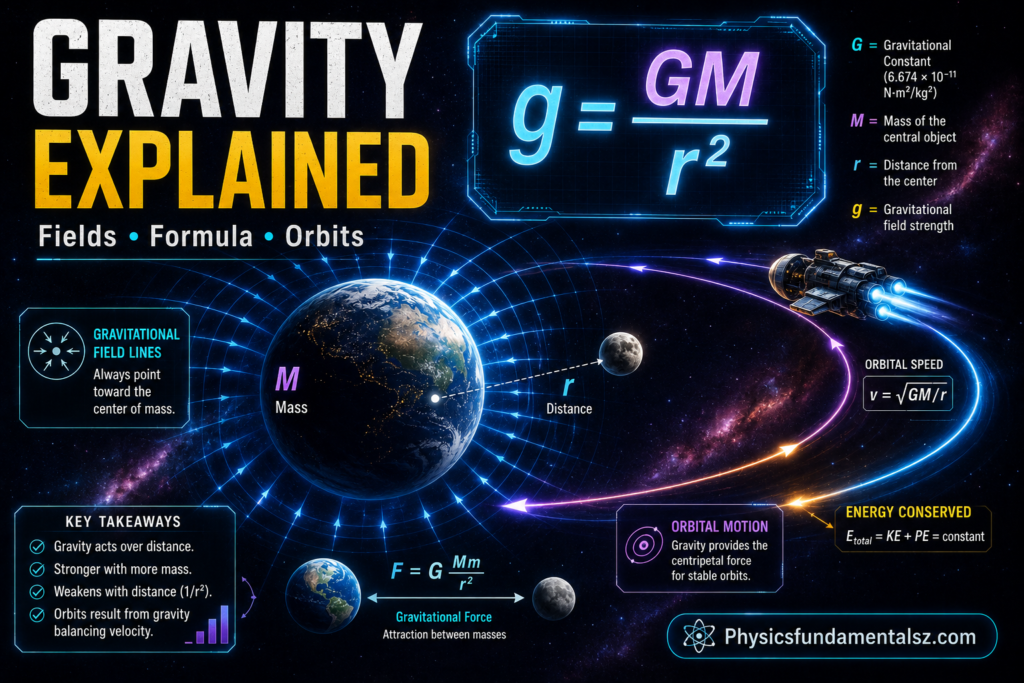
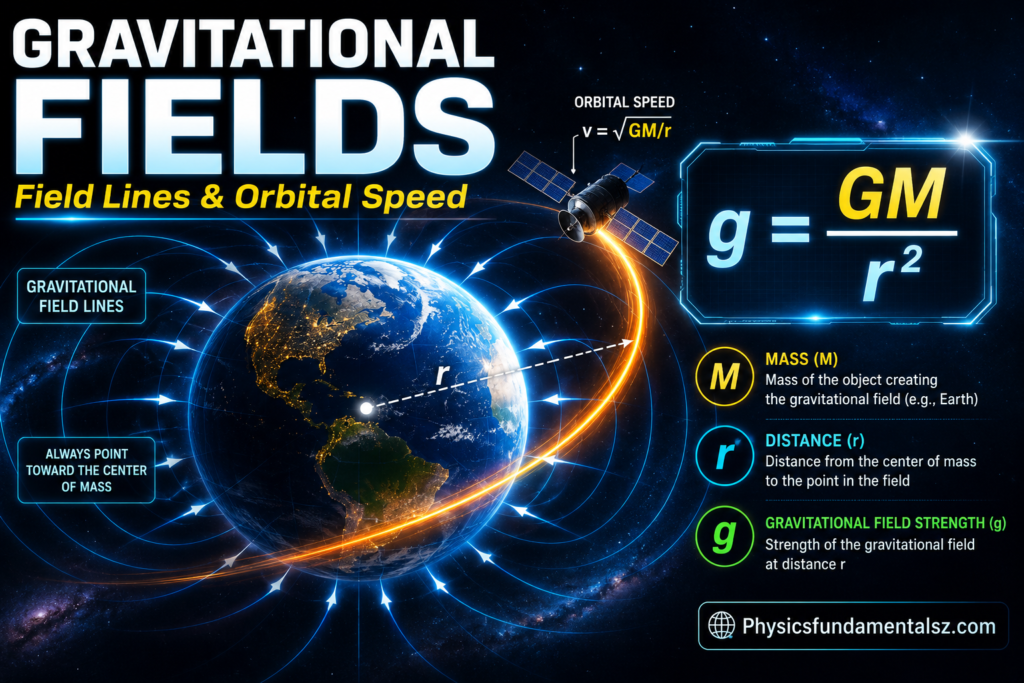
Radial gravitational fields occur around a point mass or a spherical body when considered over larger distances, such as a planet viewed from space. Here, the field lines spread outward like spokes from the centre of the mass, converging as they approach it and spreading apart as distance increases. This spreading illustrates the inverse square law directly: the field lines become less densely packed further from the source, matching the weakening field strength described by g = GM/r².
Most introductory problems near Earth’s surface use the uniform field approximation, while problems involving satellites, orbits, and planetary motion require the full radial field treatment.
Gravitational Field Lines
Gravitational field lines are a visual tool used to represent the direction and relative strength of a gravitational field at every point in space. A few key rules govern how they are drawn:
- Field lines always point in the direction a small test mass would accelerate if placed at that point, which for gravity always means toward the source of the field.
- Lines are drawn closer together where the field is stronger, and further apart where it is weaker.
- Field lines never cross, since a mass at any single point can only experience one net force in one direction.
For a point mass or spherical planet, these lines radiate inward toward the centre from every direction, forming the radial pattern described above. Close to a flat surface such as the ground, the same lines appear nearly parallel, which is exactly why the uniform field approximation works so well for everyday physics.
Newton’s Law of Universal Gravitation
Gravitational fields exist because of the underlying force described by Newton’s law of universal gravitation, one of the foundational results in classical mechanics. The law states that every mass attracts every other mass with a force proportional to the product of their masses and inversely proportional to the square of the distance between them:
F = G · M · m / r²
This single equation explains an enormous range of phenomena, from why apples fall to the ground to why planets stay in stable orbits around the Sun. Dividing this force by the mass of the smaller object, m, gives exactly the gravitational field strength formula shown earlier, g = GM/r², confirming that gravitational field strength is simply the force a unit mass would experience at a given point.
Key idea
A gravitational field is not something an object carries with it. It exists at every point in space around a mass, regardless of whether anything else is there to feel it. Only when a second mass is introduced does the field reveal itself as a measurable force.
Gravitational Fields and Gravitational Potential Energy
Gravitational fields and gravitational potential energy describe the same underlying phenomenon from two different angles. A gravitational field tells you the force per unit mass at a point in space. Gravitational potential energy tells you how much energy an object has stored because of its position within that field.
Near the Earth’s surface, where the field is treated as uniform, this connection produces the familiar formula GPE = mgh, explored in detail in our guide to gravitational potential energy. Over larger distances, where the field is radial and weakens with distance, the more general potential energy formula U = -GMm/r applies instead, matching the changing field strength described by g = GM/r².
This relationship also explains escape velocity, since escaping a gravitational field entirely means gaining enough kinetic energy to overcome all of the gravitational potential energy holding an object in place. You can explore this using the escape velocity and gravitational potential energy calculators on our physics calculators page.
A Worked Example of Gravitational Field Strength
Numbers make the inverse square law concrete. Suppose you want to calculate the gravitational field strength at the surface of Mars, given that Mars has a mass of about 6.42 × 10²³ kg and a radius of about 3.39 × 10⁶ m.
Using the formula:
g = G · M / r² g = (6.674 × 10⁻¹¹) × (6.42 × 10²³) / (3.39 × 10⁶)² g ≈ 3.71 N/kg
This confirms why objects on Mars weigh roughly 38 percent of what they weigh on Earth. Since gravitational field strength depends only on the mass and radius of the planet, the same formula works for any celestial body, from the Moon to Jupiter, simply by substituting different values of M and r.
A second useful comparison shows how quickly gravitational field strength changes with altitude. At Earth’s surface, g is approximately 9.8 N/kg. At an altitude of 400 km, roughly where the International Space Station orbits, the distance from Earth’s centre increases from about 6,371 km to 6,771 km. Recalculating with the inverse square law gives a gravitational field strength of about 8.7 N/kg, still substantial, which is why astronauts in low orbit are not weightless because gravity has vanished, but because they are continuously falling around the Earth.
Common Mistakes When Working With Gravitational Fields
- Confusing gravitational field strength with gravitational force. Field strength (g) is force per unit mass, measured in N/kg, while force (F) depends on the specific mass placed in the field, measured in newtons. Forgetting to divide by mass is a frequent source of errors.
- Using the uniform field formula over large distances. The approximation g = 9.8 N/kg only holds near a planet’s surface. For satellites, orbits, or comparisons between planets, the full inverse square formula g = GM/r² must be used instead.
- Measuring distance from the surface instead of the centre. The variable r in every gravitational field formula is measured from the centre of the mass creating the field, not from its surface. This is easy to forget when working with altitude above a planet rather than distance from its core.
- Assuming gravitational field strength depends on the mass of the object being pulled. It does not. Gravitational field strength depends only on the mass creating the field and the distance from it, which is exactly why all objects accelerate at the same rate in a given field, regardless of their own mass.
Frequently Asked Questions (FAQs)
What is the difference between gravitational field and gravitational field strength?
A gravitational field is the region of space around a mass in which another mass experiences a gravitational force. Gravitational field strength is the specific measurable quantity describing that field at a given point, defined as the force per unit mass, measured in N/kg. The field is the concept; field strength is the number that quantifies it.
Why is gravitational field strength the same as acceleration due to gravity?
Gravitational field strength and acceleration due to gravity share the same formula and the same units because of Newton’s second law, F = ma. Since gravitational field strength is force per unit mass (g = F/m), and acceleration is also force per unit mass for a freely falling object, the two quantities are numerically identical, which is why both are represented by the symbol g.
Do gravitational fields exist in empty space with nothing else around?
Yes. A gravitational field exists at every point in space around a mass, independent of whether another object is present to experience it. The field describes the potential force that would act on a mass if one were placed at that point, meaning the field itself is a property of space around the source, not something that requires a second object to exist.
Conclusion
Gravitational fields explain why every mass in the universe pulls on every other mass, why the strength of that pull weakens predictably with distance, and why every object accelerates identically within a given field regardless of its own mass.
From a dropped pen to a satellite in stable orbit, the same inverse square relationship, g = GM/r², governs it all, connecting directly to gravitational potential energy, escape velocity, and the broader structure of classical mechanics.