Impulse & Momentum: J = FΔt = Δp Formula & Worked Examples
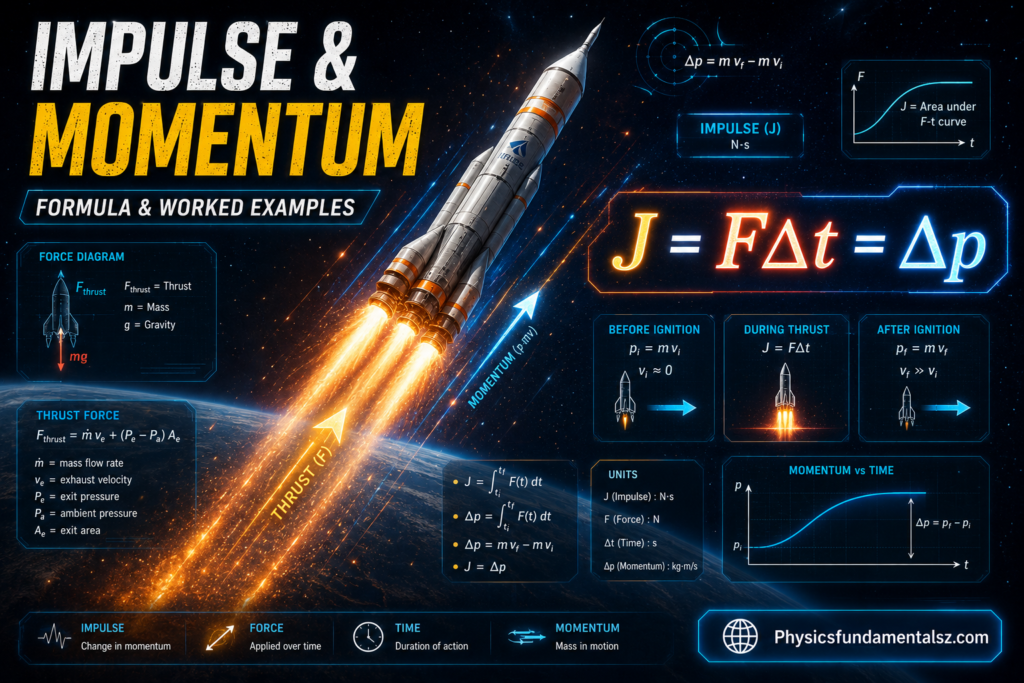
Impulse & momentum are two of the most important concepts in classical mechanics, and they explain everything from why airbags save lives to why a rocket can accelerate in the vacuum of space.
If you have not yet reviewed the basics of force and motion, it helps to start with Newton’s Laws of Motion, since impulse and momentum are direct extensions of Newton’s second and third laws applied over time.
Table of Contents
What Is Momentum?
Momentum Definition in Simple Terms
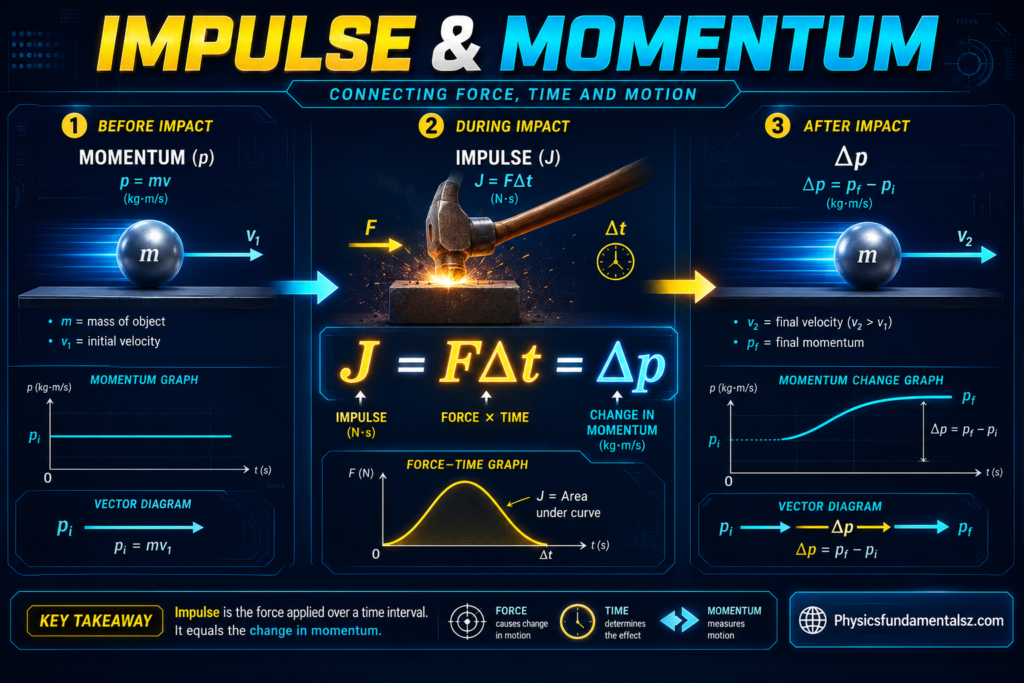
Momentum is a measure of the quantity of motion an object has. It depends on two things: how much mass an object carries, and how fast it is moving. A heavy truck moving slowly can have the same momentum as a small car moving quickly, because momentum accounts for both mass and velocity together.
In simple terms, momentum tells you how hard it would be to stop something. A bowling ball rolling at moderate speed is harder to stop than a tennis ball moving at the same speed, because the bowling ball has far more momentum.
Momentum Formula and Units
The momentum formula is:
p = mv
Where:
- p is momentum
- m is the mass of the object
- v is the velocity of the object
Momentum is measured in kilogram meters per second (kg·m/s) in SI units. Since velocity is a vector quantity, momentum is also a vector, meaning it has both magnitude and direction. If you want a refresher on the difference between vector and scalar quantities before continuing, our guide on Vectors and Scalars covers this in detail, and it applies directly to how momentum is represented and calculated.
What Is Impulse?
Impulse Definition in Simple Terms
Impulse is the effect of a force acting on an object over a period of time. It is what causes an object’s momentum to change. A gentle push over a long time and a sharp shove over a short time can produce the same impulse, and therefore the same change in momentum, even though they feel very different.
A common everyday example is catching a ball. If you pull your hands back as you catch it, you extend the time of contact, which reduces the force needed to bring the ball to a stop. The impulse, the total change in momentum, stays the same either way, only the force and time trade off against each other.
Impulse Formula and Units
The impulse formula is:
J = FΔt
Where:
- J is impulse
- F is the net force applied
- Δt is the time interval over which the force acts
Impulse is measured in newton seconds (N·s), which is dimensionally equivalent to kilogram meters per second (kg·m/s), the same unit used for momentum. This is not a coincidence, it directly reflects the relationship between impulse and momentum described in the next section.
The Impulse-Momentum Theorem
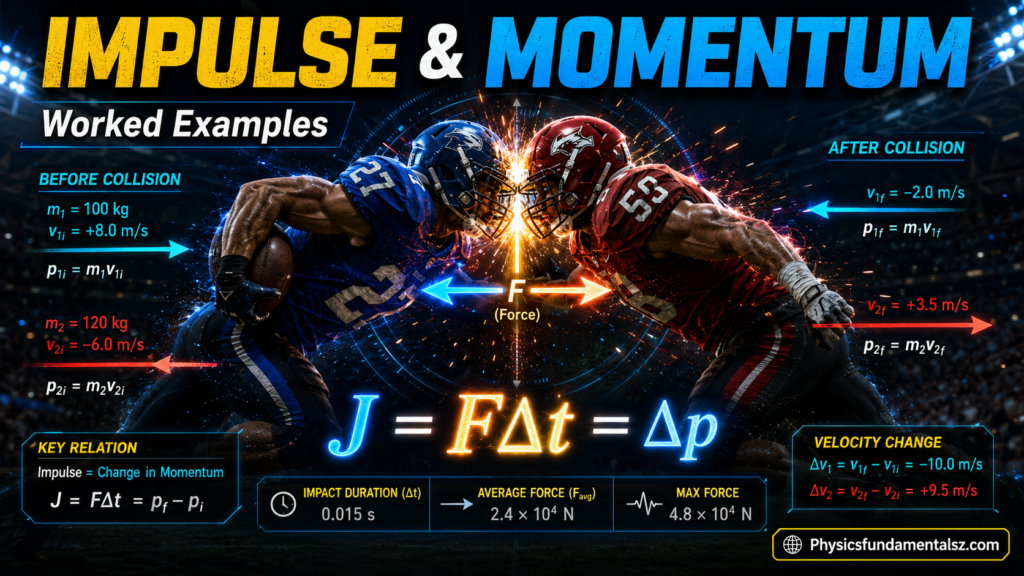
The impulse-momentum theorem is the mathematical link between impulse and momentum. It states that the impulse applied to an object is equal to the change in that object’s momentum.
J = Δp = mv_f − mv_i
Where v_f is the final velocity and v_i is the initial velocity of the object.
Deriving the Impulse-Momentum Theorem from Newton’s Second Law
The impulse-momentum theorem comes directly from Newton’s second law of motion. Here is the full derivation, step by step.
Step 1: Start with Newton’s second law
F = ma
Step 2: Express acceleration as the rate of change of velocity
a = Δv / Δt
Substituting this into Newton’s second law gives:
F = m(Δv / Δt)
Step 3: Multiply both sides by Δt
FΔt = mΔv
Step 4: Recognize the left side as impulse and the right side as change in momentum
FΔt = m(v_f − v_i) = mv_f − mv_i
This gives us the impulse-momentum theorem:
J = Δp
Why Impulse Equals Change in Momentum
This relationship tells us that any change in an object’s momentum must be caused by an impulse, and the size of that impulse depends on both the force applied and how long that force acts. This is why engineers design crumple zones in cars and padding in sports equipment: increasing the time over which a collision occurs reduces the peak force experienced, even though the total change in momentum, and therefore the total impulse, stays exactly the same.
Impulse and Momentum as Vector Quantities
Both impulse and momentum are vector quantities, meaning direction matters just as much as magnitude. A ball bouncing off a wall does not just slow down, it reverses direction, which means its momentum changes sign, not just its magnitude.
This is an important distinction from scalar quantities like speed or kinetic energy, which only carry magnitude. Understanding vectors properly, including how to add and subtract them, is essential for solving real impulse and momentum problems correctly, especially in two-dimensional collisions. For a complete breakdown of vector operations, see our guide on Vectors and Scalars.
Conservation of Momentum in Collisions
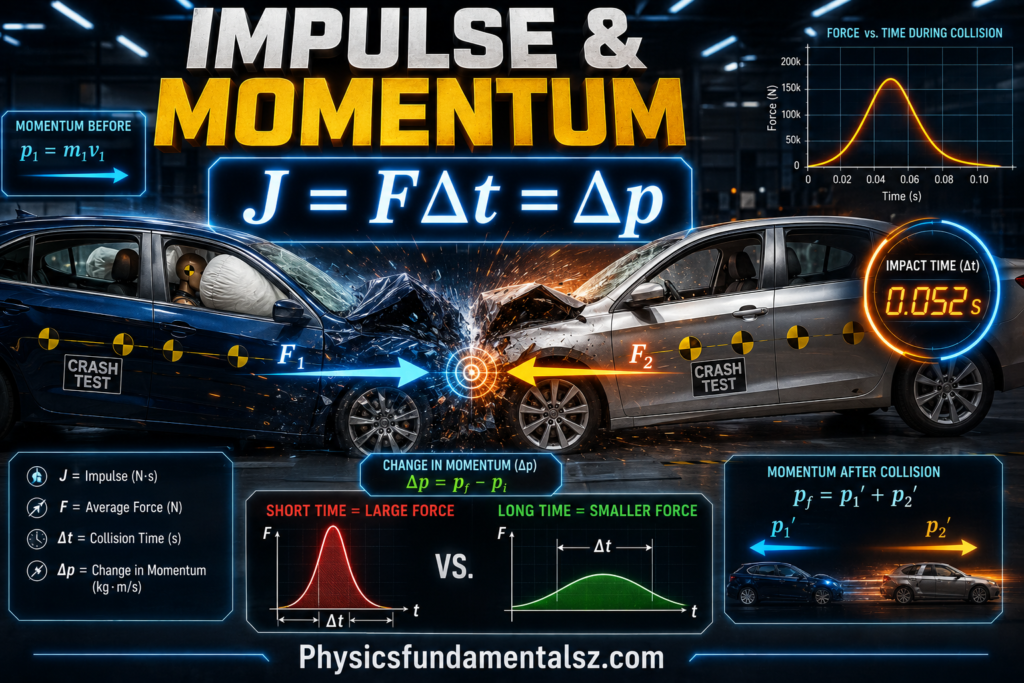
One of the most powerful applications of momentum is the law of conservation of momentum, which states that in a closed system with no external forces, the total momentum before a collision equals the total momentum after the collision.
This principle applies to two broad categories of collisions:
- Elastic collisions, where both momentum and kinetic energy are conserved, such as billiard balls colliding
- Inelastic collisions, where momentum is conserved but kinetic energy is not, such as two cars crumpling together in a crash
Conservation of momentum and the impulse-momentum theorem work together to explain the physics of any collision, explosion, or interaction between objects. For a deeper dive into how this conservation law is derived and applied, read our full article on Conservation of Momentum.
Impulse-Momentum Theorem vs Work-Energy Theorem
Students often confuse the impulse-momentum theorem with the work-energy theorem, since both describe how forces change an object’s motion. The key difference lies in what variable is being tracked.
- The impulse-momentum theorem relates force and time to a change in momentum: J = FΔt = Δp
- The work-energy theorem relates force and distance to a change in kinetic energy: W = FΔd = ΔKE
Both theorems come from Newton’s second law, but they answer different questions. Impulse and momentum are most useful when analyzing collisions and short-duration forces, while work and energy are more useful when analyzing forces applied over a distance. To understand the second half of this comparison in detail, see our guides on What Is Energy? and the Work-Energy Theorem.
Real World Examples of Impulse and Momentum
Car Safety and Airbags
Airbags and seatbelts are direct applications of the impulse-momentum theorem. During a crash, a passenger’s momentum must change from a high speed to zero. Airbags increase the time over which this change happens, which reduces the force experienced by the passenger’s body, since impulse stays constant while time increases and force decreases.
Sports Impacts: Baseball, Boxing and Beyond
In sports, athletes constantly manipulate the relationship between force, time, and momentum. A baseball player follows through on a swing to increase contact time and maximize the impulse delivered to the ball. A boxer rolling with a punch extends the time of impact to reduce the force felt, even though the momentum change of the fist is identical either way.
Rocket Propulsion and Newton’s Third Law
Rockets work by expelling mass, usually hot gas, at high velocity in one direction, which produces an equal and opposite change in momentum for the rocket itself. This is a direct consequence of Newton’s third law, every action has an equal and opposite reaction, applied through the lens of momentum conservation. To connect this back to the fundamental laws involved, revisit our guide on Newton’s Laws of Motion.
How to Calculate Impulse and Momentum: Step-by-Step Example
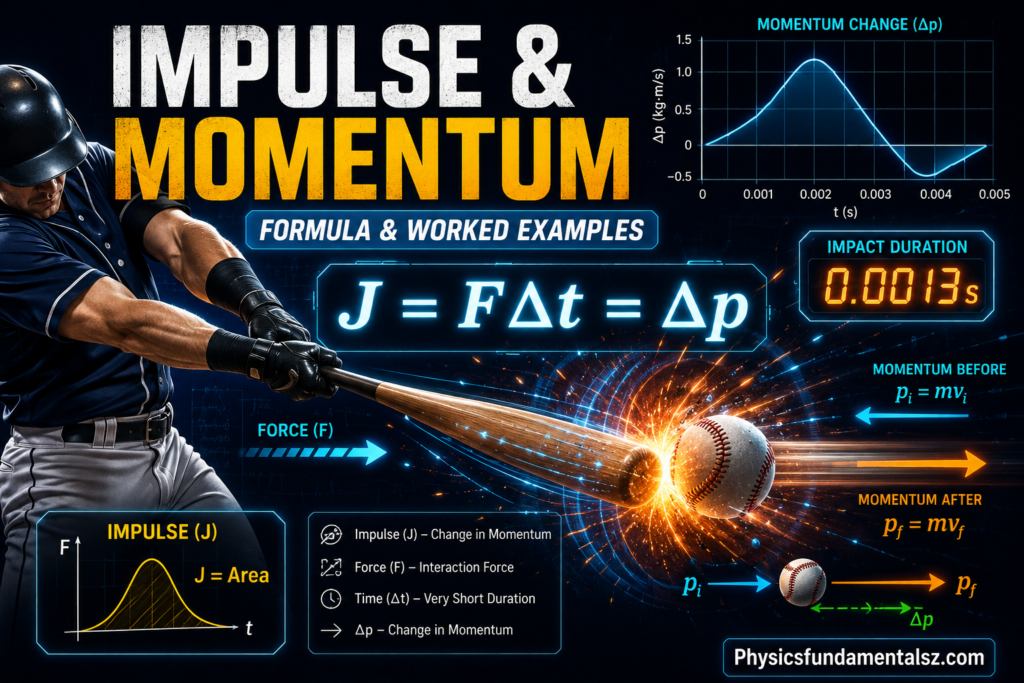
Let’s work through a complete example using real numbers.
Scenario: A 0.5 kg ball is moving at 4 m/s when a bat strikes it, sending it back in the opposite direction at 20 m/s. The bat is in contact with the ball for 0.01 seconds. Find the impulse delivered to the ball and the average force applied by the bat.
Step 1: Assign a positive direction
Let the ball’s initial direction be positive. This means the final velocity, since it reverses direction, is negative.
v_i = +4 m/s v_f = −20 m/s
Step 2: Calculate initial and final momentum
p_i = mv_i = 0.5 × 4 = 2 kg·m/s p_f = mv_f = 0.5 × (−20) = −10 kg·m/s
Step 3: Calculate the change in momentum, which equals the impulse
J = Δp = p_f − p_i = −10 − 2 = −12 kg·m/s
The impulse delivered to the ball is −12 N·s, meaning 12 N·s in the direction opposite to the ball’s original motion.
Step 4: Calculate the average force using the impulse formula
J = FΔt
F = J / Δt = −12 / 0.01 = −1,200 N
The average force applied by the bat is 1,200 newtons in the direction opposite to the ball’s original velocity, a large force acting over a very short time interval, which is typical of high-speed sports impacts.
If you would rather test different masses, velocities, and time intervals instantly rather than solving by hand, visit our physics calculators page for tools that solve momentum and impulse problems and show every formula used.
Common Misconceptions About Impulse and Momentum
Misconception 1: Impulse and force are the same thing. Impulse depends on both force and the time that force acts, while force alone says nothing about duration. Two very different forces can produce the same impulse if their contact times differ enough.
Misconception 2: A larger force always means a larger change in momentum. A large force applied for a very short time can produce the same impulse as a small force applied for a much longer time, since impulse depends on the product of the two, not either one alone.
Misconception 3: Momentum and kinetic energy are conserved in every collision. Momentum is always conserved in a closed system, but kinetic energy is only conserved in elastic collisions. In inelastic collisions, kinetic energy is lost to heat, sound, and deformation, even though momentum remains constant.
Misconception 4: Momentum only applies to moving objects with mass. While this guide focuses on classical momentum, which does require mass and velocity, momentum as a broader physical concept also applies in other areas of physics, such as photon momentum in optics, even though photons have no rest mass.
Frequently Asked Questions (FAQs)
What is the difference between impulse and momentum?
Momentum is a property of a moving object, calculated as mass times velocity. Impulse is the change caused in that momentum, calculated as force times the time the force acts. The impulse-momentum theorem connects the two directly.
What is the formula for impulse and momentum?
Momentum is calculated as p = mv. Impulse is calculated as J = FΔt. The impulse-momentum theorem states that J equals the change in momentum, or J = Δp.
Why do impulse and momentum have the same units?
Impulse (N·s) and momentum (kg·m/s) are dimensionally equivalent because impulse is defined as the quantity that produces a change in momentum. Working through the derivation from Newton’s second law shows that both expressions reduce to the same base units.
How does the impulse-momentum theorem relate to Newton’s second law?
The impulse-momentum theorem is derived directly from Newton’s second law, F = ma, by expressing acceleration as a change in velocity over time and multiplying both sides of the equation by the time interval.
Why do airbags reduce injury during a crash?
Airbags increase the time over which a passenger’s momentum changes during a collision. Since impulse stays the same regardless of how long the collision takes, increasing time reduces the average force experienced by the passenger’s body.
Is momentum conserved in every type of collision?
Yes, total momentum is always conserved in a closed system with no external forces, in both elastic and inelastic collisions. Kinetic energy, however, is only conserved in elastic collisions.
Final Thoughts
Impulse and momentum form one of the most practical frameworks in all of physics, connecting Newton’s laws of motion to real-world outcomes like car safety, sports performance, and rocket propulsion.
The impulse-momentum theorem, J = FΔt = Δp, shows exactly how force and time combine to change an object’s motion, while the law of conservation of momentum extends this idea to entire systems of colliding objects.
To keep building on these foundations, explore related topics like Newton’s Laws of Motion, Conservation of Momentum, and the Work-Energy Theorem on Physics Fundamentals.