Momentum and Impulse Collisions: Conservation Laws & Examples
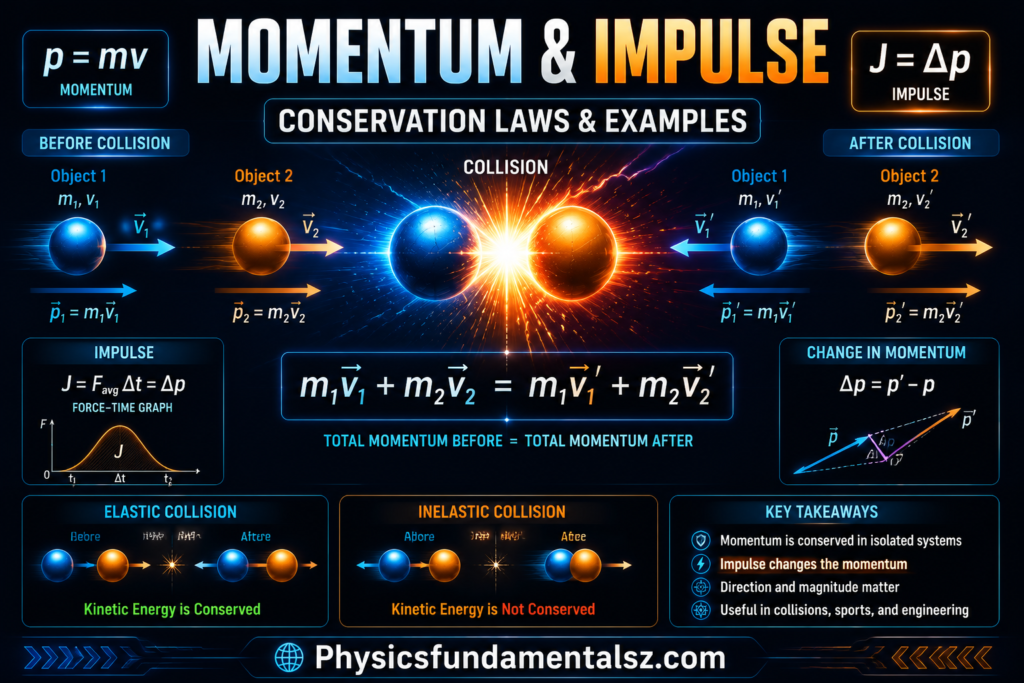
Momentum and impulse collisions form one of the most important topics in classical mechanics.
Every time two objects crash into each other, whether it is a car accident, a football tackle, or two billiard balls striking on a table, the outcome is governed by two connected ideas: momentum and impulse.
Understanding how these quantities behave during a collision helps explain everything from why airbags save lives to why a tennis ball bounces the way it does.
If you are still building your foundation in mechanics, it helps to first review Newton’s Laws of Motion, since momentum and impulse are direct extensions of Newton’s second law.
Table of Contents
What Is Momentum in Physics?
Momentum is the quantity that describes how much motion an object has. It depends on two things: how heavy the object is and how fast it is moving.
Momentum Formula
The linear momentum formula is written as:
p = m × v
Where p is momentum measured in kilogram meters per second (kg·m/s), m is mass in kilograms, and v is velocity in meters per second.
A heavy truck moving slowly can have the same momentum as a small car moving fast, because momentum depends on the product of mass and velocity, not on either quantity alone. An object at rest, no matter how heavy, has zero momentum since its velocity is zero.
Momentum as a Vector Quantity
Momentum is a vector, which means it has both magnitude and direction. The direction of an object’s momentum is always the same as the direction of its velocity. This is important in momentum and impulse collisions because when two objects move toward each other, their momenta point in opposite directions and can partially or fully cancel out.
What Is Impulse in Physics?
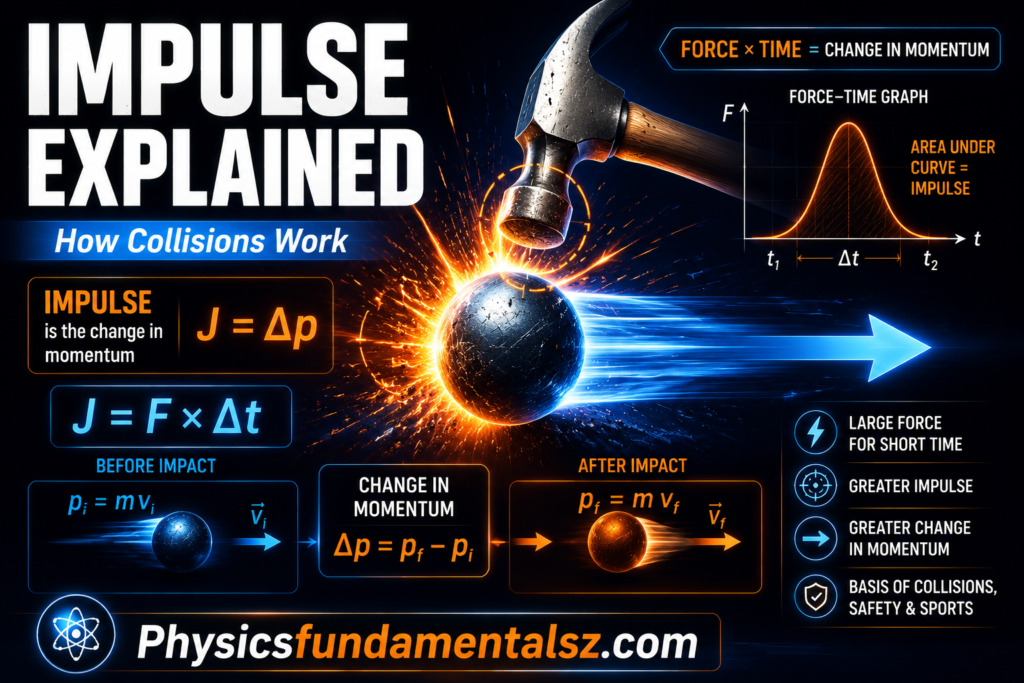
Impulse is the change in momentum that an object experiences when a force acts on it over a period of time. In a collision, this happens very quickly, but the underlying physics is the same as any other force interaction described in Newton’s Laws of Motion.
Impulse Formula
The impulse formula is expressed as:
J = F × t
Where J is impulse, F is the average force applied, and t is the time interval over which the force acts. Impulse is measured in newton seconds (N·s), which is equivalent to kg·m/s, the same unit as momentum.
This equation reveals a practical relationship: for a fixed change in momentum, a smaller force applied over a longer time produces the same effect as a larger force applied briefly. This single idea explains why crumple zones, airbags, and padded flooring all work.
The Impulse Momentum Theorem
The impulse momentum theorem connects impulse directly to the change in an object’s momentum:
J = Δp = m × Δv
In words, the impulse experienced by an object during momentum and impulse collisions is always equal to the change in its momentum. If a force acts on an object and changes its velocity from an initial value to a final value, the impulse delivered equals the difference between the final and initial momentum.
This theorem is derived from Newton’s second law, F = ma, since acceleration itself is simply the rate of change of velocity over time. That derivation is one of the clearest bridges between force based mechanics and momentum based mechanics.
How Momentum and Impulse Work Together in Collisions
In any collision, whether it lasts a few milliseconds or several seconds, the colliding objects exert equal and opposite forces on each other for the same amount of time. Because the force and time are equal in magnitude, the impulse delivered to each object is equal in magnitude but opposite in direction.
This is the core reason momentum and impulse collisions always conserve total momentum in an isolated system. The impulse one object receives is exactly balanced by the impulse the other object receives, so the total momentum of the system before and after the collision stays the same.
Consider a football halfback running down the field who collides with a defensive back. The halfback experiences a force over a short time interval, which produces an impulse that slows him down. If the defender applies 800 N of force for 0.9 seconds, the impulse delivered is 720 N·s, which causes a momentum change of 720 kg·m/s in the halfback. This is a textbook example of how impulse directly causes a measurable change in momentum during real world contact.
Law of Conservation of Momentum
The law of conservation of momentum states that in a closed system with no external forces acting on it, the total momentum before a collision equals the total momentum after the collision.
Total momentum before collision = Total momentum after collision
m1v1 + m2v2 = m1v1′ + m2v2′
This principle only applies to internal forces such as those exchanged between two colliding objects. External forces, like friction from the ground or air resistance, can change the total momentum of a system, which is why real collisions are usually analyzed over the very short time interval when the collision forces are far larger than any external force.
For a deeper breakdown of this law with derivations and solved examples, see our full guide on Conservation of Momentum.
Why Only Internal Forces Cancel
Internal forces in a system, like the push two ice skaters exert on each other, always occur in action reaction pairs described by Newton’s third law. Since these pairs are equal and opposite, they cancel out when you sum the momentum of the entire system. External forces do not have a matching partner within the system, so they are the only forces capable of changing a system’s total momentum.
Types of Collisions: Elastic vs Inelastic
Not all momentum and impulse collisions behave the same way once you look at energy. While momentum is always conserved in an isolated system, kinetic energy is only conserved in certain types of collisions.
Elastic Collisions
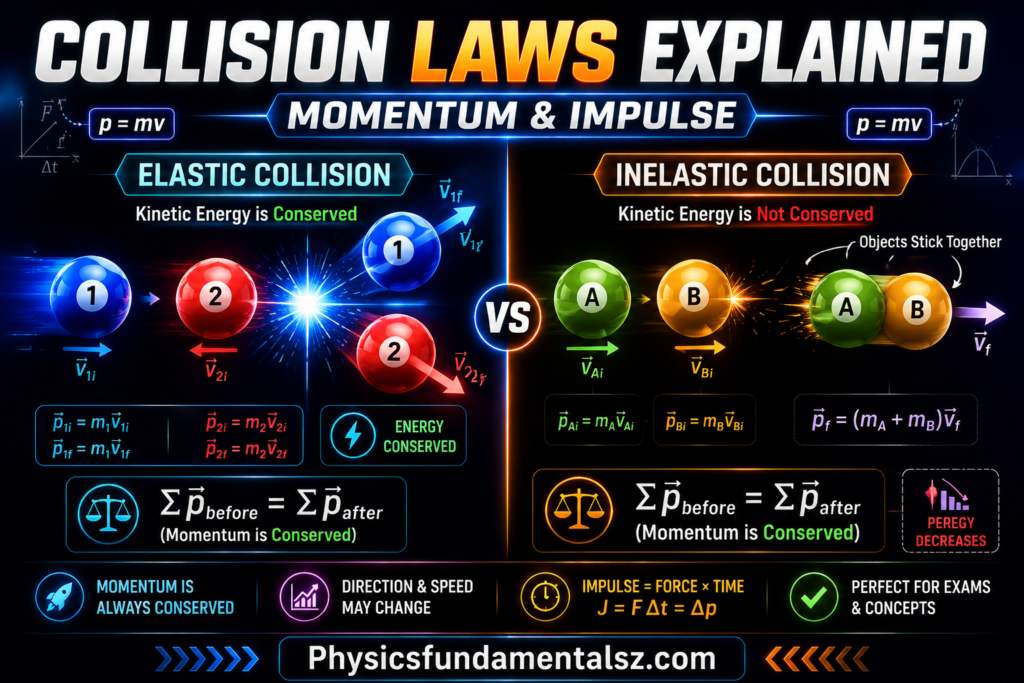
An elastic collision is one where both momentum and kinetic energy are conserved. The objects bounce off each other without any permanent deformation or heat loss. Two billiard balls of equal mass colliding head on is a classic near elastic collision example, since very little energy is lost to sound or deformation.
Elastic collision formula for two objects:
m1v1 + m2v2 = m1v1′ + m2v2′ ½m1v1² + ½m2v2² = ½m1v1’² + ½m2v2’²
Inelastic Collisions
An inelastic collision is one where momentum is conserved but kinetic energy is not. Some of the kinetic energy converts into heat, sound, or deformation of the objects involved. A car crash where the vehicles crumple is a real world inelastic collision.
Perfectly Inelastic Collisions
In a perfectly inelastic collision, the two objects stick together after impact and move with a common final velocity. This is the type of collision with the greatest loss of kinetic energy, even though momentum remains fully conserved.
m1v1 + m2v2 = (m1 + m2)v’
Understanding the difference between elastic and inelastic collisions is essential in fields ranging from vehicle safety engineering to sports science, and it connects closely to the concept of energy transformation covered in our guide on What Is Energy?
Momentum and Impulse Collisions in Two Dimensions
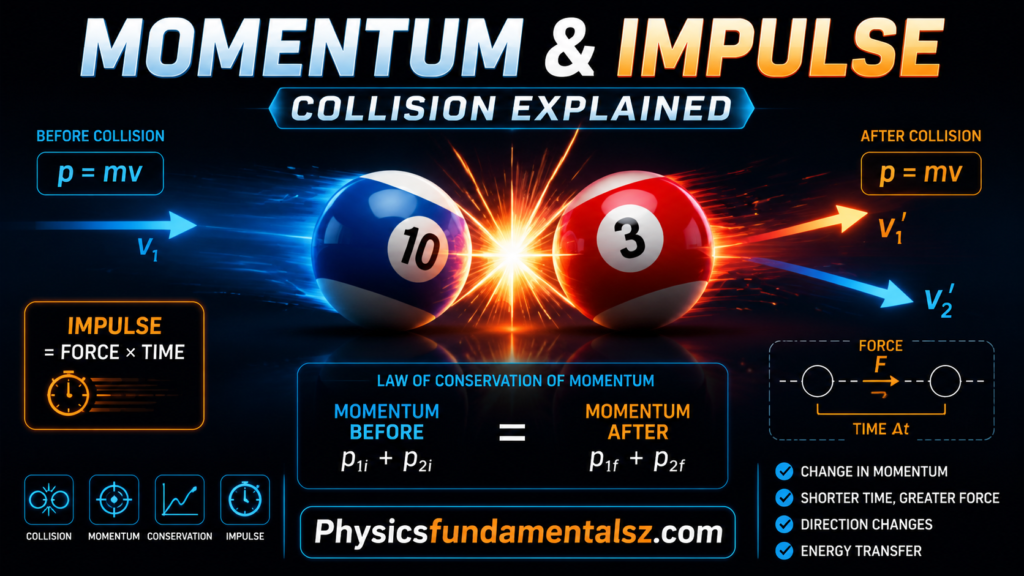
Many real collisions do not happen in a straight line. When two objects collide at an angle, momentum conservation must be applied separately to each perpendicular component of motion, typically the x and y directions.
For a two dimensional collision:
Σpx (before) = Σpx (after) Σpy (before) = Σpy (after)
A classic example is a hockey puck striking another puck at an angle, where the momentum of each puck is broken into horizontal and vertical components before and after the collision, then each component is conserved independently. This same vector based approach is used whenever you analyze motion with direction, which is covered in more depth in our article on Vectors and Scalars.
When a ball rebounds off a wall at an angle, the impulse is directed perpendicular to the wall surface, changing only the velocity component that is normal to that surface while leaving the parallel component largely unchanged.
Real World Applications of Impulse and Momentum
Airbags and Vehicle Safety
Airbags are one of the most direct real world applications of the impulse formula. During a crash, a passenger’s momentum must change from a high speed to zero almost instantly. Airbags extend the time over which this momentum change happens, which reduces the average force experienced by the passenger, since impulse is fixed but time is increased. Crumple zones in cars work on the same principle described in Newton’s second law of motion.
Sports and Impulse
In sports, athletes use the impulse momentum theorem constantly, even without realizing it. A baseball player follows through with the bat to extend the contact time with the ball, increasing the impulse and therefore the momentum transferred to the ball. Martial artists do the opposite on purpose, applying a very large force over an extremely short time interval to maximize the force delivered to a target like a breaking board.
Rocket Propulsion and Explosions
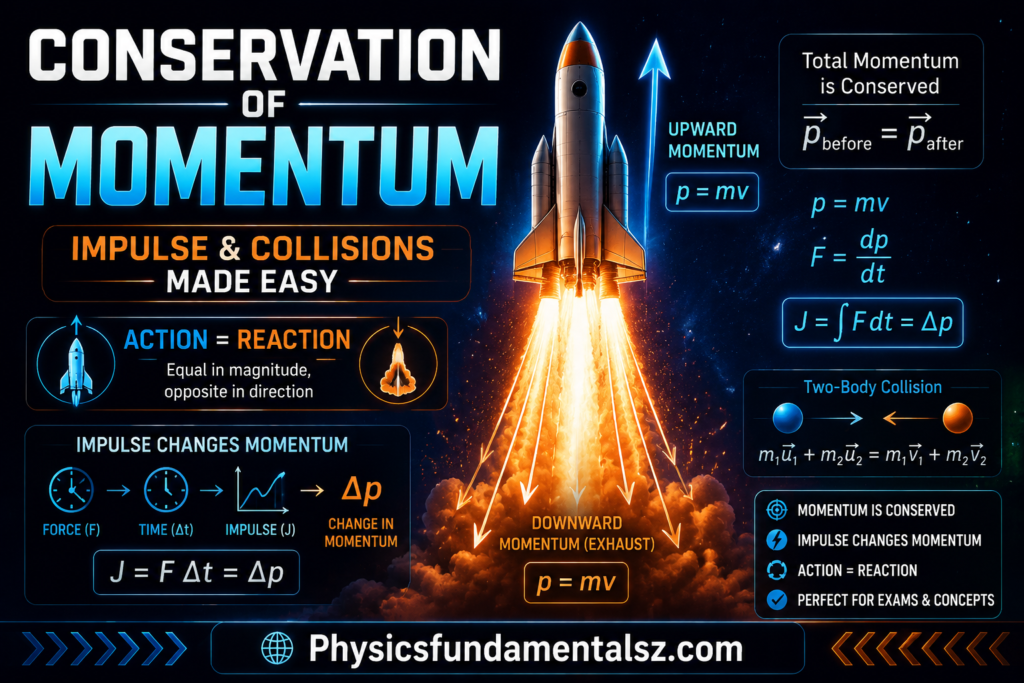
When two objects initially at rest are pushed apart by an explosion or a rocket engine, their momenta after the event are equal in magnitude but point in opposite directions, since the total momentum of the system must remain zero, matching its value before the explosion. This is one of the more advanced applications of momentum and impulse collisions and connects to rotational and circular motion concepts explored in Circular Motion and Centripetal Force.
Common Mistakes Students Make
- Treating momentum as a scalar. Momentum always has direction, and ignoring sign conventions is one of the most frequent errors in collision problems.
- Assuming kinetic energy is always conserved. It is only conserved in elastic collisions. In inelastic and perfectly inelastic collisions, kinetic energy is lost to heat, sound, or deformation.
- Forgetting that conservation of momentum applies to the whole system, not to a single object. Each object’s individual momentum can change dramatically, even while the total system momentum stays constant.
- Mixing up impulse and force. Impulse is force multiplied by time, not force alone, and it has the same units as momentum, not the units of force.
- Ignoring components in 2D collisions. Momentum must be conserved separately along each perpendicular axis, not as a single combined magnitude.
Worked Practice Problem
A 0.50 kg puck moving at 4 m/s to the right collides head on with a stationary 1.0 kg puck. After the collision, the pucks stick together in a perfectly inelastic collision. Find their common final velocity.
Step 1: Write the conservation of momentum equation. m1v1 + m2v2 = (m1 + m2)v’
Step 2: Substitute known values. (0.50)(4) + (1.0)(0) = (0.50 + 1.0)v’ 2.0 = 1.5v’
Step 3: Solve for v’. v’ = 1.33 m/s
The combined pucks move at approximately 1.33 m/s in the original direction of motion. Notice that momentum is fully conserved, but the kinetic energy before and after the collision is not equal, confirming this is an inelastic collision.
Frequently Asked Questions (FAQs)
What is the difference between momentum and impulse?
Momentum describes the quantity of motion an object has at a given instant, calculated as mass times velocity. Impulse describes the change in momentum caused by a force acting over a period of time, calculated as force times time.
Is momentum always conserved in a collision?
Yes, in an isolated system with no external forces, total momentum is always conserved regardless of whether the collision is elastic or inelastic.
Why is kinetic energy not conserved in all collisions?
During inelastic collisions, some kinetic energy converts into other forms of energy such as heat, sound, or the energy used to deform the colliding objects.
How does impulse relate to Newton’s second law?
Newton’s second law states that force equals mass times acceleration. Since acceleration is the rate of change of velocity, integrating force over time gives impulse, which equals the change in momentum, directly linking the two laws.
Conclusion
Momentum and impulse collisions sit at the heart of classical mechanics because they explain how objects exchange motion during any interaction, from a gentle nudge to a high speed crash.
Momentum, the product of mass and velocity, is always conserved in an isolated system, while impulse, the product of force and time, is what actually causes that momentum to change.
Elastic collisions conserve both momentum and kinetic energy, inelastic collisions conserve only momentum, and perfectly inelastic collisions represent the extreme case where colliding objects move together afterward.
Mastering these ideas gives you the tools to analyze everything from car safety design to sports mechanics to rocket propulsion.
For a broader foundation before or after this topic, revisit Newton’s Laws of Motion and Conservation of Momentum to see how every part of classical mechanics connects back to these same core principles.