Net Force: Definition, Formula & Newton’s Second Law Applied

Net force is one of the most important concepts in classical mechanics. Every object you see moving, stopping, or staying still is being controlled by the net force acting on it.
Whether you are pushing a shopping cart, riding a bicycle, or watching a ball roll across the floor, net force explains why and how that motion happens.
In this guide, we will break down what net force means, how to calculate it using the net force formula, and how it connects to Newton’s Laws of Motion.
We will also look at balanced and unbalanced forces, free body diagrams, and real world net force examples so the concept becomes easy to apply.
Table of Contents
What Is Net Force?
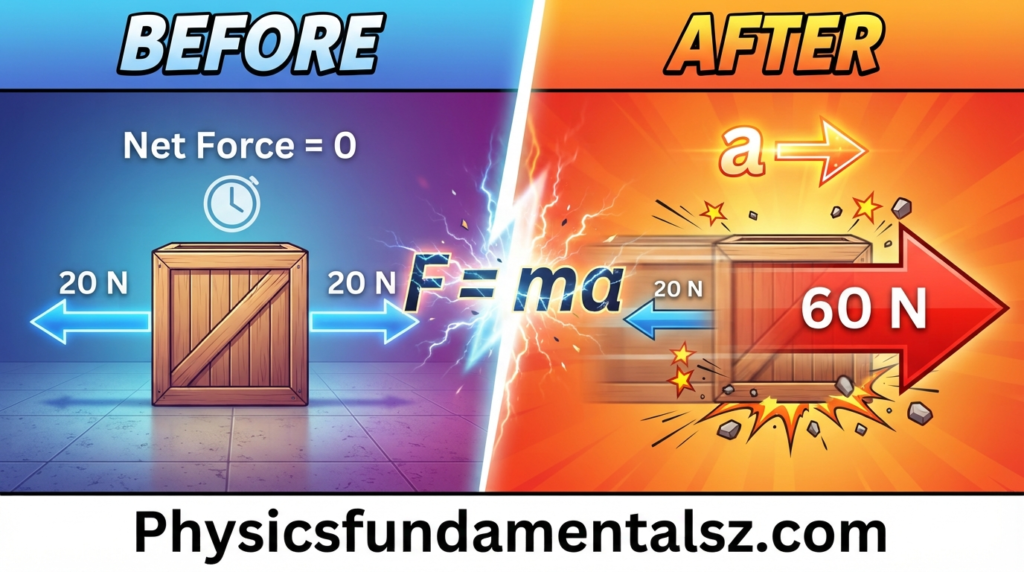
Net force is the sum of all the individual forces acting on an object at the same time. Since force is a vector quantity, meaning it has both magnitude and direction, net force is calculated by adding these forces together while accounting for their direction, not just their size.
If multiple forces act on an object in the same direction, they add up. If forces act in opposite directions, they subtract from each other. The result of this combination is called the net force, sometimes also referred to as the resultant force.
A simple way to picture this is a tug of war. If both teams pull with equal strength, the rope stays still because the net force is zero. If one team pulls harder, the rope moves toward that team because there is now a nonzero net force acting on it.
Understanding net force is essential before moving into related topics like vectors and scalars, since force calculations rely heavily on vector addition.
Net Force Formula
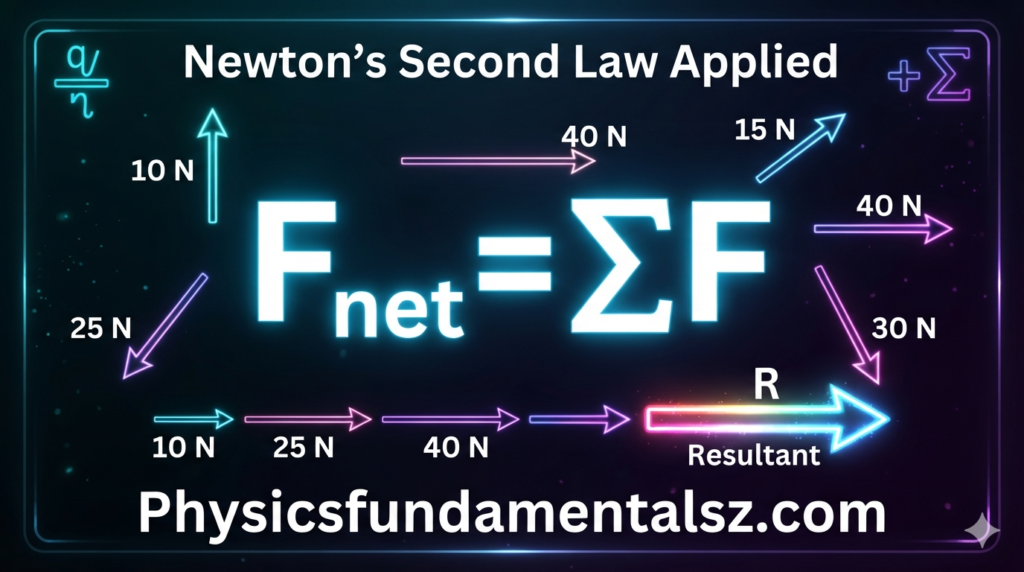
The net force formula is expressed as:
F(net) = F1 + F2 + F3 + … + Fn
Here, F1, F2, F3, and so on represent each individual force acting on the object. Since forces have direction, forces acting in one direction are treated as positive and forces acting in the opposite direction are treated as negative.
For objects where forces act along a straight line, such as left and right or up and down, the net force equation becomes a simple addition or subtraction problem. For forces acting at an angle to each other, each force must first be broken into its horizontal and vertical components before they can be combined. This method connects closely with vector components and vector addition.
Net Force Equation for Motion
Net force is also tied directly to acceleration through Newton’s Second Law of Motion, expressed as:
F(net) = m × a
In this equation, m stands for mass and a stands for acceleration. This net force equation tells us that the acceleration of an object is directly proportional to the net force acting on it and inversely proportional to its mass. A deeper explanation of this relationship can be found in our guide on Newton’s Second Law of Motion.
How to Calculate Net Force
Calculating net force involves a few clear steps. Here is a simple process you can follow for most problems.
Step 1: Identify All the Forces Acting on the Object
Before calculating net force, you need to know every force acting on the object. Common forces include gravity, friction, tension, normal force, applied force, and air resistance. You can review each of these individually in our breakdown of types of forces in physics.
Step 2: Draw a Free Body Diagram
A free body diagram is a visual tool that represents all the forces acting on an object using arrows. Each arrow points in the direction of the force and its length can represent the relative size of the force. Free body diagrams make it much easier to visualize whether forces are balanced or unbalanced. Learn how to construct one properly in our guide on free body diagrams.
Step 3: Assign Positive and Negative Directions
Choose a direction to be positive, commonly the direction of motion or to the right. Any force acting in the opposite direction is treated as negative. This step is critical because net force calculations depend entirely on direction, not just magnitude.
Step 4: Add the Forces Together
Once every force has a value and a direction, add them together using the net force formula. The result gives you the net force acting on the object, both in magnitude and direction.
Step 5: Apply Newton’s Second Law If Needed
If you know the mass of the object and want to find its acceleration, use F(net) = m × a and solve for acceleration. This step links net force calculations directly to motion and speed, which you can explore further in our article on acceleration and motion.
Net Force and Newton’s Laws of Motion

Net force is central to all three of Newton’s Laws of Motion, and understanding this relationship helps explain why objects behave the way they do.
Newton’s First Law and Net Force
Newton’s First Law, often called the law of inertia, states that an object at rest will remain at rest, and an object in motion will continue moving at a constant velocity, unless acted upon by an unbalanced net force. This means that without a net force, there is no change in motion at all. You can read more about this in our detailed post on Newton’s First Law of Motion.
Newton’s Second Law and Net Force
As mentioned earlier, Newton’s Second Law connects net force, mass, and acceleration through the equation F(net) = m × a. A larger net force produces greater acceleration, while a larger mass reduces the acceleration produced by the same net force.
Newton’s Third Law and Net Force
Newton’s Third Law states that for every action, there is an equal and opposite reaction. While this law deals with force pairs between two different objects, it is still important when calculating the net force on a single object, since reaction forces can influence the overall force balance. More detail is available in our guide on Newton’s Third Law of Motion.
Balanced Forces vs Unbalanced Forces
One of the most useful applications of net force is determining whether the forces acting on an object are balanced or unbalanced.
Balanced Forces
When the net force on an object equals zero, the forces acting on it are called balanced forces. This does not mean there are no forces at all. It means the forces cancel each other out completely. An object with balanced forces will either stay at rest or continue moving at a constant velocity, according to Newton’s First Law.
Unbalanced Forces
When the net force is not zero, the forces are called unbalanced forces. Unbalanced forces cause a change in an object’s motion, either by speeding it up, slowing it down, or changing its direction. This directly leads to acceleration, as described by Newton’s Second Law.
Understanding balanced and unbalanced forces is especially useful when studying equilibrium in physics, since equilibrium occurs whenever the net force and net torque on a system are both zero.
Net Force Examples
Let’s look at a few practical net force examples to see how the concept applies in real situations.
Example 1: Pushing a Box Across the Floor
Imagine you push a box with a force of 50 N to the right, and friction acts on the box with a force of 20 N to the left. Using the net force formula:
F(net) = 50 N minus 20 N = 30 N to the right
Since the net force is not zero, the box will accelerate to the right. This example also ties directly into our article on friction force, which explains how friction opposes motion.
Example 2: A Book Resting on a Table
A book sitting on a table experiences two forces, gravity pulling it down and the normal force from the table pushing it up. If these two forces are equal in magnitude, the net force is zero, and the book stays perfectly still. This is a classic example of balanced forces in equilibrium.
Example 3: A Falling Object with Air Resistance
When an object falls through the air, gravity pulls it downward while air resistance pushes upward against its motion. Initially, gravity is much stronger, resulting in a downward net force and increasing acceleration. As the object speeds up, air resistance increases until it eventually equals the force of gravity, resulting in zero net force. At this point, the object reaches what is known as terminal velocity. This concept is explored further in our post on gravity and free fall.
Units of Net Force
Since net force is still a force, it is measured using the same unit as any other force, the newton, abbreviated as N. One newton is defined as the amount of force required to accelerate a one kilogram mass at a rate of one meter per second squared.
1 N = 1 kg times m/s²
This unit comes directly from the net force equation F(net) = m × a, where mass is measured in kilograms and acceleration is measured in meters per second squared.
Common Mistakes When Calculating Net Force
Many students make small errors when working with net force problems. Here are a few common mistakes to avoid.
Forgetting that force is a vector and ignoring direction when adding forces together.
Assuming zero net force means there are no forces acting on the object at all, when it actually means the forces are balanced.
Mixing up mass and weight when applying the net force equation F(net) = m × a, since weight is actually the force of gravity acting on mass.
Failing to break forces into components when they act at an angle, leading to incorrect totals.
Avoiding these mistakes becomes much easier once you are comfortable with free body diagrams and vector addition, both of which are covered in more depth on our site.

Frequently Asked Questions (FAQs)
What is net force in simple terms?
Net force is the overall force acting on an object once all individual forces acting on it have been added together, taking direction into account.
What happens when net force is zero?
When net force is zero, the object is in equilibrium. It will either remain at rest or continue moving at a constant velocity in a straight line.
What is the difference between force and net force?
A single force is just one push or pull acting on an object. Net force is the combined result of all forces acting on that object at the same time.
Can net force be negative?
Yes. A negative net force simply indicates that the overall force is acting in the direction chosen as negative, often causing the object to decelerate or move in that opposite direction.
How does net force relate to acceleration?
Net force is directly proportional to acceleration according to Newton’s Second Law, F(net) = m × a. A greater net force results in greater acceleration, assuming mass stays constant.
Final Thoughts on Net Force
Net force is the foundation for understanding motion in physics. It ties together forces, direction, mass, and acceleration into one unified concept that explains why objects behave the way they do.
Once you understand how to identify forces, draw free body diagrams, and apply the net force formula, solving motion problems becomes far more intuitive.
To strengthen your understanding further, explore our related guides on Newton’s Laws of Motion, types of forces, and free body diagrams to build a complete picture of how forces shape the physical world around us.