Newton’s Law of Universal Gravitation
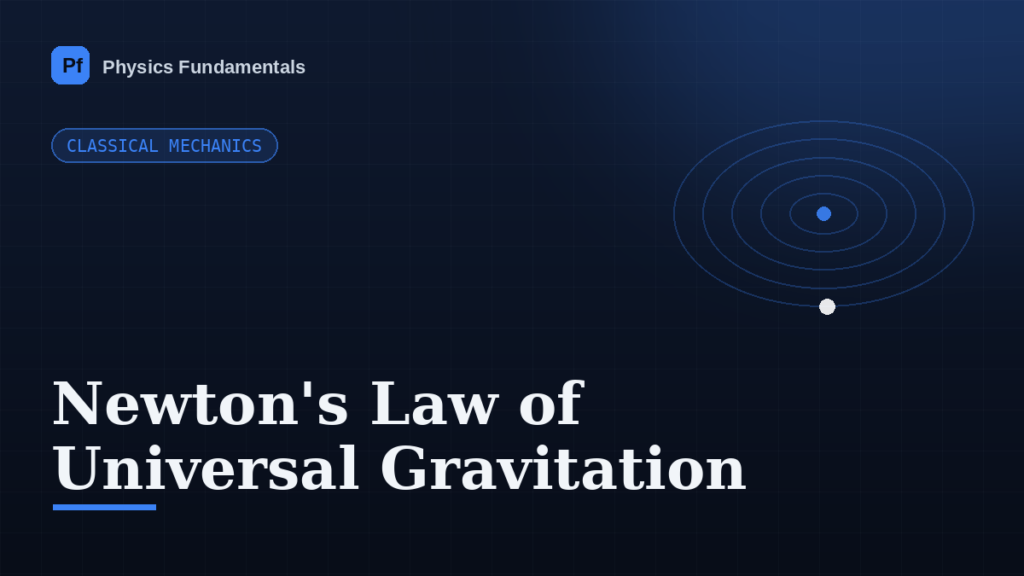
Before Isaac Newton, the heavens and the Earth were thought to obey different rules. Newton’s law of universal gravitation shattered that divide, showing that the same force that makes objects fall also keeps planets in orbit. It was one of the great unifications in the history of science.
The universal law
Newton proposed that every mass in the universe attracts every other mass. The strength of this attraction grows with the masses involved and weakens rapidly with distance. The relationship is:
Here F is the gravitational force, m₁ and m₂ are the two masses, r is the distance between their centres, and G is the gravitational constant, a fixed number that sets the overall strength of gravity throughout the cosmos.
What the equation tells us
Two features of this formula deserve attention.
- Force grows with mass: Double either mass and the force doubles. The Sun is so massive that it dominates the whole solar system.
- Force falls with the square of distance: Move twice as far apart and the force drops to a quarter. This inverse-square behaviour is the key to understanding orbits.
The word universal is meant literally. The same law governs a falling apple, the tides, the orbit of the International Space Station, and the rotation of distant galaxies.
The gravitational constant
The constant G is extraordinarily small:
Its tiny value tells us that gravity is actually a very weak force. The gravitational pull between two everyday objects is utterly negligible. Gravity only becomes commanding when at least one of the masses is astronomical, like a planet or a star. Henry Cavendish first measured G in 1798 with a delicate torsion balance, an experiment so precise it effectively weighed the Earth.
Gravity is by far the weakest of the fundamental forces, yet because it always attracts and never cancels out, it accumulates over huge masses to shape stars, planets, and the entire structure of the universe.
From the apple to weight
Near the Earth’s surface, the universal law simplifies into the familiar idea of weight. Plugging in the Earth’s mass and radius, the force on any object becomes its mass times a constant acceleration of about 9.8 m/s², the gravitational field strength we call g:
This is why all objects fall at the same rate regardless of their mass, neglecting air resistance: the heavier object feels more force but also has more inertia, and the two effects cancel. It also connects directly to Newton’s laws of motion, where force, mass, and acceleration meet.
Why the Moon does not fall down
Newton’s great insight was that the Moon is falling, constantly. It is pulled toward the Earth by the very same gravity that pulls the apple. But the Moon also moves sideways fast enough that as it falls toward Earth, the Earth’s surface curves away beneath it by just the same amount. The result is a perpetual fall that never reaches the ground, which we call an orbit.
This same balance explains planetary orbits around the Sun and satellites around the Earth. The inverse-square form of the law is exactly what produces the stable elliptical orbits that Kepler had described decades earlier, and Newton was able to derive Kepler’s laws directly from his own.
Where Newton’s law gives way
Newton’s law is astonishingly accurate and still used for spacecraft navigation today. But it is not the final word. In 1915 Einstein’s general relativity reinterpreted gravity not as a force but as the curving of spacetime by mass. For tiny corrections, such as a slight wobble in Mercury’s orbit or the bending of starlight near the Sun, Einstein’s theory is needed. Yet for everyday and most astronomical purposes, Newton’s elegant inverse-square law remains a triumph of physics.
Frequently asked questions
Why do heavy and light objects fall at the same rate?
Gravity pulls harder on a heavier object, but that object also resists acceleration more because it has more inertia. The extra force and the extra inertia cancel exactly, so all objects accelerate at the same g when air resistance is ignored.
Does gravity ever reach zero?
Mathematically, no. The inverse-square law means gravity weakens with distance but never quite disappears. Even between galaxies a faint pull remains, which is why gravity can shape structures across the entire universe.
If gravity is so weak, why does it dominate space?
Because gravity only ever attracts and cannot be cancelled, while electric forces come in positive and negative that largely neutralise each other. Over astronomical masses, the small but relentless gravitational pull adds up to become the dominant force in the cosmos.