Gravitational Force and Newton’s Law of Gravitation
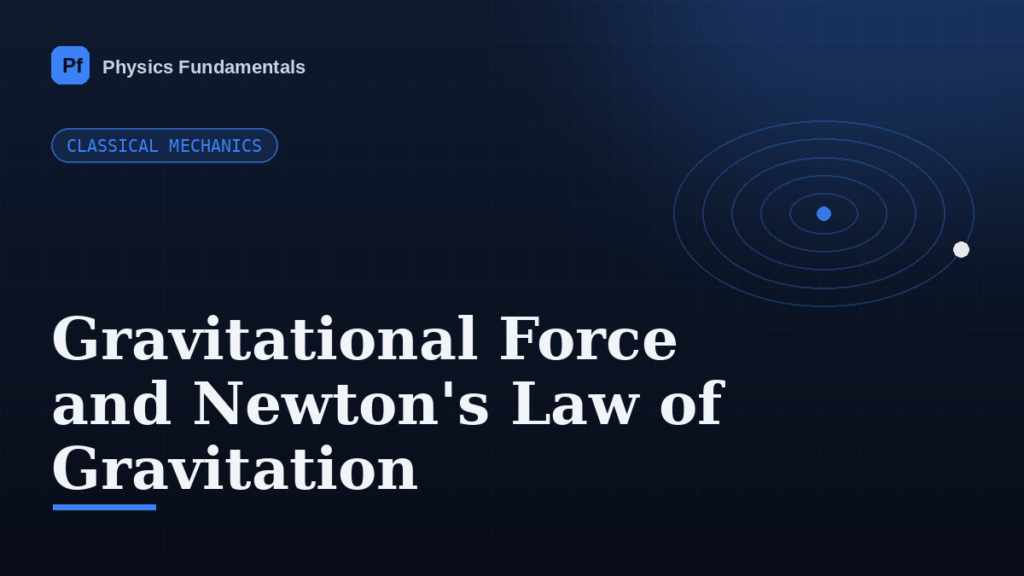
Why does an apple fall, while the Moon, also falling, never reaches the ground? Isaac Newton’s profound answer was that both obey the same law: every mass in the universe attracts every other mass. This single insight unified the heavens and the Earth and remains one of the greatest achievements in the history of science.
The universal law
Newton’s law of universal gravitation states that any two masses attract each other with a force that grows with their masses and weakens with the square of the distance between them. For two point masses m₁ and m₂ separated by a distance r:
Here G is the gravitational constant, about 6.674 × 10⁻¹¹ N·m²/kg². It is extraordinarily small, which is why you do not feel a pull toward the person next to you — gravity only becomes significant when at least one mass is enormous, like a planet.
What “inverse square” really means
The r² in the denominator is the heart of the law. Double the distance between two objects and the force drops not to a half but to a quarter. Triple it and the force falls to a ninth. This rapid weakening is called an inverse-square relationship, and it appears throughout physics — in light, sound and electric forces too.
The inverse-square law has a geometric origin: a fixed influence spreading out from a point gets diluted over the surface of a sphere, and a sphere’s area grows as r². Spread the same gravitational pull over four times the area and you get a quarter the intensity.
From force to weight
Your weight is just the gravitational force between you and the Earth. Plugging the Earth’s mass and radius into Newton’s law, the pull on a mass m near the surface comes out to:
This g is the familiar gravitational field strength — the force per kilogram, and equally the acceleration of a freely falling object. So weight is simply mg. Because g depends on the Earth’s radius, you would weigh slightly less on a high mountain, where r is a touch larger, and far less on the smaller, lighter Moon.
Why the Moon stays in orbit
The genius of Newton’s idea was realising that the Moon is constantly falling toward the Earth — it just keeps missing. The Moon has enough sideways speed that as gravity pulls it inward, the curved Earth falls away beneath it at the same rate, so it loops around forever. The very same force that drops an apple is what bends the Moon’s path into an orbit.
This is why a satellite needs the right speed: too slow and it spirals down, too fast and it escapes. Orbital motion is gravity providing the centripetal force needed to keep curving the path, a topic explored in circular motion.
Gravitational fields
Rather than thinking of gravity as instant action at a distance, physicists picture a gravitational field surrounding every mass — a region in which other masses feel a pull. The field strength at distance r from a mass M is:
This is the same inverse-square pattern. The field is strong close to a planet and fades with distance, and the force on any object is simply its mass times the local field strength. Fields give us a clean way to map gravity through space without referring to a specific second object.
The limits of Newton’s law
Newton’s law is astonishingly accurate — it guides spacecraft across the solar system to within metres. But it is not the final word. It treats gravity as a force acting instantly across space, and it falters in extreme conditions: very strong fields near the Sun, the bending of light, and the precise orbit of Mercury. Einstein’s general relativity replaced the force picture with curved spacetime and explains these cases. Yet for the overwhelming majority of practical situations, Newton’s elegant formula remains the working tool of physics and engineering. For the broader framework it sits within, revisit Newton’s laws of motion.
Frequently asked questions
Why don’t I feel gravity pulling me toward other people?
You do, but the gravitational constant G is so tiny that the force between two everyday objects is utterly negligible. Gravity only becomes noticeable when one of the masses is astronomically large, like a planet or star.
What is the difference between mass and weight?
Mass is the amount of matter in an object, the same everywhere. Weight is the gravitational force on that mass, which changes with location — you would weigh about a sixth as much on the Moon, though your mass is unchanged.
Does gravity ever reach zero?
Mathematically, gravity’s reach is infinite — it only fades to zero at infinite distance. There is always some pull, however faint. “Zero gravity” felt by astronauts is really free fall, not the absence of gravity, since orbiting craft are still firmly held by the Earth.