Magnetic Flux and Faraday’s Law: Formula, Examples & Applications
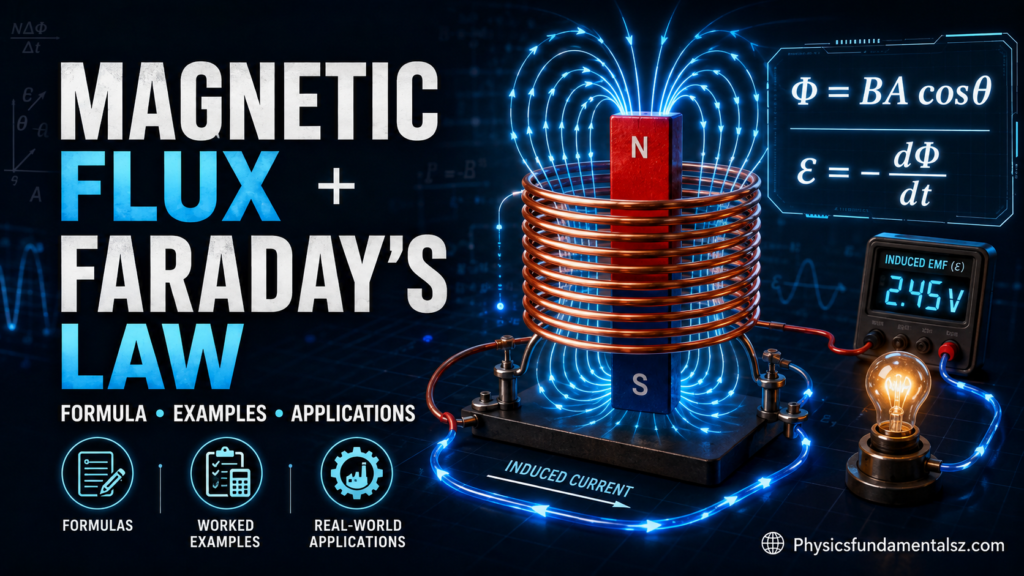
Magnetic Flux and Faraday’s Law: Every time you charge your phone wirelessly, drive an electric car with regenerative braking, or plug into the power grid, you’re relying on a discovery Michael Faraday made in 1831.
He found that a changing magnetic field could push electric current through a wire without any physical contact — a phenomenon that quietly powers most of modern electrical technology.
Table of Contents
What Is Magnetic Flux and Faraday’s Law?
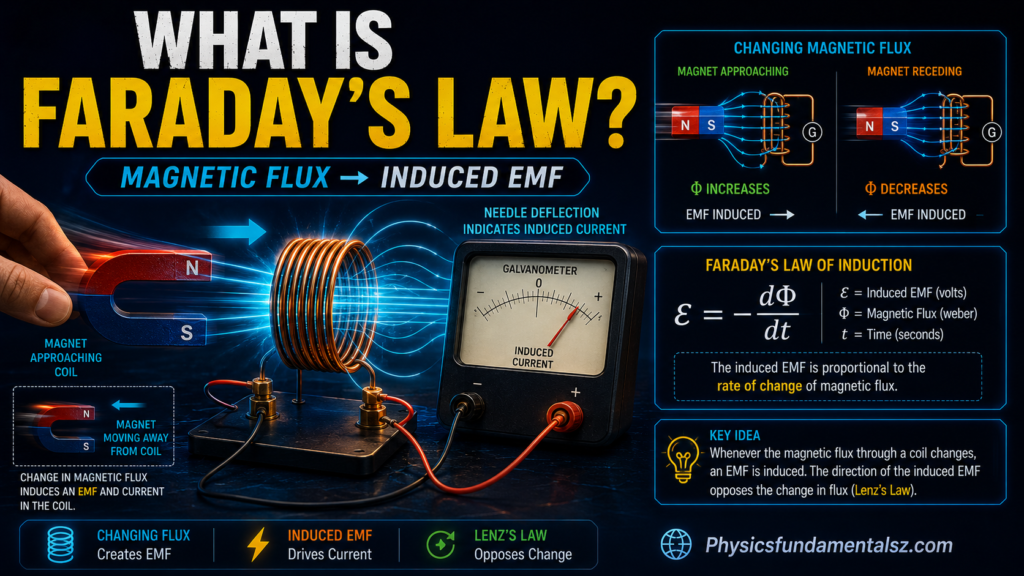
Magnetic flux is a measure of how much magnetic field passes through a given area, calculated as Φ = B·A·cosθ. Faraday’s Law of induction states that a changing magnetic flux through a coil induces an electromotive force (EMF), given by the formula ε = −N(ΔΦ/Δt), where N is the number of coil turns and ΔΦ/Δt is the rate at which flux changes over time. In short: the faster the magnetic flux changes, and the more coil turns you have, the more voltage gets induced.
What Is Magnetic Flux?
Magnetic flux describes the total amount of magnetic field “flowing through” a given surface — imagine counting how many magnetic field lines pass through a loop of wire. The more field lines passing through, or the stronger the field, the greater the flux.
The Magnetic Flux Formula (Φ = B·A·cosθ)
Magnetic flux is calculated with the formula:
Φ = B × A × cos θ
- Φ (phi) = magnetic flux, measured in webers (Wb)
- B = magnetic field strength (also called flux density), measured in teslas (T)
- A = the area of the surface the field passes through, in square meters (m²)
- θ = the angle between the magnetic field direction and the line perpendicular (normal) to the surface
When the field is perfectly perpendicular to the surface (θ = 0°), flux is at its maximum. When the field runs parallel to the surface (θ = 90°), no field lines pass through it, and flux is zero.
Units of Magnetic Flux: The Weber
The SI unit of magnetic flux is the weber (Wb), named after physicist Wilhelm Weber. One weber equals one tesla of magnetic field strength passing through one square meter of area (1 Wb = 1 T·m²).
What Is Faraday’s Law of Induction?
Faraday’s Law is the principle that connects magnetic flux to electricity: whenever the magnetic flux through a coil changes, it induces an electromotive force (EMF) — essentially, a voltage — in that coil.
The Faraday’s Law Formula (ε = −N ΔΦ/Δt)
The formula is written as:
ε = −N (ΔΦ / Δt)
- ε (epsilon) = induced electromotive force (EMF), measured in volts
- N = the number of turns (loops) in the coil
- ΔΦ = the change in magnetic flux
- Δt = the time interval over which that change occurs
- The negative sign indicates the direction of the induced EMF, as described by Lenz’s Law (explained below)
What Each Term Means
In plain terms: induced EMF depends on how fast the flux changes (ΔΦ/Δt) and how many loops of wire the changing field passes through (N). Double the number of turns, and you double the induced voltage. Change the flux twice as fast, and you also double the voltage.
Why Does a Changing Magnetic Flux Induce an EMF?
Faraday discovered that it doesn’t matter how the flux changes — only that it does. A stationary magnet next to a stationary coil produces zero induced voltage, no matter how strong the magnet is, because nothing is changing.
Ways Magnetic Flux Can Change
Since Φ = B·A·cosθ, flux can change in three distinct ways:
- Changing the magnetic field strength (B) — e.g., increasing current in an electromagnet
- Changing the area (A) — e.g., expanding or shrinking a loop of wire, or moving a wire in and out of the field
- Changing the angle (θ) — e.g., rotating a coil within a fixed magnetic field, which is exactly how AC generators work
The Role of Coil Turns (N)
Adding more turns of wire to a coil doesn’t change the flux through each individual loop, but it does mean the changing flux threads through more loops at once. Since each loop contributes its own induced EMF, the total voltage adds up — this is why generators and transformers use tightly wound coils with many turns rather than a single loop of wire.
Faraday’s Law and Lenz’s Law
Why Is There a Negative Sign?
The negative sign in Faraday’s Law formula represents Lenz’s Law, developed by physicist Heinrich Lenz. Lenz’s Law states that the direction of an induced current always opposes the change in magnetic flux that created it.
This isn’t an arbitrary mathematical detail — it’s a direct consequence of the conservation of energy. If the induced current reinforced the change instead of opposing it, you’d get a runaway feedback loop that generates energy from nothing, which isn’t physically possible.
How to Determine the Direction of Induced Current
To find the direction of induced current using Lenz’s Law:
- Determine whether the magnetic flux through the loop is increasing or decreasing.
- Recognize that the induced current will create its own magnetic field opposing that change.
- Apply the right-hand rule: curl your right-hand fingers in the direction of the induced current, and your thumb points in the direction of the magnetic field that current produces.
- Adjust the current direction so that the field it creates opposes the original flux change.
Worked Example: Calculating Induced EMF
Suppose a coil with 5 turns and a cross-sectional area of 0.04 m² sits in a magnetic field that increases uniformly from 0.3 T to 0.8 T over 1 second, with the field perpendicular to the coil (θ = 0°, so cos θ = 1).
Step 1: Calculate the initial and final flux per turn.
Φ₀ = B₀ × A = 0.3 T × 0.04 m² = 0.012 Wb Φf = Bf × A = 0.8 T × 0.04 m² = 0.032 Wb
Step 2: Find the change in flux.
ΔΦ = Φf − Φ₀ = 0.032 − 0.012 = 0.02 Wb
Step 3: Apply Faraday’s Law.
ε = −N (ΔΦ / Δt) = −5 × (0.02 / 1) = −0.1 V
The magnitude of the induced EMF is 0.1 volts. The negative sign simply confirms the induced current opposes the increasing flux, exactly as Lenz’s Law predicts.
Magnetic Flux vs. Magnetic Field vs. Flux Linkage
These three terms are closely related but distinct, and mixing them up is one of the most common sources of error in electromagnetism problems.
| Term | Symbol | Definition | Unit |
|---|---|---|---|
| Magnetic Field (Flux Density) | B | The strength of a magnetic field at a point in space | Tesla (T) |
| Magnetic Flux | Φ | The total field passing through a given area (Φ = B·A·cosθ) | Weber (Wb) |
| Flux Linkage | NΦ | The total flux multiplied by the number of coil turns it passes through | Weber-turns (Wb) |
Magnetic field describes the field itself; magnetic flux accounts for how much of that field passes through a specific area; flux linkage scales that up for a multi-turn coil, which is what actually determines induced EMF.
Real-World Applications of Faraday’s Law
Electric Generators
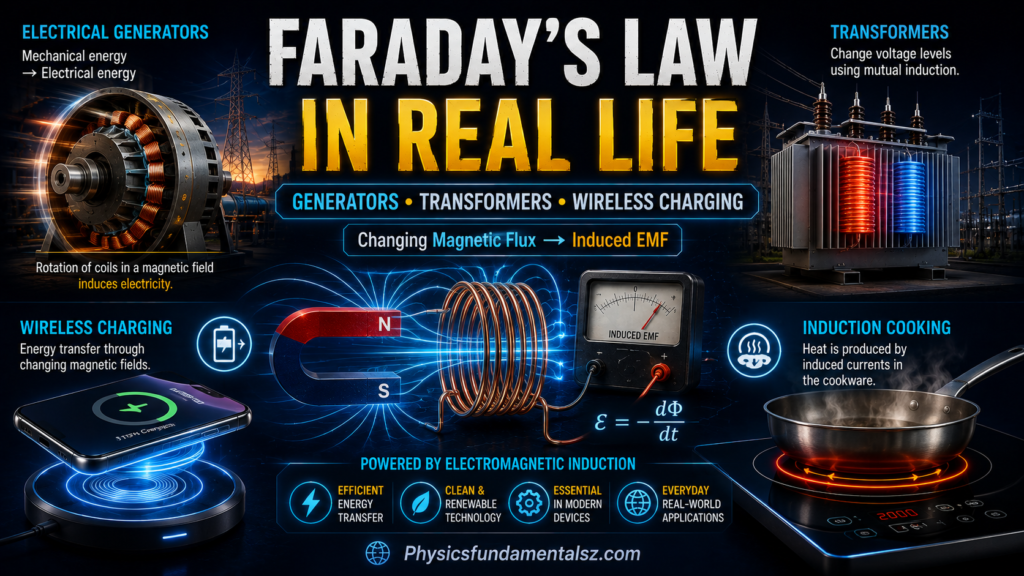
Generators rotate a coil within a magnetic field (or rotate a magnet within a fixed coil), continuously changing the angle θ and therefore the flux. This constant change induces a continuously varying EMF — the basis of virtually all large-scale electricity generation, from coal and natural gas plants to hydroelectric dams and wind turbines.
Transformers
Transformers use two coils wound around a shared iron core. Alternating current in the primary coil creates a constantly changing magnetic flux, which induces a corresponding EMF in the secondary coil — allowing voltage to be stepped up or down for efficient power transmission across the electrical grid.
Wireless Charging
Wireless chargers use a transmitting coil that generates a rapidly changing magnetic field. When you place a compatible device on the pad, its receiving coil experiences changing flux, inducing a current that charges the battery — all without a physical cable connection.
Regenerative Braking in EVs
Electric and hybrid vehicles use regenerative braking, where the electric motor temporarily acts as a generator. As the wheels slow the rotor, the changing magnetic flux induces a current that’s fed back into the battery, recovering energy that would otherwise be lost as heat in conventional brakes.
MRI Machines
Magnetic Resonance Imaging relies on strong, precisely controlled magnetic fields and coils that detect tiny changes in flux from the body’s hydrogen atoms, using principles rooted in electromagnetic induction to build detailed internal images without surgery or radiation.
Common Mistakes When Applying Faraday’s Law
- Forgetting the number of turns (N). Students often calculate flux correctly but forget to multiply by N when finding total induced EMF for a coil.
- Mixing up units. Magnetic field (tesla) and magnetic flux (weber) are not interchangeable — always confirm which quantity a problem is actually asking for.
- Ignoring the angle θ. If the field isn’t perpendicular to the loop, forgetting the cosθ term leads to overestimating the flux.
- Misapplying the sign. The negative sign indicates direction (per Lenz’s Law), not that the EMF is somehow “less than zero” in magnitude — most calculations report the magnitude and separately determine direction.
- Assuming a stationary magnet induces current. Flux must be changing — a magnet sitting motionless near a coil, no matter how strong, induces nothing.
Expert Tips for Solving Faraday’s Law Problems
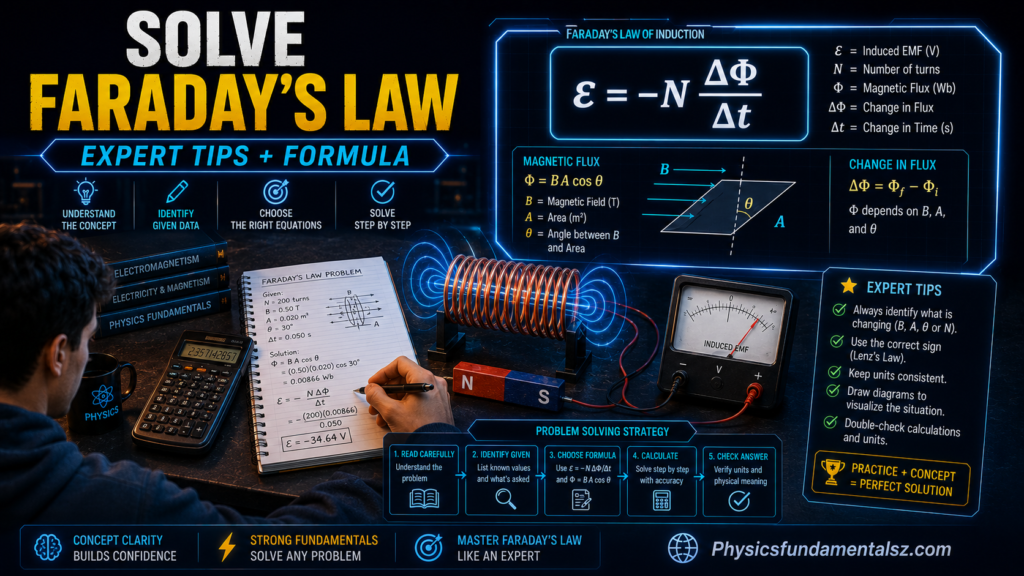
- Always sketch the setup first — identify what’s changing (field strength, area, or angle) before plugging numbers into the formula.
- When multiple variables change at once, calculate ΔΦ using the full flux formula before dividing by Δt, rather than trying to combine rates separately.
- For rotating coil problems (like generators), remember that θ changes continuously, which is why generator output is naturally sinusoidal (AC), not constant.
- In real transformer and generator design, engineers use laminated cores (thin insulated layers rather than solid metal) specifically to reduce energy loss from eddy currents induced by the same changing-flux principle.
Frequently Asked Questions (FAQs)
What is magnetic flux?
Magnetic flux is a measure of the total magnetic field passing through a given area, calculated as Φ = B·A·cosθ, and measured in webers.
What is Faraday’s Law of induction?
Faraday’s Law states that a changing magnetic flux through a coil induces an electromotive force (EMF), described by ε = −N(ΔΦ/Δt).
What is the formula for magnetic flux?
Φ = B × A × cos θ, where B is magnetic field strength, A is area, and θ is the angle between the field and the surface normal.
What is the formula for Faraday’s Law?
ε = −N (ΔΦ/Δt), where N is the number of coil turns, ΔΦ is the change in flux, and Δt is the time interval.
What is the SI unit of magnetic flux?
The weber (Wb).
What is the SI unit of magnetic field strength?
The tesla (T).
What does the symbol Φ represent in physics?
Φ (phi) represents magnetic flux.
What does N represent in Faraday’s Law formula?
N represents the number of turns (loops) in a coil.
Why is there a negative sign in Faraday’s Law?
The negative sign reflects Lenz’s Law, indicating that the induced EMF always opposes the change in magnetic flux that created it.
What is Lenz’s Law?
Lenz’s Law states that the direction of an induced current is always such that it opposes the change in magnetic flux that produced it.
How is Faraday’s Law related to Lenz’s Law?
Faraday’s Law gives the magnitude of induced EMF, while Lenz’s Law, represented by the negative sign, determines its direction.
What is electromotive force (EMF)?
EMF is the voltage generated by a source, such as a battery or an induction process, that drives current through a circuit.
What causes a changing magnetic flux?
A change in magnetic field strength, a change in the area exposed to the field, or a change in the angle between the field and the surface can all cause flux to change.
Can magnetic flux change without the magnet moving?
Yes — flux can also change if the coil’s area or orientation changes, or if the magnetic field strength itself varies, such as in an electromagnet with changing current.
What is motional EMF?
Motional EMF is the voltage induced when a conductor physically moves through a magnetic field, calculated as ε = B·ℓ·v for a straight conductor.
What is flux linkage?
Flux linkage is the total flux multiplied by the number of coil turns (NΦ), representing the combined effect of flux through every loop in a coil.
How is flux linkage different from magnetic flux?
Magnetic flux refers to a single loop or surface, while flux linkage scales that value by the number of turns in a multi-loop coil.
How do you calculate induced EMF in a coil with multiple turns?
Multiply the rate of change of flux per turn by the number of turns: ε = −N(ΔΦ/Δt).
Does the angle between the magnetic field and coil matter?
Yes — flux is maximum when the field is perpendicular to the coil (θ = 0°) and zero when the field runs parallel to the coil’s surface (θ = 90°).
What happens to induced EMF if you add more coil turns?
Induced EMF increases proportionally, since each additional turn contributes its own induced voltage to the total.
What is the right-hand rule, and how does it relate to induction?
The right-hand rule helps determine the direction of a magnetic field created by current flow, which is used alongside Lenz’s Law to find the direction of induced current.
How does a generator use Faraday’s Law?
A generator rotates a coil within a magnetic field (or vice versa), continuously changing flux and inducing a continuous, alternating EMF.
How does a transformer use Faraday’s Law?
A transformer uses alternating current in one coil to create a changing magnetic flux in a shared core, inducing a corresponding EMF in a second coil.
How does wireless charging use Faraday’s Law?
A transmitting coil generates a changing magnetic field, which induces current in a nearby receiving coil to charge a device without a physical connection.
How does regenerative braking in electric vehicles use Faraday’s Law?
The vehicle’s motor acts as a generator during braking, and the changing flux from the slowing rotor induces current that recharges the battery.
How does an MRI machine use electromagnetic induction?
MRI machines use strong magnetic fields and detect small changes in flux caused by hydrogen atoms in the body, applying induction principles to construct internal images.
What are eddy currents, and why are they a problem?
Eddy currents are unwanted loops of induced current within a conductor’s bulk material, caused by changing flux, and they generate wasted heat and energy loss.
How do engineers reduce eddy current losses?
By using laminated cores made of thin, electrically insulated layers instead of solid metal, which restricts the paths available for eddy currents to form.
What is self-inductance?
Self-inductance is the property of a coil where a changing current in the coil induces an EMF within that same coil.
What is mutual inductance?
Mutual inductance occurs when a changing current in one coil induces an EMF in a separate, nearby coil — the working principle behind transformers.
What is the difference between AC and DC generators?
AC generators produce continuously alternating voltage from a rotating coil in a magnetic field, while DC generators use a commutator to convert that alternating output into a one-directional current.
Who discovered Faraday’s Law?
Michael Faraday, an English scientist, discovered the principle of electromagnetic induction in 1831.
What is the historical significance of Faraday’s Law?
It provided the first experimental proof that magnetism could generate electricity, laying the foundation for generators, transformers, and modern electrical power systems.
How did Maxwell contribute to the theory of Faraday’s Law?
James Clerk Maxwell later formalized Faraday’s experimental findings into a precise mathematical relationship, which became one of Maxwell’s four fundamental equations of electromagnetism.
Is Faraday’s Law one of Maxwell’s equations?
Yes — Faraday’s Law of induction is incorporated as one of Maxwell’s four equations describing classical electromagnetism.
What common mistakes do students make with Faraday’s Law problems?
Common mistakes include forgetting to multiply by the number of turns, ignoring the angle θ, mixing up tesla and weber units, and misapplying the negative sign.
Can Faraday’s Law be applied to a stationary loop in a moving magnetic field?
Yes — Faraday’s Law applies whenever flux changes, whether the coil moves, the magnetic source moves, or the field strength itself changes.
What is the difference between magnetic flux and magnetic field?
Magnetic field describes field strength at a point, while magnetic flux measures the total field passing through a specific area, incorporating both field strength and area.
How do you determine the direction of induced current using Lenz’s Law?
Identify whether flux is increasing or decreasing, then apply the right-hand rule so the induced current creates a magnetic field that opposes that change.
Key Takeaways
- Magnetic flux (Φ = B·A·cosθ) measures how much magnetic field passes through a given area, in webers.
- Faraday’s Law (ε = −N ΔΦ/Δt) states that a changing magnetic flux through a coil induces an EMF, proportional to the rate of change and the number of coil turns.
- The negative sign reflects Lenz’s Law — induced current always opposes the flux change that created it, consistent with energy conservation.
- Flux can change through variation in field strength, area, or angle — and each mechanism powers different real-world technologies.
- Generators, transformers, wireless chargers, regenerative braking systems, and MRI machines all rely directly on this single principle.